

Key Takeaways
Timing Belt (or Timing Chain)
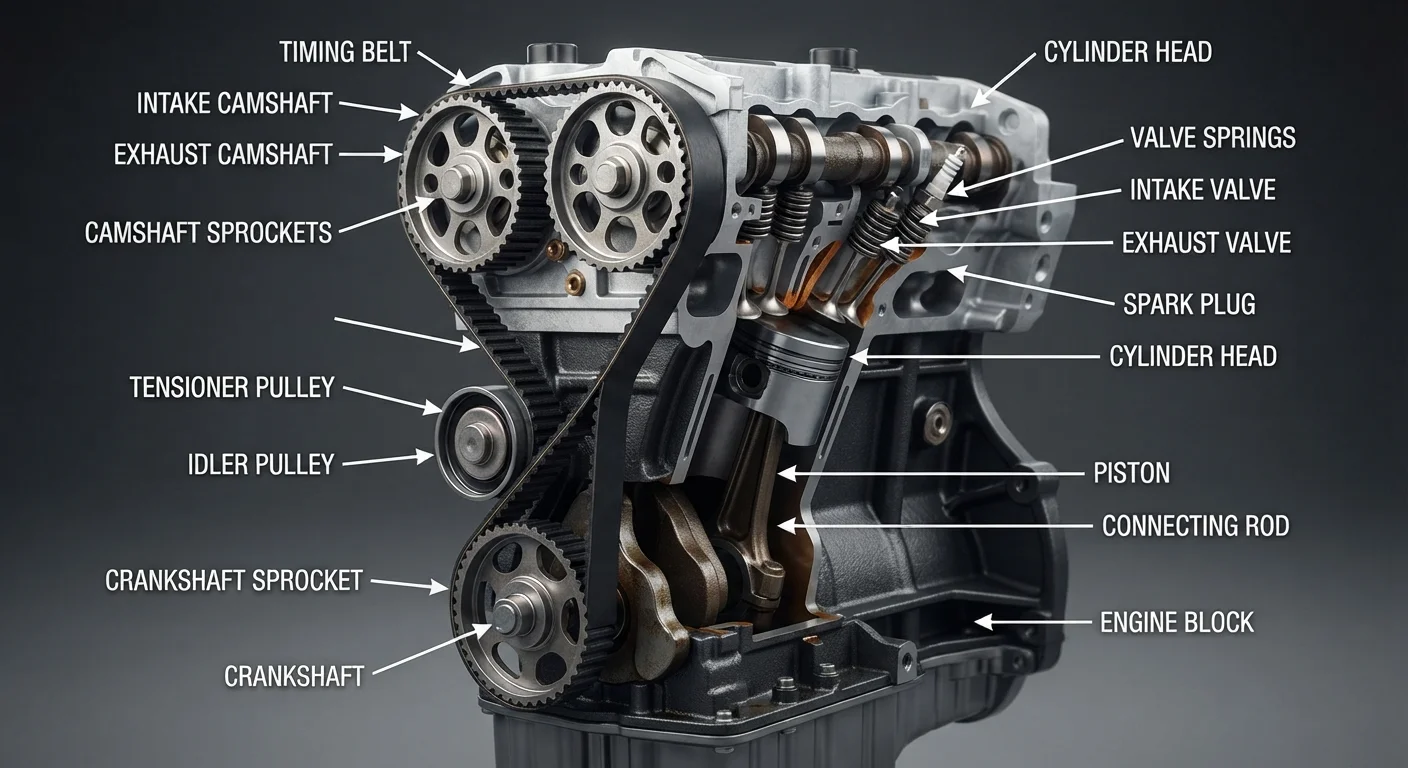
A timing belt is a reinforced rubber belt - or in some engines, a metal chain - that synchronizes the rotation of the crankshaft and camshaft. This coordination ensures that engine valves open and close at precisely the right moment during each combustion cycle. Without it, your engine's internal components would operate out of sequence and could collide with each other.
Engines are classified as either 'interference' or 'non-interference' designs. In interference engines, a timing belt failure almost always causes immediate valve-to-piston contact, resulting in severe mechanical damage.
The Role of the Timing Belt in Your Engine
Every four-stroke engine runs on a precise sequence: intake, compression, combustion, exhaust. The timing belt is the mechanical link that keeps this sequence synchronized between two critical shafts - the crankshaft, which converts the pistons' up-and-down movement into rotation, and the camshaft, which opens and closes the intake and exhaust valves.
Think of it as a conductor's baton in an orchestra. If the crankshaft and camshaft fall out of sync by even a few degrees, combustion becomes inefficient. If they fall out of sync significantly - or the belt snaps entirely - pistons and valves can physically collide inside the engine.
What Actually Happens When the Belt Fails
When a timing belt breaks, the camshaft stops turning while the crankshaft continues spinning. In a non-interference engine, the pistons and valves occupy separate areas of the cylinder, so they don't make contact. The engine simply stalls. This is the better outcome - the car stops, but the engine survives.
In an interference engine - which covers a large portion of modern vehicles - the pistons and open valves share overlapping space in the cylinder. When the belt snaps:
- Valves freeze in place mid-stroke
- Pistons continue moving upward at high speed
- Metal-to-metal impact occurs within fractions of a second
- Valves bend or break, pistons crack, and cylinder head damage often follows
The result is frequently an engine that cannot be repaired economically - what mechanics call a totaled engine.
Warning Signs and When to Replace
Timing belts are made from fiber-reinforced rubber, which degrades over time from heat, oil exposure, and mechanical stress - regardless of mileage. Most manufacturers specify replacement intervals between 60,000 and 100,000 miles, but always consult your owner's manual for the exact interval for your engine.
Watch for these early warning signs:
- Ticking or slapping noise from the front of the engine, especially at startup
- Engine misfires or rough idle that wasn't present before
- Oil leaks near the timing cover (a sign the seal is deteriorating)
- Check Engine light with camshaft or crankshaft position sensor fault codes
If you've purchased a used vehicle and have no service history, treating the timing belt as due for replacement is a prudent approach - particularly if the car is past 60,000 miles.
Why Proactive Replacement Is Worth It
The cost comparison is stark. Scheduled timing belt replacement - including the water pump and tensioner, which are commonly serviced at the same time - is a planned, manageable expense. Repairing the internal damage from a snapped belt in an interference engine, however, can run several times higher, and some engines are not worth repairing at all given the vehicle's value.
Beyond cost, a failed timing belt can leave you stranded without warning, often at highway speed. There is rarely visible deterioration on the outside of a belt that signals imminent failure. The rubber can look intact right up until the moment it breaks.
Staying on schedule with this one maintenance item is one of the most effective things a driver can do to protect a significant investment.