

Key Takeaways
Auto Insurance Coverage Types
An auto insurance policy is not a single blanket protection - it's a bundle of separate coverage types, each designed to pay for specific kinds of losses. Liability, collision, and comprehensive are the three foundational coverages, and most policies also include options like uninsured motorist and medical payments coverage. Understanding what each one does helps you know what you're actually buying - and what gaps may exist.
Coverage requirements vary by state. Most states mandate minimum liability limits but do not require collision or comprehensive coverage, though lenders typically require both on financed or leased vehicles.
Liability Coverage: What You Owe Others
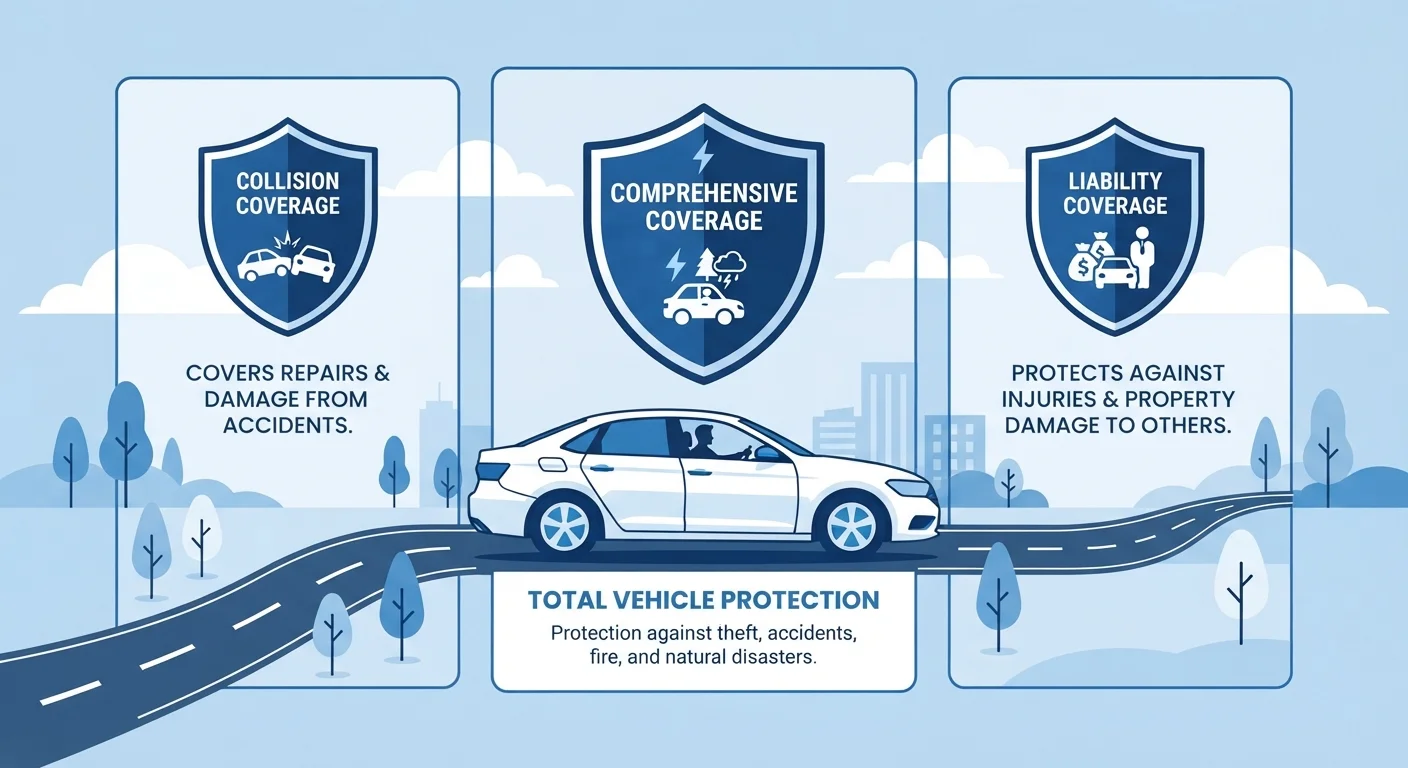
Liability coverage is the foundation of virtually every auto policy and the coverage most states legally require. It pays for bodily injury and property damage that you cause to other people in an accident where you are at fault. It does not pay for your own injuries or damage to your own vehicle.
A liability limit is typically written as three numbers - for example, 25/50/25 - representing thousands of dollars: $25,000 per injured person, $50,000 per accident for bodily injury, and $25,000 for property damage. If a claim exceeds your limits, you are personally responsible for the difference. For readers interested in adding protection beyond those limits, umbrella insurance can extend liability coverage above your auto policy's ceiling.
State minimums are a legal floor, not a recommended amount. Serious accidents can generate costs well above minimum limits, which is why many financial professionals suggest carrying higher limits than the law requires.
Review Your Liability Limits Carefully
State-mandated minimums are designed to keep you legal, not to fully protect your assets. A serious accident involving significant injuries or an expensive vehicle can generate costs that far exceed typical minimum limits. Consider your overall financial picture - including assets that could be at risk in a lawsuit - when choosing how much liability coverage to carry.
Collision and Comprehensive: Covering Your Own Vehicle
Where liability leaves off, collision and comprehensive pick up - these coverages protect your own car rather than third parties.
Collision coverage pays to repair or replace your vehicle after it collides with another car or object, or rolls over, regardless of fault. If you're at fault and have no collision coverage, you pay for your own repairs out of pocket.
Comprehensive coverage handles losses that aren't the result of a collision: theft, vandalism, fire, flooding, hail, and striking an animal are common examples. It's sometimes called "other than collision" coverage, which is a more literal description of what it does.
Both coverages come with a deductible - the amount you pay before insurance covers the rest. Choosing a higher deductible lowers your premium but increases what you owe after a claim. For a plain-language breakdown of how deductibles work alongside premiums, see how deductibles and premiums interact.
~13%
Estimated share of US drivers uninsured
According to the Insurance Research Council, roughly 1 in 8 drivers on US roads carries no auto insurance.
$500-$1,000
Typical collision deductible range
Most drivers choose deductibles in this range; higher deductibles lower premiums but increase out-of-pocket costs after a claim.
49 states
States requiring minimum liability coverage
New Hampshire is the only state that does not mandate liability insurance, though it requires drivers to demonstrate financial responsibility after an accident.
Uninsured and Underinsured Motorist Coverage
Even when you drive responsibly, you share the road with drivers who carry no insurance - or limits so low they barely cover minor damage. Uninsured motorist (UM) coverage pays for your injuries and, in many states, your vehicle damage when the at-fault driver has no insurance. Underinsured motorist (UIM) coverage applies when the other driver has insurance, but their limits aren't high enough to cover your losses.
Several states require UM/UIM coverage; others offer it as an optional add-on. Given that a meaningful share of drivers on US roads carry no insurance at all, this coverage addresses a real and common risk rather than an unlikely scenario.
UM/UIM Rules Vary Significantly by State
Some states require insurers to offer uninsured and underinsured motorist coverage, while others mandate that drivers carry it. A handful allow drivers to waive it in writing. Because rules differ so much by jurisdiction, check your state's specific requirements - and consider whether waiving the coverage makes sense given how many uninsured drivers operate on public roads.
To build a solid foundation before reviewing any policy in detail, auto insurance terms every driver should understand provides a useful reference for the language that appears throughout a standard policy.
How the Coverages Work Together
Think of an auto policy as a layered system. Liability protects other people from your mistakes. Collision and comprehensive protect your vehicle from a range of physical losses. UM/UIM protects you from other drivers' failures. Medical payments or personal injury protection (PIP), which some states require, can cover your medical costs regardless of fault.
A financed or leased vehicle typically requires collision and comprehensive because the lender has a financial stake in the car until it's paid off. Once a vehicle is owned outright, carrying those coverages becomes a choice - one that depends on the car's current market value relative to what you'd pay in premiums and deductibles over time.
For a broader look at how all these moving parts fit together, car insurance coverage types decoded offers additional context on reading and comparing policies. More general ownership logistics are also covered in the Owning a Vehicle hub.
This article is for general informational purposes only and does not constitute personalized insurance or financial advice. Coverage availability, requirements, and terms vary by state and insurer. Consult a licensed insurance professional for guidance specific to your situation.