

Key Takeaways
Option A
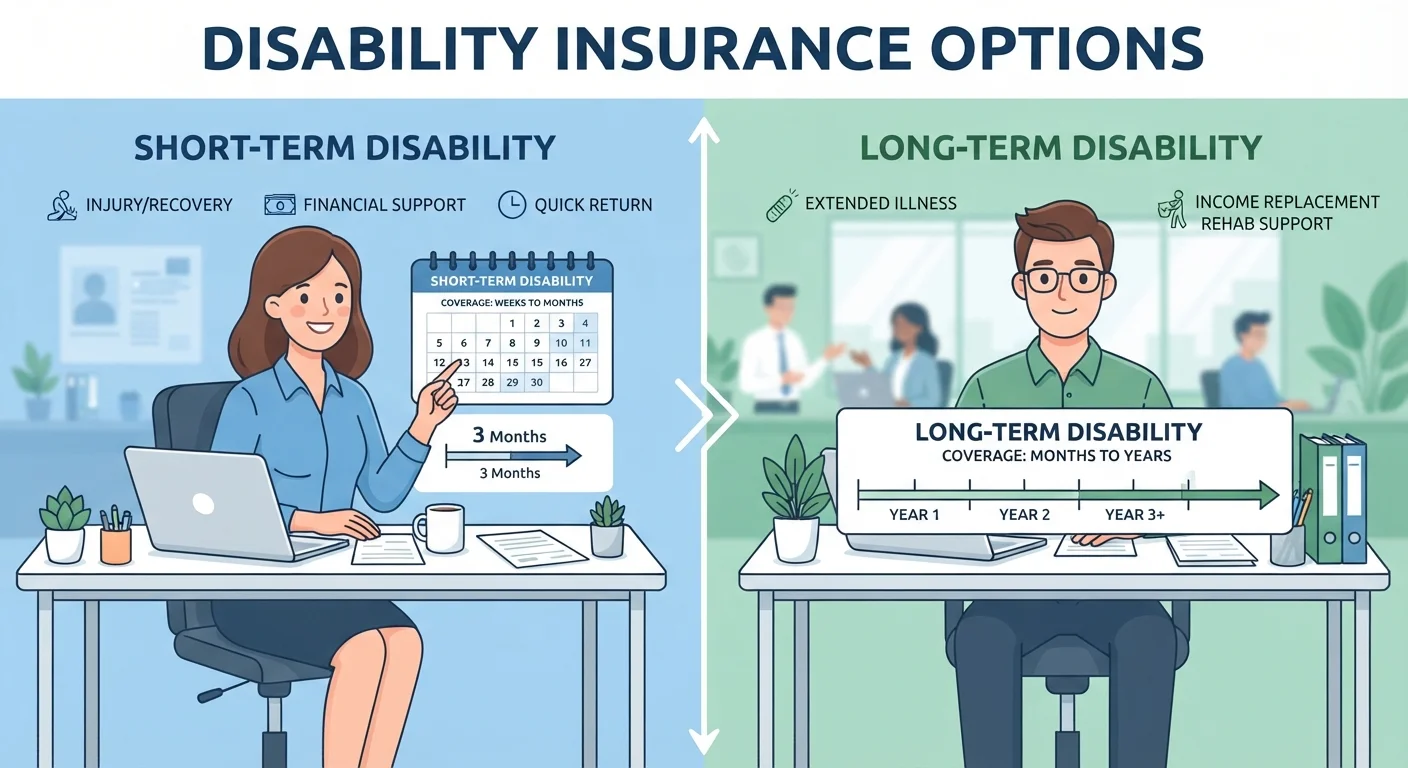
Short-Term Disability Insurance
The immediate safety net for temporary income loss.
Best for: Workers who need quick income replacement during recovery from illness, injury, or surgery lasting weeks to months.
Option B
Long-Term Disability Insurance
The durable protection for serious, prolonged disability.
Best for: Workers seeking financial protection against conditions that could prevent them from working for years or permanently.
If you have minimal emergency savings and need immediate income replacement
Short-Term Disability Insurance
Short elimination periods mean benefits begin quickly, bridging the gap before your savings are depleted.
If you want protection against a serious illness or injury that could sideline you for years
Long-Term Disability Insurance
Long-term policies provide sustained income replacement that short-term coverage and emergency funds cannot match.
If you want comprehensive income protection across any length of disability
Both types in combination
Short-term coverage handles the initial period while long-term kicks in after the elimination period, leaving no income gap.
What Each Policy Actually Does
Disability insurance replaces a portion of your income when a medical condition prevents you from working. Short-term disability (STD) and long-term disability (LTD) policies share that fundamental purpose but differ sharply in how quickly they pay, how long they pay, and what conditions they cover.
Short-term disability is designed for temporary disruptions - a broken arm, a complicated pregnancy recovery, or outpatient surgery. Coverage typically begins within a few days to two weeks of becoming disabled, and benefits usually last between 9 and 26 weeks depending on the policy. Many employers include STD as part of a group benefits package, which can make it easier to access without individual underwriting.
Long-term disability covers serious, extended conditions: a back injury that limits mobility for years, a chronic illness, or a condition that results in permanent disability. Because the potential payout is far larger, LTD policies carry longer elimination periods - commonly 60 to 180 days - before benefits begin. Benefit periods can extend from two to five years, or all the way to age 65 or beyond, depending on the policy terms.
Understanding both is especially important because most people significantly underestimate the probability of a long disability. According to the Social Security Administration, roughly one in four workers will experience a disability lasting 90 days or more at some point in their career. See our discussion of coverage gaps that catch policyholders off guard for a broader look at where protection commonly falls short.
| Criterion | Short-Term Disability | Long-Term Disability |
|---|---|---|
| Elimination (waiting) period | 0-14 days | 60-180 days |
| Benefit duration | 9-26 weeks | 2 years to age 65 |
| Income replacement | 60-80% of salary | 60-80% of salary |
| Disability definition | Own occupation | Own then any occupation |
| Employer group availability | Common benefit | Varies; often supplemental |
| Best suited for | Short recovery periods | Serious or permanent conditions |
Key Differences That Affect Your Coverage
Beyond timing and duration, several structural differences determine how each policy works in practice.
Definition of Disability
STD policies typically define disability as the inability to perform your own occupation. Most LTD policies begin with an own-occupation definition for the first two years, then shift to an any occupation standard - meaning you must be unable to perform any job for which you're reasonably qualified. This distinction is significant: a surgeon with a hand injury may qualify for own-occupation benefits but not any-occupation benefits once the shift occurs. Higher-cost LTD policies preserve the own-occupation definition for the full benefit period.
Benefit Amount
Both policy types generally replace 60-80% of your pre-disability gross income, not your full salary. This reflects the principle that disability benefits are often tax-advantaged - if your employer paid the premiums, benefits are typically taxable; if you paid premiums with after-tax dollars, benefits are generally tax-free. Consult a tax professional to understand your specific situation.
Premium Cost and Availability
Short-term disability coverage is often provided through employers at low or no direct cost to employees. Long-term disability coverage, while sometimes offered as a group benefit, may require supplemental individual coverage to reach adequate benefit levels - particularly for higher earners whose income exceeds group plan caps.
1 in 4
Workers who experience a 90+ day disability
The Social Security Administration estimates roughly one in four working adults will face a disability lasting 90 days or more before reaching retirement age.
34.6 months
Average long-term disability claim duration
The Council for Disability Awareness has reported that the average long-term disability claim lasts nearly three years, underscoring the need for extended coverage.
For those evaluating their full insurance picture, the framework used to analyze these policies shares logic with other coverage decisions - much like the structure outlined in term vs. whole life insurance.
This article is for general informational and educational purposes only and does not constitute personalized insurance, financial, or legal advice. Coverage terms, eligibility, and costs vary by insurer, employer, and individual circumstances. Consult a licensed insurance professional before making coverage decisions.