

Key Takeaways
Option A
Index Funds
The low-cost, market-matching passive approach.
Best for: Investors seeking broad market exposure, minimal fees, and a hands-off long-term strategy.
Option B
Actively Managed Funds
The research-driven, beat-the-market alternative.
Best for: Investors comfortable with higher costs in exchange for a professional manager's discretionary strategy.
If you want a low-cost, long-term wealth-building strategy
Index Funds
Index funds minimize fees and have historically captured broad market growth, making them a practical core holding for most long-term investors.
If you're investing in a less efficient or niche market segment
Actively Managed Funds
Skilled active managers may add value in markets where information is less widely distributed, such as small-cap or emerging markets.
If you're just starting out and building your first portfolio
Index Funds
Simplicity and low cost reduce the complexity beginners face, and broad diversification limits concentration risk from the start.
If you want a manager to actively navigate market volatility
Actively Managed Funds
Active managers have the flexibility to shift holdings during downturns, though this does not guarantee better outcomes and adds cost.
What Each Fund Type Actually Does
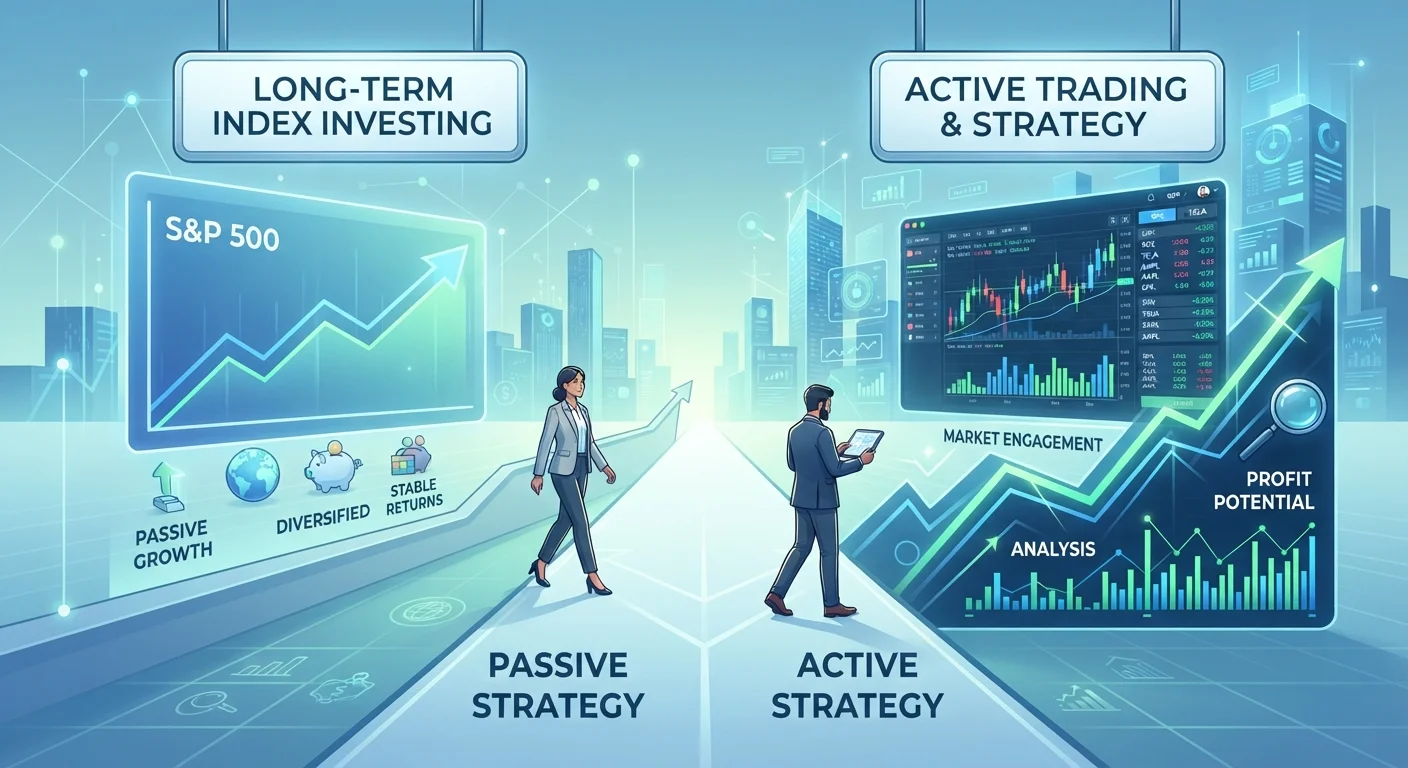
An index fund is designed to replicate the performance of a specific market benchmark - such as the S&P 500 or the total US bond market. The fund holds the same securities as the index, in the same proportions, and changes its holdings only when the underlying index changes. No fund manager is making daily buy or sell calls.
An actively managed fund does the opposite. A portfolio manager - supported by analysts and research teams - selects holdings, times trades, and adjusts the portfolio in pursuit of returns that beat a stated benchmark. This discretionary process drives higher operating costs, which are passed to investors as higher fees.
Understanding this fundamental difference is essential before opening your first investment account, because the fund type you choose will shape your costs and outcomes for years.
Cost Structures: Where the Real Difference Lives
The most concrete and durable difference between these two approaches is cost. Index funds typically carry expense ratios - the annual fee expressed as a percentage of assets - well below 0.10% for broad-market options. Many actively managed funds charge between 0.50% and 1.00% or more annually.
~0.05%
Typical index fund expense ratio
Broad-market US equity index funds commonly carry expense ratios at or below this level, according to industry data from Morningstar.
~85%
Active US equity funds that underperformed over 15 years
S&P Dow Jones Indices' SPIVA US Scorecard has consistently found that a large majority of active funds trail their benchmarks over long horizons, net of fees.
0.95%
Average active equity fund expense ratio
Morningstar's annual fee study has placed the asset-weighted average expense ratio of active US equity funds around this range in recent reporting periods.
That gap may seem small in dollar terms today, but compounded over 20 or 30 years, it represents a significant drag on returns. A fund charging 1.00% annually versus one charging 0.05% costs an investor with a $50,000 portfolio roughly an additional $475 per year - money that would otherwise remain invested and compounding. This is one reason cost awareness is a cornerstone of building a starter portfolio.
Active funds may also generate higher taxable events through frequent trading, adding a potential tax-efficiency disadvantage in taxable brokerage accounts. Inside tax-advantaged accounts like IRAs or 401(k)s, this factor is reduced. For a breakdown of those account types, see our guide to tax-advantaged accounts.
Performance: What the Data Shows
The performance debate is well-documented. Research from S&P Dow Jones Indices (the SPIVA report series) consistently finds that the majority of actively managed US equity funds underperform their benchmark index over 10- and 15-year periods, after fees. This pattern holds across most fund categories, though the degree varies.
| Criterion | Index Funds | Actively Managed Funds |
|---|---|---|
| Management style | Passive - tracks an index | Active - manager selects holdings |
| Typical expense ratio | Under 0.10% for broad-market | 0.50%-1.00%+ annually |
| Long-term performance (net of fees) | Beats most active funds over 15 years | Majority underperform benchmark |
| Tax efficiency | High - low turnover, fewer events | Lower - frequent trading may trigger gains |
| Flexibility | None - mirrors index composition | High - manager can shift strategy |
| Transparency | Full - holdings mirror public index | Partial - disclosed periodically |
| Minimum complexity for investor | Low - no manager evaluation needed | Higher - requires manager due diligence |
That said, aggregate statistics don't mean every active fund underperforms. Some managers, particularly in less-efficient market segments, have demonstrated persistent skill. The challenge for investors is identifying those managers in advance - a task that research suggests is difficult even for professionals.
It's also worth noting that index funds, by design, will always slightly underperform their target index due to the fund's own minimal operating costs. They won't beat the market - but they're structured to come close.
If you're weighing other approaches, our piece on investing in individual stocks explores a different trade-off entirely.
Where Active Management May Offer Genuine Value
Passive investing has clear advantages in large, heavily researched markets like US large-cap equities, where prices reflect available information quickly. In those environments, outperforming is structurally harder for any active manager.
Market Efficiency Matters for This Debate
The 'efficient market hypothesis' holds that in highly liquid, well-researched markets, prices already reflect available information - leaving little consistent edge for active managers. This theory is most applicable to large US and developed-market equities. In markets with less coverage or transparency, the efficiency argument weakens, which is part of why active management retains more credibility in certain segments. This is a theoretical framework, not a guarantee of outcomes in either direction.
However, active management has a plausible case in less-efficient areas: smaller companies with limited analyst coverage, emerging markets where data quality varies, or specialized strategies like alternatives and multi-asset income funds. In these spaces, a skilled manager's research advantage may justify the higher fee - though this is a general observation, not a guarantee of individual outcomes.
Investors who want broad market exposure but also want a manager to reduce drawdowns during sharp market declines may find active funds appealing. Whether that defensive flexibility is worth the cost depends on individual risk tolerance and financial goals. A strategy like dollar-cost averaging can also reduce timing anxiety for index fund investors without adding active management costs.
This article is for general informational and educational purposes only. It is not personalized investment, financial, tax, or legal advice. Past performance of any fund type does not guarantee future results. Consult a qualified, licensed financial adviser before making investment decisions specific to your situation.