

Key Takeaways
Risk Tolerance & Time Horizon
Risk tolerance is how much fluctuation in your investment's value you can handle - financially and emotionally - without abandoning your strategy. Time horizon is the length of time you plan to keep money invested before you need it. Together, these two factors form the backbone of any sound investment approach.
In formal portfolio construction, risk tolerance is often decomposed into risk capacity (objective, financial) and risk attitude (subjective, behavioral). Time horizon directly influences asset allocation models and the acceptable drawdown threshold for a given portfolio.
Why These Two Concepts Matter More Than Any Hot Stock Tip
The investing conversation is often dominated by what to buy - which sector is trending, which asset class is outperforming. But the more fundamental questions are how much risk you should take and how long you intend to stay invested. Without clear answers to both, even well-chosen assets can produce bad outcomes.
Risk tolerance and time horizon are not optional add-ons to a portfolio strategy. They are the foundation. An investor who holds the right assets for the wrong timeline, or tolerates more volatility than their emotional or financial situation allows, is set up for costly mistakes. Understanding these concepts gives you a framework for making decisions that fit your actual life - not someone else's.
This article is for general educational purposes only and does not constitute personalized financial or investment advice. Consult a licensed financial adviser before making decisions about your own portfolio.
Risk Tolerance: What It Really Means
Risk tolerance has two dimensions that are often conflated: risk capacity and risk attitude. Risk capacity is objective - it reflects your financial situation. Do you have an emergency fund? Stable income? Low debt? These factors determine how much loss you could actually absorb without derailing your financial life. Risk attitude is subjective - it's about psychology. Some people check their portfolio daily and lose sleep over a 5% dip. Others barely notice a 15% decline.
Both dimensions matter. High risk capacity with low risk attitude is a mismatch that often leads to panic-selling at market lows - one of the most reliably damaging moves an investor can make. See how volatility triggers common investor mistakes for a deeper look at this pattern.
Reassess When Your Life Changes
Risk tolerance is not a one-time calculation. Major life events - a new child, a job change, a large inheritance, approaching retirement - can meaningfully shift both your capacity to absorb loss and your emotional comfort with it. Build in periodic reviews of your investment approach, not just your account balances.
Risk tolerance is not fixed. A raise, a health crisis, a new mortgage - any of these can shift your capacity to absorb loss. Revisit your assessment periodically, not just when markets are turbulent.
Time Horizon: The Variable That Changes Everything
Time horizon is how long you plan to leave money invested before drawing it down. It is perhaps the single most powerful modifier of how risk should be approached. A 30-year-old saving for retirement at 65 has roughly 35 years of runway. A 58-year-old planning to retire in seven years does not. The same investment that makes sense for the first person may be inappropriate for the second.
The logic is straightforward: markets have historically recovered from downturns given enough time, though past performance does not guarantee future results. A longer horizon gives a portfolio more opportunity to recover from short-term losses. A shorter horizon compresses that recovery window, making capital preservation relatively more important.
20+ years
Typical equity recovery window for major downturns
Historical US market data shows major equity indices have recovered from significant drawdowns when held over multi-decade periods, though past recovery patterns do not guarantee future results.
~50%
Investors who report panic-selling during downturns
Behavioral finance research consistently finds that emotional responses to market declines drive a significant portion of retail investor underperformance relative to index benchmarks.
3-5 years
Common threshold for shifting to conservative allocation
Many financial planning guidelines suggest reassessing equity exposure and increasing stable assets when a financial goal is within three to five years of the target date.
This interplay directly influences how accounts like 401(k)s and IRAs are typically structured - tax-advantaged retirement accounts are designed with long time horizons in mind, which is part of why they offer certain growth advantages that shorter-term accounts do not.
How the Two Concepts Interact in Practice
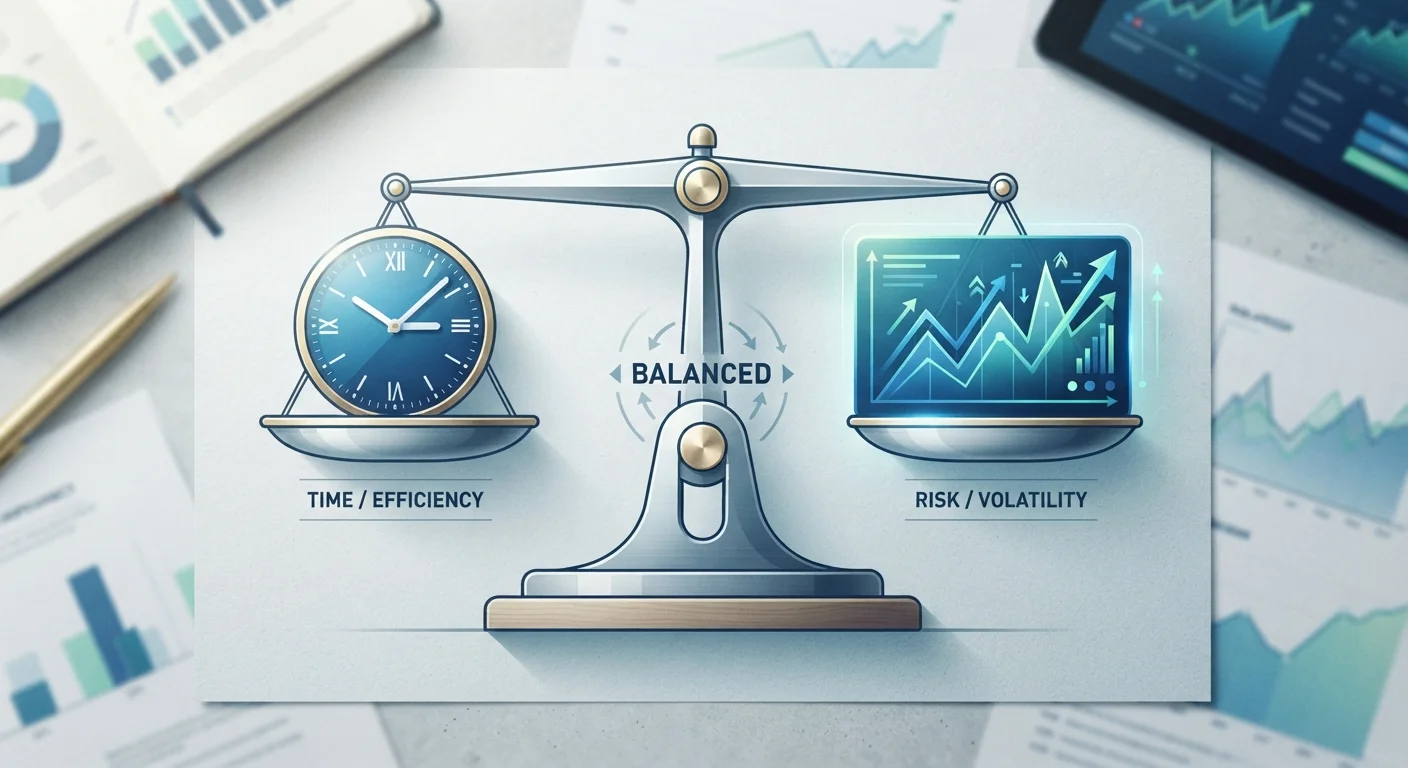
Risk tolerance and time horizon are most useful when considered together. Think of them as two axes on a grid. A long time horizon can offset a moderate risk tolerance - there's time to recover. A high risk tolerance matters less if your horizon is short, because a major drawdown close to a withdrawal date can cause real, lasting damage.
Asset allocation - the mix of equities, bonds, and other asset classes in a portfolio - is the primary tool for translating these factors into a real portfolio. Broadly speaking: longer horizon plus higher tolerance points toward equity-heavy allocations. Shorter horizon or lower tolerance shifts the balance toward more stable, income-generating assets.
Diversification - spreading investments across different asset types - is one of the structural ways investors manage the risk component. Once you understand your own tolerance and horizon, diversification becomes a natural next step in building a coherent strategy. Consistent habits over time then reinforce the structural decisions you make at the outset.
Individual results will vary. This content is educational and does not replace personalized advice from a qualified financial professional.