

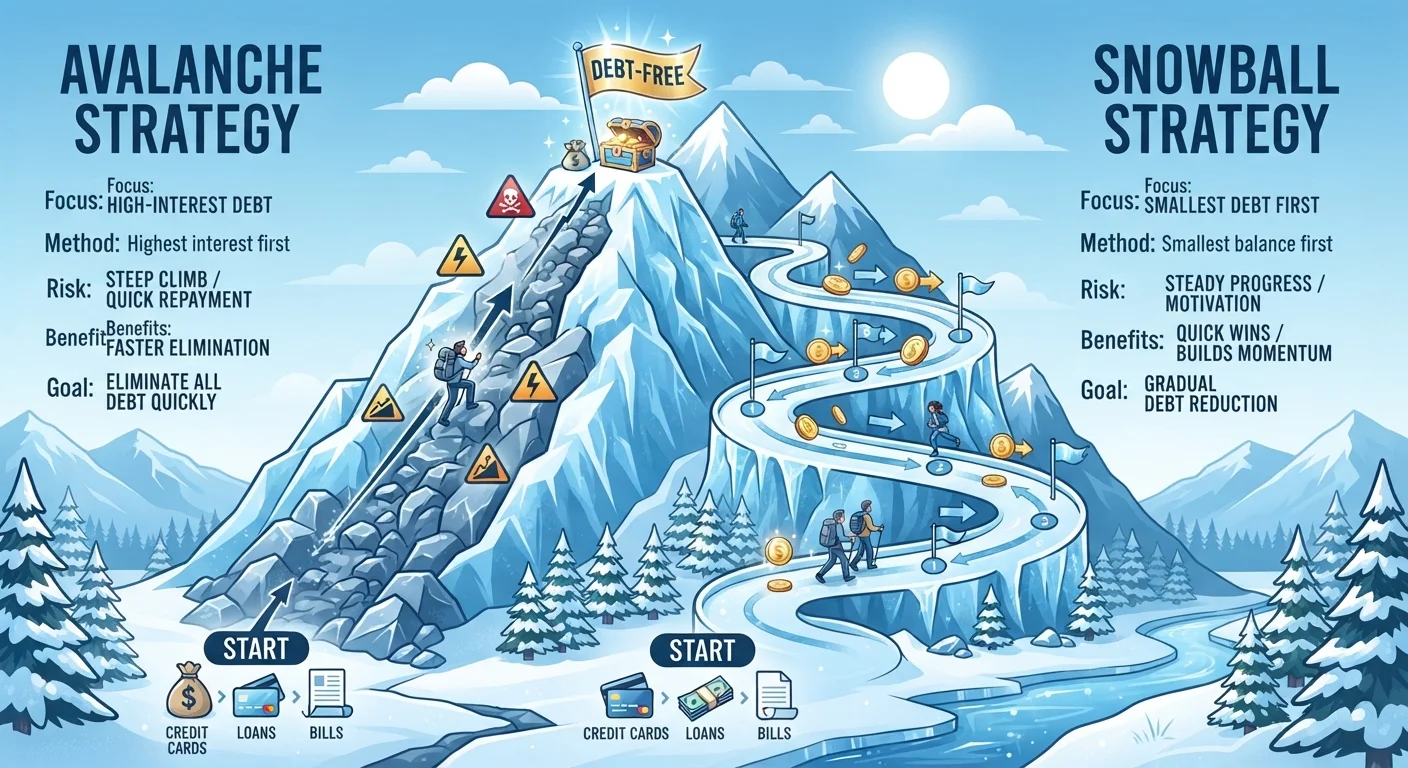
Key Takeaways
Option A
Debt Avalanche
The mathematically optimal, interest-first approach.
Best for: Disciplined savers who want to minimize total interest paid over time.
Option B
Debt Snowball
The momentum-driven, smallest-balance-first method.
Best for: Anyone who benefits from early wins to stay motivated through a long payoff journey.
If minimizing total interest cost is your top priority
Debt Avalanche
Targeting high-interest balances first reduces the total amount you pay over the life of your debt, which can add up to hundreds or thousands of dollars depending on your balances.
If you've struggled to stay motivated with debt repayment before
Debt Snowball
Eliminating smaller debts quickly provides concrete proof of progress, which behavioral research consistently links to higher follow-through on financial goals.
If your highest-interest debt also carries the smallest balance
Debt Avalanche
When the math and the motivational win align on the same account, the avalanche gives you both the financial and psychological benefit simultaneously.
If you have many small accounts cluttering your monthly budget
Debt Snowball
Closing out numerous small accounts simplifies your finances and frees up minimum payments faster, reducing the administrative burden of managing multiple creditors.
How Each Method Actually Works
Both the debt avalanche and the debt snowball share the same operational foundation: you make the required minimum payment on every debt each month, then direct any remaining available funds toward one target account. The strategies differ entirely in how they rank that target.
Debt Avalanche: You order your debts from highest annual percentage rate (APR) to lowest. Your extra payment goes to the top of that list. Once that balance reaches zero, you roll its former payment - minimums plus extra - onto the next highest-rate debt. Because interest accrues as a percentage of the outstanding balance, attacking high-rate debt first limits how much interest compounds against you over time.
Debt Snowball: You order your debts from smallest outstanding balance to largest, regardless of interest rate. The extra payment targets the smallest balance first. When that account closes, its full payment folds into the next-smallest balance - the growing "snowball" - and so on. The method was popularized by personal finance educators as a way to leverage quick wins and behavioral momentum.
| Criterion | Debt Avalanche | Debt Snowball |
|---|---|---|
| Payoff order | Highest APR first | Smallest balance first |
| Total interest paid | Lower (mathematically) | Potentially higher |
| First payoff milestone | Slower if high-rate debt is large | Faster - smallest balance closes first |
| Psychological motivation | Relies on long-term discipline | Delivers early wins to sustain momentum |
| Best rate environment | Wide spread between debt APRs | Similar APRs across debts |
| Complexity | Simple - rank by rate | Simple - rank by balance |
It's worth noting that both methods are strictly for general information purposes. How either fits your specific income, expenses, and debt obligations is a question for a licensed financial professional or credit counselor. For context on how debt payoff fits within your broader financial picture, see when to prioritize debt versus savings.
The Math vs. The Mind: Where the Real Difference Lies
In pure arithmetic terms, the avalanche wins every time when interest rates differ across debts. Paying down a 24% APR credit card before a 6% personal loan means less of your money evaporates to interest each month. The gap can be meaningful - on a multi-debt portfolio with a mix of high-rate cards and lower-rate installment loans, avalanche users may pay noticeably less in total interest, though the exact amount depends on balances, rates, and how much extra you can apply each month.
~$1,000+
Potential interest savings with avalanche method
On a typical mixed-debt portfolio, avalanche users may save over $1,000 in total interest compared to snowball users, depending on balances and rates.
80%
Of debt payoff success attributed to behavior
Financial counselors and behavioral economists broadly estimate that consistency and motivation - not method - account for the majority of debt payoff outcomes.
3-5
Average number of separate debts US households carry
Federal Reserve consumer finance surveys consistently find that many US households juggle multiple credit accounts simultaneously, making a structured payoff sequence especially valuable.
The snowball's case rests on behavioral economics, not arithmetic. A body of research - including a widely cited 2012 study published in the Journal of Marketing Research - found that consumers who focused on eliminating individual accounts were more likely to stay engaged with debt repayment than those focused on reducing aggregate balances. Motivation and consistency compound over time just as interest does.
This dynamic helps explain why many financial counselors describe both strategies as valid depending on the individual. A mathematically superior plan that gets abandoned after three months is worse in practice than a slightly less efficient plan that gets followed for three years. Common myths about debt payoff can make it harder to find an approach that genuinely works - understanding the real trade-offs is a better starting point.
Practical Considerations Before You Choose
Before committing to either method, a few structural factors are worth examining:
- Rate spread: If your debts carry nearly identical interest rates, the avalanche's mathematical advantage shrinks. In that scenario, the snowball's motivational benefit may tip the balance.
- Balance distribution: If your highest-rate debt also has a very large balance, the avalanche could take years to deliver its first payoff. That extended runway tests patience. Conversely, if your highest-rate debt is also your smallest, the two methods converge on the same account anyway.
- Cash flow stability: Both strategies require a consistent monthly surplus beyond minimum payments. If your income is irregular, spending patterns that quietly erode progress deserve attention before choosing a payoff method.
- Automation: Whichever method you select, automating your extra payment reduces the friction of remembering and the temptation to redirect those funds. Automation has real trade-offs worth understanding, but for a fixed monthly extra debt payment it is generally low-risk.
When to Seek Professional Guidance
If your total debt load is unmanageable relative to your income, or if you're facing collections, wage garnishment, or potential bankruptcy, neither the avalanche nor snowball alone may be sufficient. Nonprofit credit counseling agencies accredited by the NFCC (National Foundation for Credit Counseling) can help evaluate options including debt management plans. These services are often available at low or no cost.
Some people combine elements of both: they use the snowball to eliminate one or two small balances quickly, then switch to the avalanche for the remaining higher-rate debts. This hybrid isn't a separate system - it's a pragmatic acknowledgment that personal finance is, in fact, personal.
Once debt is under control, redirecting freed-up payments toward long-term goals becomes the next priority. Understanding the distinction between saving and investing for different goals can help structure what comes next.
This article is for general informational and educational purposes only. It does not constitute personalized financial, tax, or legal advice. Readers should consult a qualified financial professional or licensed credit counselor before making decisions about their own debt repayment strategy.