

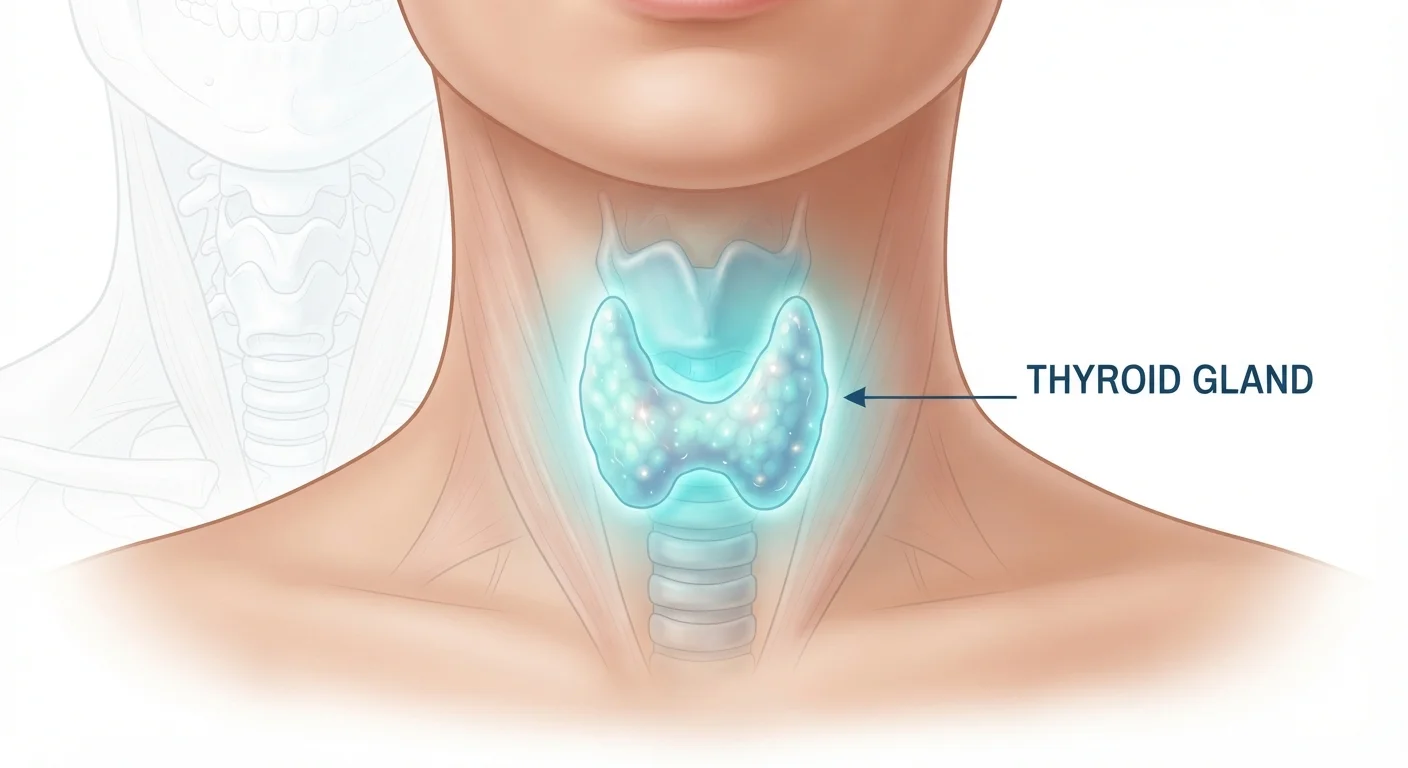
| Gland location | Front of the neck, below the larynx |
| Primary hormones produced | T3 (triiodothyronine) and T4 (thyroxine) |
| Most common thyroid disorder | Hypothyroidism (American Thyroid Association) |
| Standard screening test | TSH blood test |
| Most common cause of hypothyroidism (US) | Hashimoto's thyroiditis (autoimmune) |
| Most common cause of hyperthyroidism (US) | Graves' disease (autoimmune) |
What the Thyroid Does - and Why It Matters
The thyroid is a small, butterfly-shaped gland located at the front of the neck. Despite its modest size, it plays an outsized role in regulating metabolism, heart rate, body temperature, and energy levels by producing two key hormones: thyroxine (T4) and triiodothyronine (T3). These hormones influence nearly every cell in the body, which is why thyroid disorders can produce such wide-ranging symptoms.
A third hormone, thyroid-stimulating hormone (TSH), is produced by the pituitary gland and signals the thyroid to increase or decrease hormone output. TSH levels are the most common starting point in thyroid blood panels and are often the first number a clinician reviews when thyroid dysfunction is suspected.
| Gland location | Front of the neck, below the larynx |
| Primary hormones produced | T3 (triiodothyronine) and T4 (thyroxine) |
| Most common thyroid disorder | Hypothyroidism (American Thyroid Association) |
| Standard screening test | TSH blood test |
| Most common cause of hypothyroidism (US) | Hashimoto's thyroiditis (autoimmune) |
| Most common cause of hyperthyroidism (US) | Graves' disease (autoimmune) |
When the thyroid produces hormones outside the normal range - either too little or too much - the resulting conditions are broadly classified as hypothyroidism or hyperthyroidism. Both are considered chronic conditions in most cases, meaning they typically require ongoing management rather than a one-time cure.
Hypothyroidism: When the Thyroid Underperforms
Hypothyroidism occurs when the thyroid produces insufficient amounts of T3 and T4. The body's processes slow down as a result, and common symptoms include fatigue, unexplained weight gain, cold sensitivity, constipation, dry skin, and sluggish reflexes. Depression and cognitive fog are also frequently reported.
The most common cause worldwide is Hashimoto's thyroiditis (also called Hashimoto's disease), an autoimmune condition in which the immune system mistakenly attacks thyroid tissue. Other causes include iodine deficiency, prior thyroid surgery, and radiation therapy to the neck area. In some cases, hypothyroidism is a side effect of certain medications.
TSH (Thyroid-Stimulating Hormone)
A hormone produced by the pituitary gland that signals the thyroid to produce more or less T3 and T4. Elevated TSH typically indicates hypothyroidism; suppressed TSH often signals hyperthyroidism.
T4 (Thyroxine)
The primary hormone secreted by the thyroid gland. Most T4 is converted to the more active T3 in body tissues. It plays a central role in regulating metabolism and energy.
T3 (Triiodothyronine)
The biologically active thyroid hormone that directly influences cellular metabolism. It can be produced by the thyroid or converted from T4 in body tissues.
Hashimoto's Thyroiditis
An autoimmune condition and the leading cause of hypothyroidism in iodine-sufficient countries. The immune system attacks the thyroid gland, gradually reducing its hormone output.
Graves' Disease
An autoimmune disorder and the most common cause of hyperthyroidism. Antibodies stimulate the thyroid to overproduce hormones, speeding up bodily functions.
Euthyroid
The clinical term for a thyroid gland functioning normally - producing hormones within the established reference range, with no signs of overactivity or underactivity.
Diagnosis typically involves a blood test showing an elevated TSH alongside low or low-normal T4. Treatment generally centers on thyroid hormone replacement therapy, which is managed by a physician and tailored to individual needs. People with hypothyroidism often manage it as an ongoing condition requiring periodic monitoring.
Hyperthyroidism and Related Conditions
Hyperthyroidism is the opposite state: the thyroid produces excess hormones, accelerating the body's functions. Symptoms commonly include unintentional weight loss, rapid or irregular heartbeat (palpitations), nervousness, heat intolerance, increased sweating, and difficulty sleeping. Some people experience a fine tremor in the hands.
The most prevalent cause is Graves' disease, another autoimmune disorder in which antibodies overstimulate the thyroid. Other causes include thyroid nodules that become overactive (toxic nodular goiter) and thyroiditis, an inflammation that can temporarily release stored hormone into the bloodstream.
Hyperthyroidism Can Mimic Anxiety Disorders
The symptoms of hyperthyroidism - racing heart, nervousness, difficulty sleeping, and restlessness - closely resemble those of generalized anxiety. Clinicians often include thyroid function testing when evaluating new-onset anxiety symptoms, particularly in women, who are more frequently affected by thyroid disorders. A simple TSH blood test can help differentiate the two. If you are experiencing these symptoms, speak with a healthcare provider rather than self-diagnosing.
A distinctive feature of Graves' disease is Graves' ophthalmopathy - inflammation affecting the muscles and tissues around the eyes, which can cause bulging eyes (exophthalmos), redness, and visual changes. This eye involvement is separate from thyroid hormone levels and may require its own treatment approach.
Treatment options for hyperthyroidism include antithyroid medications, radioactive iodine therapy, or surgery to remove part or all of the thyroid. Each approach has trade-offs, and the appropriate path depends on the underlying cause, severity, age, and other individual factors - decisions made in close consultation with an endocrinologist or physician.
Other Thyroid Terms Worth Knowing
Beyond the two primary categories, several additional terms come up frequently in thyroid discussions:
- Goiter: An enlargement of the thyroid gland. It can occur with hypothyroidism, hyperthyroidism, or even normal thyroid function, and has multiple possible causes.
- Thyroid nodule: A lump or growth within the thyroid. Most nodules are benign, but some require biopsy to rule out malignancy.
- Subclinical hypothyroidism/hyperthyroidism: Abnormal TSH levels with T3 and T4 still within the normal range. Whether to treat these states is an active area of clinical discussion.
- Thyroid cancer: A malignancy of thyroid cells. It represents a distinct category from functional thyroid disorders; most types have favorable outcomes with appropriate treatment.
- Euthyroid: The clinical term for a normally functioning thyroid - neither overactive nor underactive.
Understanding these terms makes it easier to follow conversations with a healthcare provider, interpret lab results, and stay informed about your own thyroid health. For any specific symptoms or lab findings, a qualified physician or endocrinologist is the appropriate resource for guidance.
This article is for general informational and educational purposes only and does not constitute medical advice. Always consult a qualified healthcare professional for questions about your personal health, symptoms, or any medical conditions.