

Key Takeaways
Our Verdict
Individual therapy remains the most personalized and evidence-supported option for complex or acute mental health concerns. Group therapy excels when peer connection and shared experience are central to healing. Self-guided approaches are most effective as supplements to professional care or for building everyday resilience. There is no universally superior format — the right fit depends on the individual's goals, severity of concerns, and practical circumstances.
| Best for | Recommended |
|---|---|
| Those dealing with complex trauma, acute distress, or highly personal concerns | Individual Therapy |
| Those seeking peer connection, shared experience, or lower-cost professional support | Group Therapy |
| Those managing mild stress or looking to reinforce skills between sessions | Self-Guided Approaches |
| Those with limited access to in-person care or tight scheduling constraints | Self-Guided Approaches (as a bridge) |
Why Format Matters as Much as Content
When people consider therapy, the conversation often centers on what type of therapy to pursue — cognitive behavioral, psychodynamic, mindfulness-based — rather than how it's delivered. But the format of treatment shapes the experience just as meaningfully as the underlying approach. Individual sessions, group settings, and structured self-help each engage different psychological mechanisms and suit different needs.
Understanding these distinctions helps you ask better questions when exploring options and have more productive conversations with a mental health professional. As a complement to that process, evidence-based techniques like those used in CBT can translate across all three formats.
| Individual Therapy | Group Therapy | Self-Guided Approaches | |
|---|---|---|---|
| Personalization | Highly tailored to individual | Moderate — shared focus | Low — fixed program structure |
| Confidentiality | Legally protected | Expected but not legally enforced | Full — private to the user |
| Peer connection | None | Central to the format | None |
| Typical cost per session | $100–$300 (without insurance) | $30–$80 | Free to low-cost |
| Accessibility | Limited by therapist supply | More available than individual | On-demand, no waitlist |
| Evidence base | Strongest, broadest | Strong for specific conditions | Good for mild concerns with guidance |
| Best suited for | Complex or acute conditions | Isolation, grief, addiction, social anxiety | Mild stress, skill-building, maintenance |
Individual Therapy: Depth and Personalization
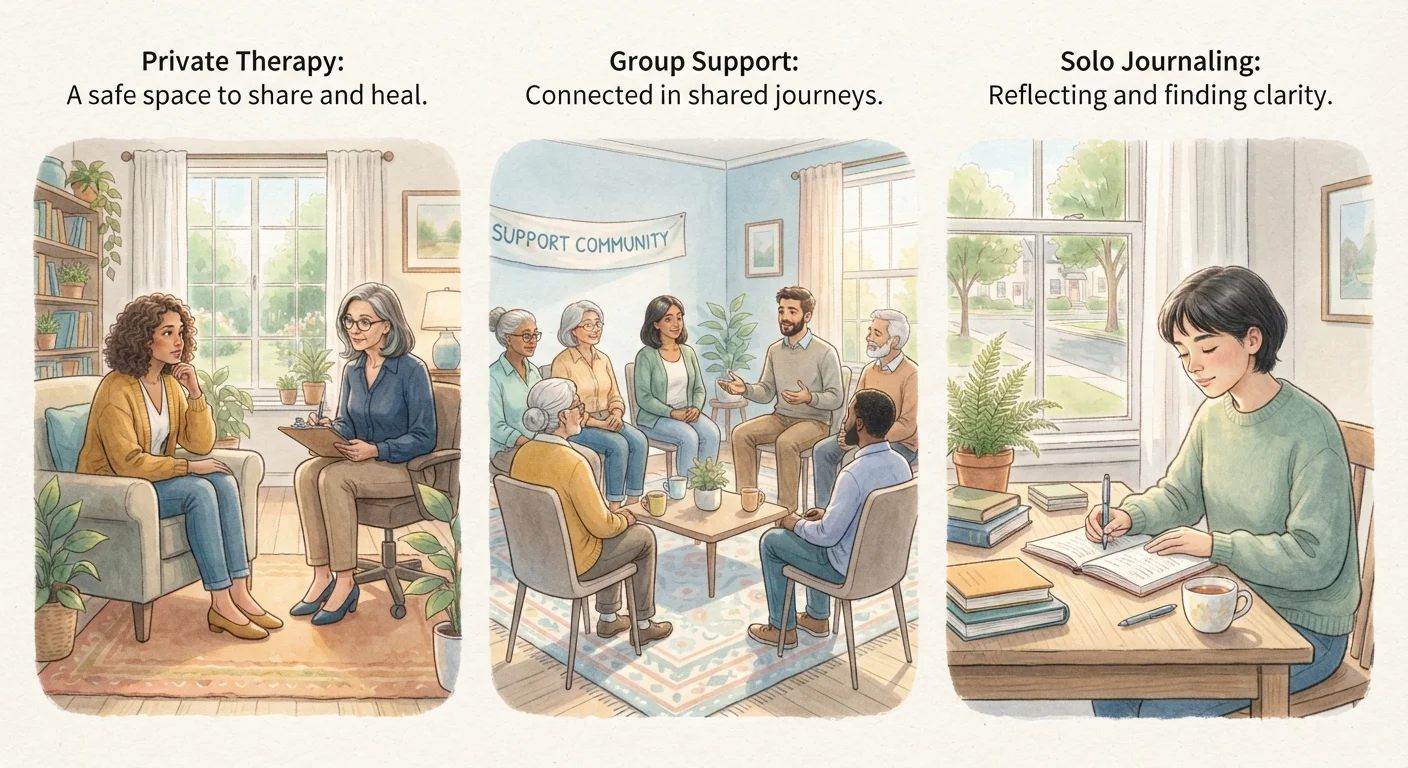
One-on-one therapy with a licensed mental health professional is the most studied and widely used format. Its central advantage is depth: the therapist can tailor every session to a person's unique history, presenting concerns, and pace of progress. Confidentiality is structurally guaranteed, which allows clients to explore sensitive material — trauma, relationship patterns, shame — without fear of social exposure.
Research consistently supports individual therapy for a wide range of conditions, including depression, anxiety disorders, PTSD, and eating disorders. The therapeutic alliance — the quality of the working relationship between client and therapist — is one of the strongest predictors of outcome across modalities.
The primary limitations are cost and availability. Sessions typically run $100–$300 per hour without insurance, and therapist shortages in many regions mean waitlists can extend for months. For those navigating a new or complex diagnosis, structured preparation for clinical conversations can help maximize the value of each appointment.
Ask About Format During Your First Contact
When reaching out to a mental health provider, ask directly whether individual, group, or a combination of formats is recommended for your specific concerns. Many practices offer stepped-care models, starting with lower-intensity support and moving to more intensive formats if needed. This conversation is a normal and important part of finding the right fit.
Group Therapy: Connection as a Mechanism of Change
Group therapy involves a licensed facilitator guiding a structured session with multiple participants, typically between six and twelve people. It is not simply a cheaper alternative to individual therapy — it operates through different therapeutic mechanisms. Research by psychiatrist Irvin Yalom identified factors unique to group settings, including universality (the recognition that others share your struggles), altruism (the healing effect of helping peers), and interpersonal learning through real-time group dynamics.
Group formats are particularly effective for social anxiety, grief, addiction recovery, and conditions where isolation amplifies distress. Seeing others make progress can be motivating in ways that a one-on-one setting cannot replicate. Groups are also generally more affordable, often running $30–$80 per session.
The trade-off is reduced individualization and less control over the session's direction. Confidentiality, while expected of participants, is not legally enforceable in the same way it is with a licensed provider. For those whose concerns are highly personal or who find group settings activating, individual work may need to come first.
Group Therapy Is Not the Same as a Support Group
Clinically led group therapy is a structured, professionally facilitated treatment. Peer support groups — while valuable — are not the same and do not substitute for licensed clinical care. If you are experiencing significant distress, verify that any group you join is led by a credentialed mental health professional rather than a volunteer or peer facilitator alone.
Self-Guided Approaches: Accessible but Limited
Structured self-help includes workbooks grounded in established therapies, app-based programs, psychoeducation resources, and guided journaling frameworks. The research picture here is nuanced. Meta-analyses suggest that guided self-help — where a professional provides minimal check-ins — produces meaningful outcomes for mild-to-moderate anxiety and depression. Purely unguided self-help shows smaller effects and higher dropout rates.
The strengths are obvious: self-guided tools are available on demand, require no waitlist, and can be extraordinarily low-cost. They also allow people to build skills at their own pace. CBT-informed techniques like thought records and behavioral activation are well-suited to self-guided practice and can reinforce work done in formal therapy.
The critical limitation is that self-guided approaches are not appropriate as standalone interventions for moderate-to-severe mental health conditions, active suicidality, psychosis, or complex trauma. They work best as bridges between professional appointments, maintenance tools after completing formal treatment, or entry points for people not yet ready to engage with a therapist. Maintaining sustainable mental wellness habits in everyday life can extend the benefits of any therapeutic format.
This article is for general informational and educational purposes only and is not a substitute for professional mental health advice, diagnosis, or treatment. Always consult a qualified mental health professional regarding any concerns about your mental health or before beginning any therapeutic program.