

Key Takeaways
Our Verdict
No single apartment size is universally right—the best choice depends on your household size, budget, work situation, and how you actually live day to day. Studios suit budget-conscious solo renters in high-cost cities; one-bedrooms serve most individuals and couples well; two-bedrooms offer value when shared or when dedicated space is a genuine need.
| Best for | Recommended |
|---|---|
| Budget-conscious solo renters in high-cost urban markets | Studio |
| Individuals or couples who prioritize privacy and livability | One-Bedroom |
| Roommate pairs or remote workers needing a dedicated office | Two-Bedroom |
| Small families or those expecting a lifestyle change soon | Two-Bedroom |
Why Apartment Size Is a Bigger Decision Than It Looks
Choosing between a studio, one-bedroom, or two-bedroom apartment isn't just about square footage — it shapes your daily routine, your finances, and how comfortably you can live and work in a space. Renters often underestimate this and either stretch their budget for room they don't need or squeeze into a unit they quickly outgrow.
Before comparing floor plans, it helps to clarify three things: how many people will live in the unit, how you use your home day-to-day (remote work, entertaining, hobbies), and what you can realistically afford after accounting for all rental costs — not just the monthly rent. For a full picture of what those costs include, see the hidden costs of renting an apartment.
| Studio | One-Bedroom | Two-Bedroom | |
|---|---|---|---|
| Typical size range | 300–600 sq ft | 550–900 sq ft | 800–1,200 sq ft |
| Relative monthly rent | Lowest | Moderate | Highest (lower per person if shared) |
| Privacy level | Minimal — no separate bedroom | Good — separate sleeping area | Excellent — two enclosed rooms |
| Best for work-from-home | Challenging without room division | Workable with furniture arrangement | Ideal — dedicated office possible |
| Guest accommodation | Difficult | Limited but manageable | Easy with a spare room |
| Storage | Often very limited | Moderate | More closets and storage space |
| Ideal occupancy | 1 person | 1–2 people | 2–3 people or roommates |
The Studio Apartment: Maximum Efficiency, Minimum Separation
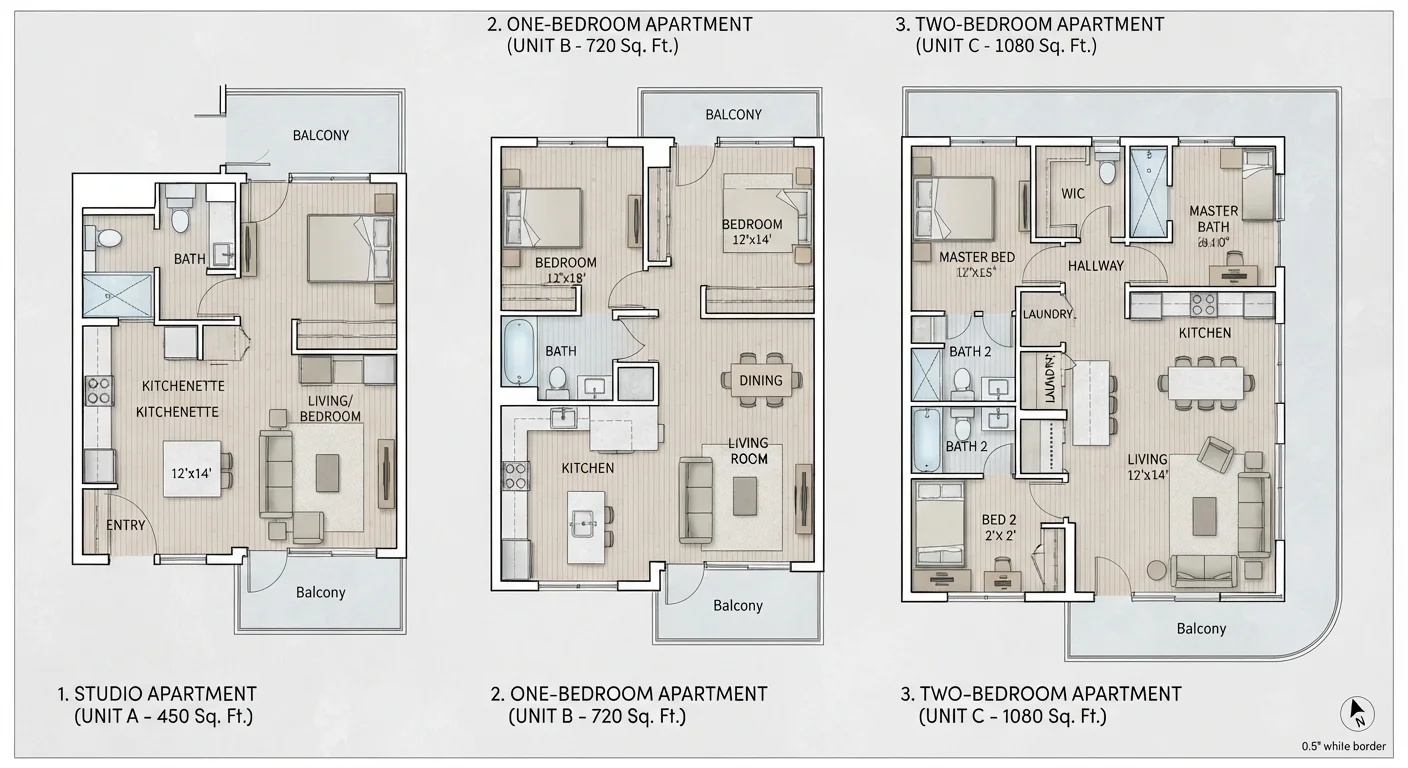
A studio combines the living area, sleeping area, and kitchen into a single open space, typically ranging from 300 to 600 square feet. Bathrooms are separate, but there are no interior walls dividing the main living zone.
Who it suits well: Solo renters who spend most of their time outside the home, those in expensive metro areas where studios represent a meaningful rent savings, and people who prefer a low-maintenance, minimal-clutter lifestyle.
Where studios fall short: If you work from home, host guests regularly, or share the space with a partner, the lack of visual and acoustic separation becomes a genuine quality-of-life issue quickly. Storage is almost universally limited in studios, which adds the hidden cost of off-site storage units for some renters.
Make a Studio Work Harder With Zoning
If a studio is the right financial fit, use furniture placement to create distinct zones — a room divider, bookshelf, or elevated bed platform can visually separate sleeping from living areas. This won't give you walls, but it meaningfully improves how the space functions day-to-day. Measure carefully before signing: a 400-square-foot studio with smart layout often lives better than a poorly designed 500-square-foot one.
The One-Bedroom Apartment: The Workhorse of Urban Rentals
One-bedrooms — typically 550 to 900 square feet — give you a defined sleeping space separate from the living area. That single wall changes how the apartment functions dramatically: you can have a guest over without rearranging your entire life, maintain a cleaner work-sleep boundary, and store more without the space feeling chaotic.
Who it suits well: Most solo renters and couples find one-bedrooms the most practical long-term option. The added privacy and defined space justify the rent premium over a studio in most cases, especially if you work from home even part of the time.
The trade-off: One-bedrooms typically cost 20–40% more than studios in the same building or neighborhood, depending on the market. If budget is the primary constraint, that gap matters. If you're a first-time renter weighing all of your options, what nobody tells you before you sign a lease is worth reading before committing.
The Two-Bedroom Apartment: When the Extra Room Earns Its Cost
Two-bedrooms range from roughly 800 to 1,200 square feet and include two separate bedrooms, a shared living area, and usually one or two bathrooms. They're the most expensive option outright, but the per-person cost can be lower than a one-bedroom when shared.
Who it suits well: Roommate pairs are the classic use case — splitting a two-bedroom often costs each person less than renting a one-bedroom solo in the same area. Setting up a shared apartment arrangement that works requires some planning around lease structure and utility splits, but the financial math is often compelling. Two-bedrooms also serve couples who need a dedicated home office, or individuals who regularly host family.
When it's too much: Renting a two-bedroom solo primarily for the extra space is rarely cost-efficient unless your income comfortably supports it. A large living room or multi-functional one-bedroom layout may accomplish the same goal at lower cost. Use a room-by-room walkthrough checklist when touring to assess whether the second bedroom is genuinely usable or just a narrow afterthought.
~30%
Average rent premium: 1BR over studio
According to general rental market analyses, one-bedrooms in most US metros command roughly 20–40% more than comparable studios in the same building.
~15–25%
Per-person savings in shared two-bedroom
When two renters split a two-bedroom, each person typically pays 15–25% less than they would renting a one-bedroom solo in the same market, depending on the city.
How to Make the Final Call
Run through these questions before committing to a size:
- Occupancy: Is it just you, or will a partner, roommate, or child share the space?
- Work habits: Do you need a door you can close for calls or focused work?
- Social use: Do you regularly host overnight guests or entertain at home?
- Budget ceiling: Can you afford the next size up without compromising other financial goals?
- Lease length: If your situation may change within 12 months, a smaller unit with a shorter lease may be smarter than locking into more space.
Also consider whether a furnished unit might affect the equation. A furnished studio that eliminates furniture costs might rival an unfurnished one-bedroom in total outlay. What renters often overlook about furnished vs. unfurnished apartments covers exactly that trade-off.
The right apartment size isn't the biggest you can afford or the smallest you can tolerate — it's the one that fits how you actually live, at a cost that doesn't strain the rest of your budget.