

Key Takeaways
What the Loan Estimate Is — and Why It Exists
The Loan Estimate is a standardized three-page form that federal law requires every mortgage lender to provide within three business days of receiving a complete loan application. Introduced as part of the TILA-RESPA Integrated Disclosure (TRID) rules that took effect in 2015, the form replaced older, less consistent disclosures with a uniform format designed to make comparison shopping practical for borrowers.
Because every lender uses the same form, a Loan Estimate from a community bank and one from a large national lender can be placed side by side and compared field by field. This is a significant consumer protection. The document is not a commitment to lend, nor is it a guarantee that the terms shown will be exactly what appears at closing — but it does come with federal rules that limit how much certain fees can increase. Understanding those rules is part of reading the form effectively.
What you will need
Before diving into individual fields, gather your Loan Estimates from all lenders you are considering. If you are still deciding between loan structures, understanding fixed vs. adjustable rate trade-offs is worth doing before you compare estimates, since the loan type affects how you interpret projected payments.
Loan Estimates Are Not Loan Approvals
Receiving a Loan Estimate does not mean your loan has been approved or that the lender has committed to lending to you. It is a good-faith estimate of terms based on the information provided at application. Final terms are confirmed in the Closing Disclosure, typically issued three business days before settlement. Always verify that your Closing Disclosure matches the Loan Estimate before signing.
How to Read and Compare Loan Estimates Step by Step
Loan Estimate (LE) Form
The standardized three-page federal disclosure document your lender provides within three business days of application.
Calculator or Comparison Spreadsheet
Used to add up and compare total closing costs and projected monthly payments across multiple lenders.
CFPB Loan Estimate Explainer
The Consumer Financial Protection Bureau publishes a free annotated guide that labels every field on the LE form.
Confirm the Loan Terms on Page One
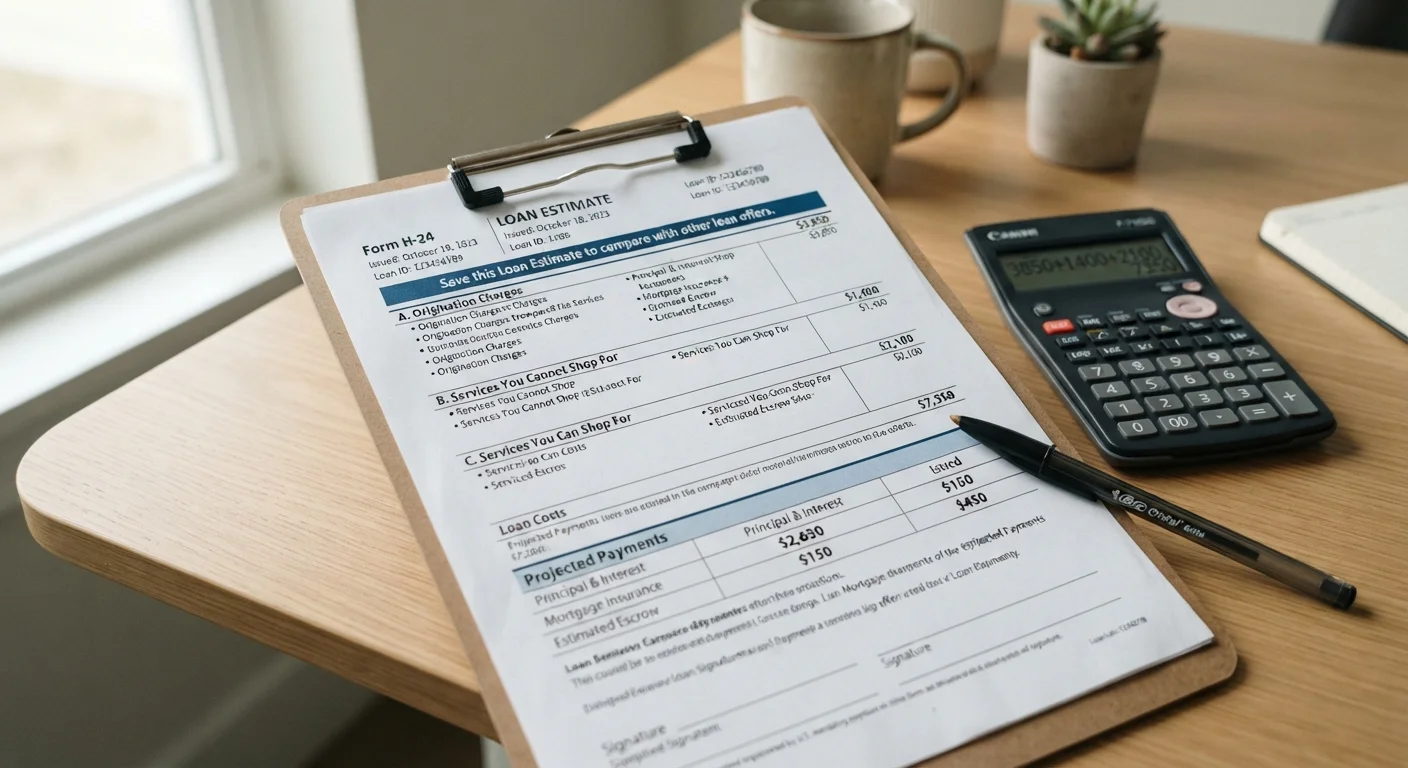
Page one of the Loan Estimate contains the most fundamental terms of the proposed loan. Verify that the loan amount, loan type (fixed or adjustable), and loan term (e.g., 30-year) match what you discussed with the lender. Check the interest rate and confirm whether it is locked or floating — a locked rate is protected for a stated period, while a floating rate can change before closing.
Also review the Projected Payments table, which breaks down your estimated monthly payment into principal and interest, mortgage insurance (if applicable), and estimated escrow amounts for taxes and homeowner's insurance. This figure is not your total housing cost, but it is the core number to compare across lenders.
Compare Interest Rate vs. APR
The interest rate and the APR are related but distinct figures. The interest rate is what you pay to borrow the principal. The APR folds in certain lender fees and other costs, expressing the true annual cost of the loan as a percentage. A lender with a slightly lower interest rate but higher fees may carry a higher APR than a competitor — making the APR the more reliable number for apples-to-apples comparison.
A significant gap between interest rate and APR (more than 0.25–0.5 percentage points on a fixed loan) typically signals higher upfront fees. Investigate what is driving that spread before choosing this lender.
Break Down Closing Costs on Page Two
Page two itemizes closing costs in two main sections: Loan Costs and Other Costs. Loan costs include origination charges (points, underwriting fees, application fees) and services required by the lender. Other costs cover prepaid items, initial escrow payments, and third-party services such as title insurance and settlement fees.
Services are labeled as either required (lender-chosen, non-negotiable) or shoppable (you can choose your own provider). For shoppable services — often title and settlement companies — getting your own quotes can reduce your closing costs meaningfully. Focus your negotiation energy on the lender's origination section, where fees are most directly within the lender's control.
Review Comparisons and Cash to Close
The bottom of page two shows two important summary lines: Closing Costs (total fees) and Cash to Close (the amount you will need to bring to settlement). Cash to close includes your down payment minus any deposits already paid, plus closing costs, adjusted for any credits from the seller or lender.
Verify that the cash-to-close figure is realistic given your available funds. If it exceeds your budget, ask whether lender credits (in exchange for a slightly higher rate) or seller concessions could reduce the figure. This is also a good point to revisit how your offer was structured — see our guide on structuring a competitive offer for context.
Examine Page Three: Comparisons, Contact, and Other Considerations
Page three includes the Comparisons table, which projects your total interest paid, APR, and cumulative payments over five years. This section is especially useful when comparing a lower-rate/higher-fee loan against a higher-rate/lower-fee loan — the five-year figure shows which is genuinely cheaper if you stay in the home that long.
Also check the Other Considerations section for details on appraisal, homeowner's insurance requirements, late payment terms, and whether the loan can be assumed by a future buyer. Finally, note the lender's contact details and confirm you are working with a licensed entity in your state.
Track Your Intent to Proceed Deadline
A Loan Estimate does not obligate the lender to fund your loan, but it does set a clock. Lenders generally require you to indicate your intent to proceed — typically in writing — before they will order an appraisal or advance your application. If you do not respond within the timeframe specified by the lender (often 10 business days), the estimate may expire and rates could change.
Once you decide which lender to move forward with, provide your intent to proceed promptly. At that stage, begin preparing for the next phase: a thorough due diligence review of the property and transaction documents.
Request Estimates From at Least Three Lenders
Because every Loan Estimate follows the same federal format, comparing offers side by side is more straightforward than with most financial documents. Gather estimates on the same day if possible so that rate environments are comparable. Even a small difference in APR or origination fees can translate to thousands of dollars over the life of a loan.
Watch for Fee Changes Between Estimate and Closing
Federal rules (Regulation Z / RESPA) cap how much certain fees can increase between the Loan Estimate and your Closing Disclosure. Lender fees and title services you were not allowed to shop for cannot increase at all. Third-party services you chose yourself can increase, but only within limits. If your Closing Disclosure shows significant unexplained increases, ask your lender for a written explanation before proceeding.
This article provides general educational information about the mortgage loan process and is not personalized financial, legal, or lending advice. Mortgage products, fees, and regulations vary by lender, state, and individual circumstances. Consult a licensed mortgage professional, HUD-approved housing counselor, or qualified financial adviser before making decisions about a specific loan.