

Key Takeaways
Our Verdict
No single driver technology is objectively superior across all listening situations. Dynamic drivers offer versatility and strong bass for everyday use; planar magnetics excel in detail retrieval and low distortion for critical listening; balanced armatures deliver precision in compact, portable form; and electrostatics represent the ceiling of technical performance for dedicated audiophiles. Matching driver type to your use case and listening priorities matters far more than chasing any one technology.
| Best for | Recommended |
|---|---|
| Everyday listening, gaming, and general portable use | Dynamic driver headphones |
| Critical listening and high-fidelity home audio | Planar magnetic headphones |
| In-ear monitors and compact portability | Balanced armature in-ears |
| Reference-grade studio or audiophile listening | Electrostatic headphones |
Why Driver Technology Matters
The driver is the engine of any headphone — it converts an electrical signal into the physical air movement you perceive as sound. Every other design decision, from ear cup shape to cable type, works around what the driver can and cannot do. Understanding the four primary driver technologies gives you a meaningful framework for interpreting spec sheets and real-world listening impressions, rather than relying on marketing language alone.
Driver size, diaphragm material, and the mechanism generating motion all influence frequency response, transient speed (how quickly sound starts and stops), distortion levels, and sensitivity. These properties interact in ways that make certain driver types better suited to specific listening scenarios.
Dynamic Drivers: The Everyday Standard
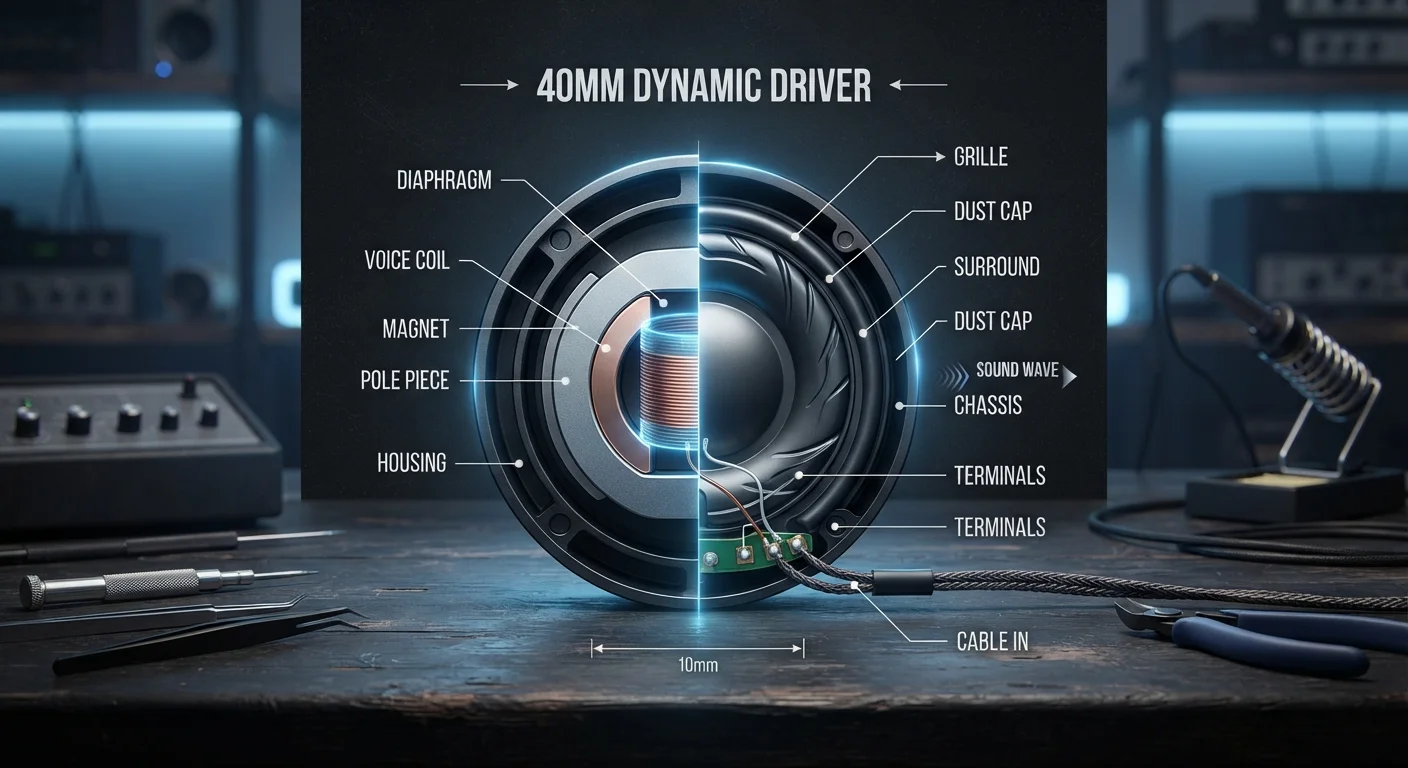
Dynamic drivers — sometimes called moving-coil drivers — operate on the same electromagnetic principle as a loudspeaker. A voice coil attached to a diaphragm sits within a magnetic field; when current flows through the coil, it moves the diaphragm back and forth, pushing air to create sound waves.
This design is mechanically simple, cost-effective to manufacture, and capable of moving substantial air volume, which supports strong, impactful bass. The trade-off is that the entire driving force concentrates at the point where the coil attaches to the diaphragm, which can introduce some mechanical distortion, particularly at high output levels.
Dynamic drivers are found across every price tier, from basic earbuds to high-end over-ear headphones, and they remain the baseline against which other technologies are often measured.
Sensitivity and Your Source Device Matter
A driver's sensitivity rating — measured in decibels per milliwatt — determines how easily it reaches listening volume from a given source. Low-sensitivity planar magnetic headphones may sound underpowered from a phone but come alive with a dedicated amplifier. Always check sensitivity and impedance specs alongside driver type when assessing compatibility with your existing gear.
Planar Magnetic Drivers: Even Force, Lower Distortion
Planar magnetic drivers replace the coil-and-cone arrangement with a thin, flat membrane embedded with a conductive circuit pattern. Magnets on one or both sides of the membrane create a field; when current flows through the embedded conductors, force distributes evenly across the entire surface rather than from a single point.
This distributed actuation tends to reduce distortion at higher volumes and can improve the speed with which the driver responds to transient sounds — the crack of a snare drum, the pluck of a guitar string. Many listeners describe planar magnetic sound as detailed and controlled, with tighter bass texture compared to dynamic drivers.
The practical downsides are weight and sensitivity. Planar magnetic headphones are typically heavier and harder to drive, often requiring a dedicated headphone amplifier to reach their performance potential.
| Dynamic | Planar Magnetic | Balanced Armature | Electrostatic | |
|---|---|---|---|---|
| Operating principle | Electromagnetic coil & cone | Distributed membrane conductors | Tilting metal armature | High-voltage charged diaphragm |
| Typical distortion level | Moderate | Low | Low–moderate | Very low |
| Bass extension | Strong, impactful | Controlled, textured | Limited sub-bass | Accurate, fast |
| Amplifier requirement | Usually none or modest | Often recommended | None (highly efficient) | Dedicated energizer required |
| Common use cases | All-purpose headphones | Home listening, studio | In-ear monitors | Reference & audiophile use |
| Typical price range | Budget to premium | Mid to high-end | Mid to professional | High to very high |
Balanced Armature Drivers: Compact Precision
Balanced armature (BA) drivers work differently from the other technologies. A tiny metal armature sits balanced between two magnets; when current flows through a coil wound around it, the armature tilts and drives a diaphragm. The entire assembly is sealed, making it extremely compact and highly efficient.
Because a single balanced armature unit covers a limited frequency range well, in-ear monitor manufacturers often combine multiple BA drivers — each tuned to a specific band — within a single earpiece. This multi-driver approach can produce excellent detail across the frequency spectrum, though crossover design between drivers significantly affects the final result.
BA drivers are less effective at reproducing deep sub-bass compared to dynamic drivers, and their sealed nature produces a different, often described as more "intimate," sound presentation.
Electrostatic Drivers: Reference-Grade Performance
Electrostatic drivers use a fundamentally different operating principle. An extremely thin, electrically charged diaphragm — often just a few microns thick — is suspended between two perforated metal stators carrying opposing high-voltage charges. Varying the voltage difference between the stators causes the diaphragm to move.
Because the diaphragm has almost no mass, it can accelerate and stop virtually instantaneously, producing exceptionally fine detail retrieval and very low distortion. This is why electrostatic headphones are frequently used in studio reference environments and favored by listeners focused on technical accuracy.
The significant barriers are cost and practicality. Electrostatic headphones require a dedicated energizer unit that steps up voltage to hundreds or thousands of volts, and the headphones themselves cannot be driven by a standard amplifier or smartphone. They are also sensitive to humidity and require careful storage.
~1–2 μm
Typical electrostatic diaphragm thickness
Electrostatic diaphragms are often just one to two microns thick, contributing to their extremely low moving mass and rapid response.
2–4+
BA drivers per earpiece in pro IEMs
Professional in-ear monitors frequently use two to four or more balanced armature drivers per side, each covering a dedicated frequency range.
Choosing the Right Driver for Your Listening
Driver type is a useful starting point, but it doesn't tell the whole story. A well-tuned dynamic driver can outperform a poorly tuned planar magnetic in perceived clarity, and a single BA in-ear can sound more musical than a multi-driver design with an ill-matched crossover. Tuning decisions made by engineers — frequency response curves, damping materials, resonance management — shape the listening experience as much as the underlying mechanism.
Consider your practical context: portability and device compatibility favor dynamic and balanced armature designs; critical home listening opens the door to planar magnetics; and a dedicated listening setup with amplification may justify exploring electrostatics. Rather than treating driver type as a quality ladder, treat it as a toolbox — each technology is optimized for different conditions.