

Key Takeaways
Why Exchange Rates Are Never Quite What They Seem
The exchange rate you see quoted in news or financial apps is the interbank rate — the rate at which large financial institutions trade currencies with one another. Individual travelers never access this rate directly. Every exchange channel adds its own layer of cost: a spread between buy and sell prices, a flat fee, a percentage commission, or some combination of all three. Understanding which layer you're paying — and how much — is what separates travelers who stretch their money from those who unknowingly give a large slice of it away.
Airport currency kiosks are the most visible example of a poor exchange channel. Their business model depends on foot traffic from travelers with no time or energy to compare rates. The spreads they apply can be dramatically wider than what you'd receive from an ATM withdrawal at a bank-affiliated machine across town. As part of a well-prepared trip, currency planning fits naturally alongside other logistics covered in commonly overlooked travel logistics that can derail even well-organized itineraries.
Airport and Hotel Exchange Desks: Convenience at a Cost
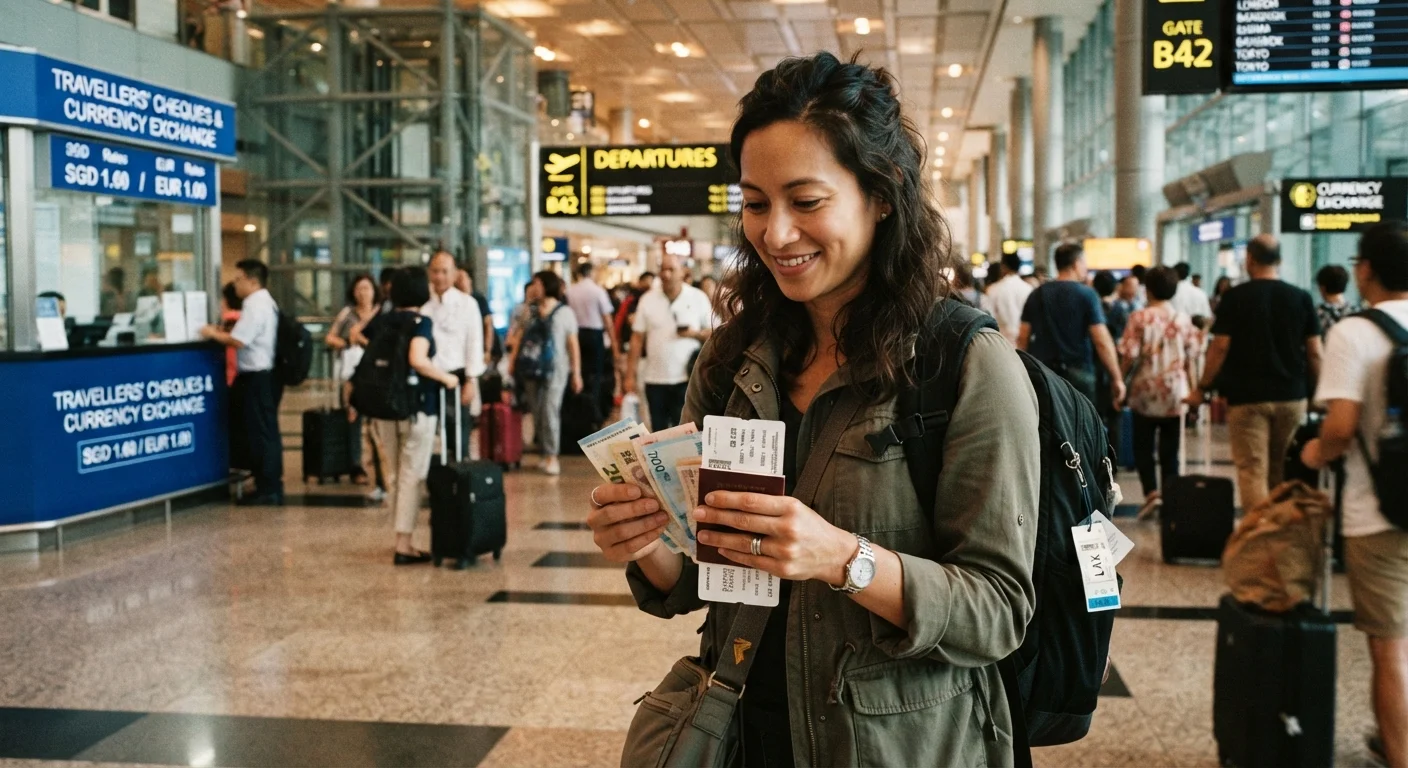
Currency exchange kiosks at airports, cruise ports, and hotel lobbies are available around the clock, but that convenience comes with a steep price. Spreads between the buy and sell rate — plus flat commissions — can consume 8–15% of your exchange amount. If you must exchange cash at an airport, exchange only a small amount to cover immediate transportation or meals, then seek a better option once you arrive.
What to Use, Where, and Why
The practical hierarchy for most travelers is: no-fee credit card for card purchases → bank-affiliated ATM for cash → small pre-trip currency order for immediate arrival needs → everything else as a last resort.
Check Your Card's Foreign Transaction Policy
Before you leave, log into your bank or credit card account and confirm whether your card charges a foreign transaction fee — commonly 1–3% per purchase — and what the ATM withdrawal fee structure looks like abroad. Some checking accounts and travel-oriented credit cards waive these fees entirely and even reimburse third-party ATM surcharges. Knowing this in advance lets you pick the right card for your trip.
It helps to think about currency access the same way you'd think about data access abroad — both involve understanding what your home provider charges internationally before you rely on them in the field. The same planning mindset applies whether you're sorting out a local SIM card or eSIM or figuring out where to withdraw cash.
What you will need
Your choice of tools matters, but so does execution. Follow the steps below to make sure you're set up before you leave, not scrambling to fix problems after you land.
Debit card linked to a checking account
Used to withdraw local currency from ATMs abroad, often at near-interbank exchange rates.
Credit card with no foreign transaction fee
Used for card purchases abroad without an added percentage fee on every transaction.
Small amount of local currency obtained before departure
Covers immediate needs on arrival — transport, tips, small purchases — before you reach an ATM.
Identify your card's international fee structure before you travel
Call your bank or review your account agreement to find out: (1) whether your debit card charges a foreign transaction fee on purchases, (2) what ATM withdrawal fees apply abroad, and (3) whether the card network (Visa, Mastercard, etc.) adds its own currency conversion markup. Credit unions and online banks sometimes offer accounts with waived international ATM fees — worth having if you travel more than once a year.
Notify your bank of your travel dates and destination
Most banks allow you to set a travel notice online or by phone. Without one, an unfamiliar foreign charge pattern can trigger a fraud alert that temporarily freezes your card — a serious problem if it happens late at night in an unfamiliar city. Set the notice to cover your full travel window, including any layover countries.
Obtain a small amount of local currency before or immediately upon arrival
Having the equivalent of roughly one day's spending in local cash on arrival removes pressure to find an ATM or exchange desk while tired and disoriented. Your home bank may offer foreign currency orders, though rates vary. Alternatively, use an airport ATM — not a currency exchange kiosk — as a last resort for this initial amount.
Use bank-affiliated ATMs in your destination for ongoing cash needs
Withdrawing local currency from ATMs connected to major bank networks typically gives you a rate close to the interbank (mid-market) rate — the fairest benchmark available. Look for ATMs inside or directly affiliated with recognized local banks rather than standalone machines in tourist areas, which often charge higher surcharges and may use less favorable conversion rates.
Decline dynamic currency conversion at every opportunity
Whenever you pay by card abroad — at a restaurant, shop, hotel, or ATM — the terminal may display a prompt offering to charge you in your home currency. Always select the local currency option. This ensures your bank applies its exchange rate rather than the merchant bank's rate, which is consistently less favorable. The same rule applies when an ATM asks which currency to use for the transaction.
Assess your destination's cash vs. card culture before you go
Some destinations — particularly in Scandinavia, the UK, and urban parts of Western Europe — have moved largely toward card-only or contactless payments. Others, including many markets in Southeast Asia, Latin America, and Eastern Europe, still rely heavily on cash for everyday transactions, taxis, and small vendors. Research your specific destination so you're not caught cashless where it matters or carrying unnecessary amounts of currency.
Always Decline Dynamic Currency Conversion
When a foreign ATM or card terminal asks whether you'd like to be charged in your home currency, always choose the local currency instead. Dynamic currency conversion (DCC) lets the merchant's bank set the exchange rate, which is almost always significantly worse than your own bank's rate. Choosing your home currency at the point of sale hands away savings for no benefit.
Fitting Currency Planning Into Your Broader Travel Budget
Fees and unfavorable exchange rates are a form of hidden travel cost — easy to overlook when building a budget, but measurable in their cumulative impact. A traveler making ten ATM withdrawals with a $5 flat fee per transaction loses $50 before they've bought anything. Stack a 2.5% foreign transaction fee on every card purchase and the losses compound quickly over a two-week trip.
Treating currency access as a line item — rather than an afterthought — is consistent with the broader discipline of building a travel budget that holds up under real conditions. When you account for these costs in advance, you can make deliberate choices: select the right card, plan your withdrawal frequency, and arrive knowing exactly what your money is worth in the local economy.
This article is for general informational purposes only and does not constitute financial advice. Exchange rates, fee structures, and banking policies vary by institution and destination. Verify current terms with your bank and check official government sources for any entry, currency, or banking regulations relevant to your destination before you travel.