

Key Takeaways
Option A
West Coast Road Trip
The dramatic, open-road journey through landscapes that feel cinematic.
Best for: Travelers who want sweeping natural scenery, long uninterrupted drives, and a relaxed, exploratory pace across diverse terrain.
Option B
East Coast Road Trip
The history-rich, city-dense corridor packed with cultural stops.
Best for: Travelers who want a mix of major cities, Colonial and Civil War history, and shorter drives between well-developed destinations.
If you want sweeping natural scenery and fewer crowds between stops
West Coast Road Trip
The Pacific route offers dramatic transitions from rainforest to desert to redwood groves with long, meditative stretches of open highway in between.
If you prefer compact driving days with rich urban culture at every stop
East Coast Road Trip
Boston, New York, Philadelphia, Washington D.C., and Charleston are all within a day's drive of each other, making it easy to go deep on cities and history.
If you're planning a solo road trip and want built-in destination variety
East Coast Road Trip
The East Coast's denser infrastructure means more lodging options, services, and populated stops — useful for solo travelers managing logistics independently.
If you want national parks and outdoor adventure as your primary focus
West Coast Road Trip
Olympic, Redwood, Point Reyes, Big Sur, and Joshua Tree all fall within reasonable reach of a Pacific route, offering unmatched diversity in landscape and recreation.
Scenery and Landscape: Natural Drama vs. Layered Terrain
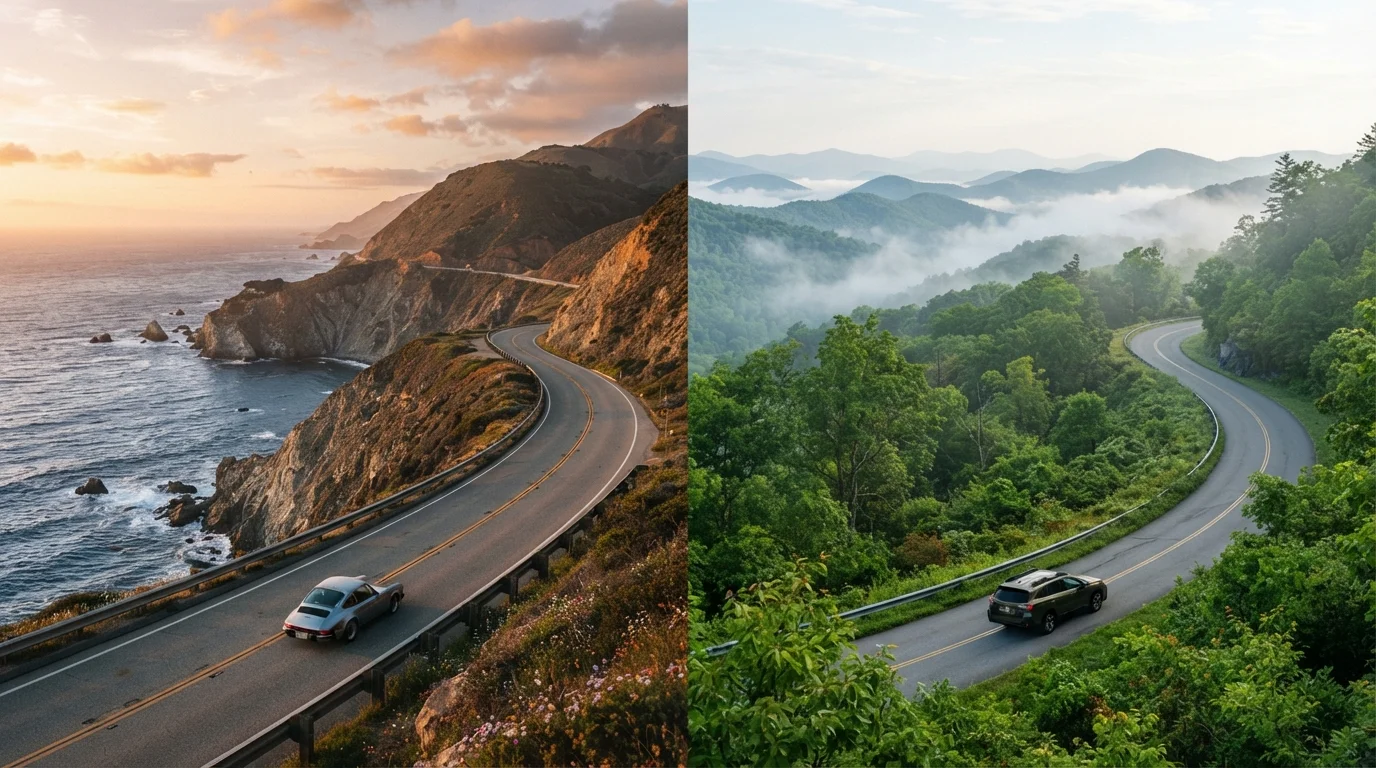
The West Coast's defining characteristic is sheer visual scale. A classic run from Seattle or Portland down to San Diego takes travelers through temperate rainforest, volcanic mountain ranges, rugged Pacific bluffs, Central California farmland, and Mojave-adjacent desert — often within a single multi-day stretch. Pacific Coast Highway (California Route 1) through Big Sur remains one of the most dramatic coastal drives in the country, where cliffs drop hundreds of feet directly into the ocean.
The East Coast offers a different kind of variety. The landscape is greener and more intimate — rolling Appalachian ridges, tidal marshes, dense colonial-era towns, and broad river estuaries. The Blue Ridge Parkway through Virginia and North Carolina delivers genuine mountain beauty with lower traffic than many western parks, while the Outer Banks of North Carolina and Maine's Acadia region provide coastal scenery of a quieter, more understated kind.
Neither landscape is inferior — they simply serve different visual appetites. Travelers seeking cinematic grandeur tend to gravitate west; those who find charm in layered, human-scaled environments often prefer the East.
| Criterion | West Coast Road Trip | East Coast Road Trip |
|---|---|---|
| Primary scenery | Ocean cliffs, redwoods, desert, volcanoes | Appalachian ridges, tidal marshes, colonial towns |
| Typical full-route distance | ~1,500 miles (Seattle to San Diego) | ~1,300 miles (Maine to Miami via I-95) |
| Traffic congestion | Moderate; rural gaps are common | High in major urban corridors |
| Distance between major stops | Often 150–300+ miles | Often 50–150 miles |
| Cultural emphasis | Indigenous heritage, counterculture, Pacific Rim | Colonial, Revolutionary, Civil War history |
| National park access | Very high — Olympic, Redwood, Point Reyes, Big Sur | Moderate — Acadia, Shenandoah, Cape Hatteras |
| Services in rural stretches | Sparse; plan fuel and food ahead | Generally available within short distances |
Driving Distances, Traffic, and Logistics
Geography shapes the logistics of each trip in meaningful ways. A full Pacific Coast route from the Canadian border to the Mexican border covers roughly 1,500 miles. Stretches through rural Northern California and Southern Oregon can go 60 to 100 miles without a gas station or major services — something that requires advance planning, especially for electric vehicles. The driving itself is often slower than the mileage suggests, because coastal roads are winding and scenic speeds reward patience.
The East Coast's I-95 corridor runs approximately 1,300 miles from Maine to Miami, but it passes through some of the most congested urban corridors in the United States. Driving through New York City, Washington D.C., or Philadelphia during peak hours can add hours to an otherwise short leg. Smart East Coast road trippers learn to time their urban transits carefully or route around city centers entirely.
~1,500 mi
Full Pacific Coast route length
A Seattle-to-San Diego drive along the Pacific coast covers roughly 1,500 miles, not counting inland detours to national parks.
Top 5
US cities by traffic congestion on I-95
According to INRIX traffic research, several of the most congested US urban corridors sit directly on the East Coast's primary I-95 road trip route.
12+
National Park units along the Pacific coast
From Olympic National Park in Washington to Channel Islands off Southern California, the West Coast corridor passes near more than a dozen national park units.
For route sequencing and realistic time estimates on either coast, see our road trip route planning guide, which covers how to turn a map into a workable itinerary.
Culture, History, and What You'll Actually Experience
The East Coast carries more than four centuries of densely layered American history in a relatively compact geography. A single trip can move through Plymouth's Pilgrim history, the Revolutionary landmarks of Philadelphia and Boston, the Civil War battlefields of Virginia and Maryland, and the antebellum architecture of Charleston — often within days of each other. Urban cultural institutions — museums, cuisine scenes, music venues — are a constant rather than an occasional find.
The West Coast's cultural texture is different in character. Indigenous history, the legacy of Spanish missions, Gold Rush settlement, counterculture movements, and Pacific Rim culinary influence all leave visible marks. Portland, San Francisco, and Los Angeles each have distinct personalities that feel genuinely unlike cities of the East. And in the stretches between cities, the West offers something the East rarely does: long, quiet miles where the only thing competing for attention is the landscape itself.
Solo travelers in particular may find the infrastructure density of the East Coast reassuring. For an honest look at what solo domestic road travel actually involves, our guide to solo US travel covers the practical realities in detail.
Seasonal Timing Matters on Both Coasts
West Coast road trips along Highway 1 can be affected by fog, landslides, and road closures, particularly in late winter and spring. East Coast travel during summer peak season brings heavy beach traffic and elevated lodging rates along popular corridors. Always verify road conditions and check ahead for seasonal closures before finalizing your route. Official state DOT websites are reliable sources for current road status.