

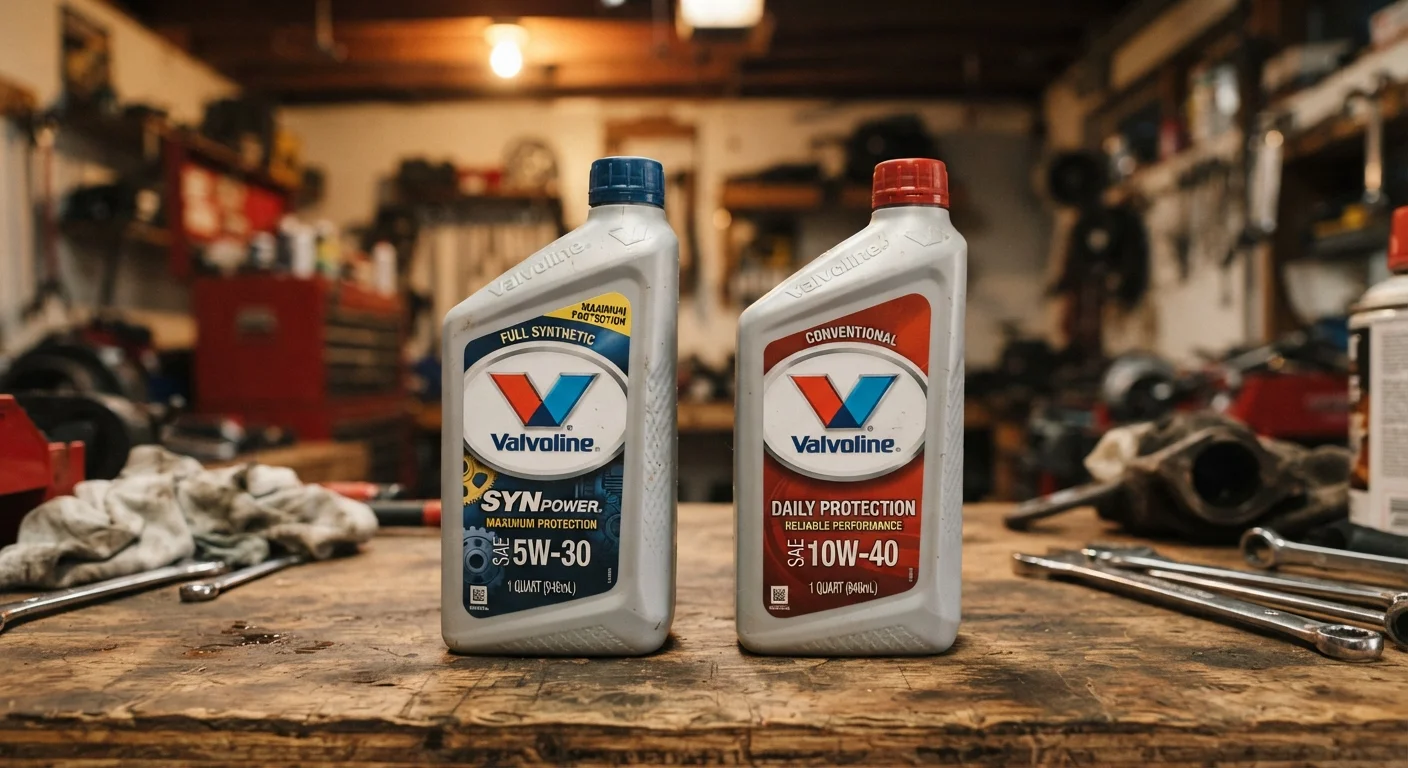
Key Takeaways
Option A
Synthetic Motor Oil
The engineered, high-performance formulation.
Best for: Drivers with newer vehicles, turbocharged engines, or those seeking longer change intervals and better protection in extreme temperatures.
Option B
Conventional Motor Oil
The traditional, widely available standard.
Best for: Owners of older vehicles with simple engine designs and modest driving demands who follow regular change schedules.
If you drive a newer vehicle with a turbocharged or high-output engine
Synthetic Motor Oil
Turbocharged engines run hotter and place greater demands on oil. Synthetic oil's engineered molecular structure handles heat and pressure more reliably.
If you own an older, high-mileage vehicle with simple engine architecture
Conventional Motor Oil
Many older engines were designed and calibrated around conventional oil viscosity characteristics, and switching may not provide meaningful benefit.
If you want longer intervals between oil changes
Synthetic Motor Oil
Synthetic formulations resist breakdown longer, allowing extended drain intervals that many manufacturers now specify - always confirm with your owner's manual.
If you're working with a tight maintenance budget on a straightforward commuter car
Conventional Motor Oil
Conventional oil costs less per quart and performs adequately in engines designed to accept it, provided you follow the recommended change schedule.
How Each Oil Is Made - and Why It Matters
Motor oil's primary job is to lubricate moving metal parts, reduce friction, carry away heat, and suspend contaminants until the next oil change. Both oil types accomplish this, but they start from very different origins.
Conventional motor oil is refined directly from crude petroleum. During refining, engineers remove the most harmful impurities, but the result is still a mix of hydrocarbon molecules of varying shapes and sizes. That molecular inconsistency means the oil behaves somewhat differently depending on temperature and load conditions.
Synthetic motor oil is either built entirely from chemical compounds in a laboratory or uses a heavily processed base stock that starts as petroleum but is restructured at the molecular level. The result is a more uniform molecular chain that maintains its properties more predictably across a wider range of operating conditions - from a cold winter startup to a hot highway run.
This difference in origin is the foundation of nearly every performance gap between the two. For a deeper dive into how viscosity grades factor into both oil types, see our guide to oil grades and intervals.
| Criterion | Synthetic Oil | Conventional Oil |
|---|---|---|
| Base stock origin | Chemically engineered or heavily processed | Refined crude petroleum |
| Cold-start performance | Flows quickly in low temperatures | Thickens more at low temperatures |
| Heat resistance | Resists oxidation and breakdown longer | Breaks down faster under sustained heat |
| Typical change interval | 7,500-15,000 miles (per manufacturer) | 5,000-7,500 miles (per manufacturer) |
| Cost per quart | Generally higher | Generally lower |
| Best engine fit | Turbocharged, modern, high-performance engines | Older, simpler engine designs |
Performance, Longevity, and Real-World Driving Conditions
The practical differences between synthetic and conventional oil show up most clearly in two scenarios: extreme temperatures and extended use.
In cold weather, conventional oil thickens more than synthetic. That sluggishness during a cold start means a brief window where engine parts receive less lubrication - a period when a significant portion of engine wear can occur. Synthetic oil flows more readily at low temperatures, coating components faster.
At the other end of the spectrum, high heat causes conventional oil to break down - a process called oxidation - more quickly than synthetic. This is especially relevant for turbocharged engines, where oil circulates through components running at significantly higher temperatures.
On longevity: conventional oil is typically changed every 3,000-5,000 miles under older guidelines, though many modern conventional-oil-compatible vehicles now specify 5,000-7,500 miles. Synthetic oil, depending on the vehicle and driving conditions, is often rated for 7,500-15,000 miles per interval. However, your owner's manual sets the authoritative interval - not the oil's marketing claims. Our article on oil change myths unpacks why the old 3,000-mile rule no longer applies to most drivers.
~40%
Engine wear that occurs at cold startup
Engineering studies cited by the American Petroleum Institute suggest a significant share of engine wear happens in the seconds after a cold start, before oil fully circulates.
2x-3x
Longer drain intervals with full synthetic
Many automakers specifying full synthetic oil set drain intervals of 10,000-15,000 miles, compared to 5,000-7,500 miles for conventional - check your owner's manual for your vehicle's specific guidance.
Which Oil Does Your Engine Actually Need?
The single most reliable source for this answer is your vehicle's owner's manual. Manufacturers specify an oil viscosity grade (such as 5W-30) and, increasingly, a minimum oil specification standard (such as API SN or ILSAC GF-6). Some automakers explicitly require full synthetic; others approve conventional oil for engines that were designed and toleranced around it.
A few practical guidelines to keep in mind:
- Turbocharged and direct-injection engines almost universally benefit from synthetic oil due to higher operating temperatures and tighter internal tolerances.
- Older vehicles built before synthetic formulations were common may not require the upgrade - though they can generally tolerate it.
- High-mileage formulations exist in both synthetic and conventional categories; these include seal conditioners to address wear-related seepage in older engines.
- Mixing oil types in an emergency is generally safe because both are chemically compatible, but it's not a long-term strategy - drain and refill with the correct oil at the next opportunity.
When Your Manual Says 'Synthetic Blend'
Some vehicles specify a synthetic blend - a mix of synthetic and conventional base stocks. These offer intermediate performance characteristics and cost less than full synthetic. If your owner's manual calls for a blend, using full synthetic is generally acceptable, but verify this with your dealership or a qualified mechanic, as some manufacturers have specific certification requirements. Do not substitute conventional-only oil where a blend or full synthetic is specified.
Ultimately, choosing between synthetic and conventional comes down to what your engine was designed for, your driving patterns, and your maintenance budget. Neither choice is inherently superior for every driver - the right oil is the one your manufacturer specifies for your actual vehicle.