

Key Takeaways
Option A
Zero-Based Budgeting
The detail-oriented method that accounts for every dollar.
Best for: People who want granular control over their spending and are willing to re-plan their budget each pay period.
Option B
Percentage-Based Budgeting
The streamlined framework built on proportional income splits.
Best for: People who prefer a low-maintenance structure that adjusts automatically as income changes.
If you want to cut spending aggressively or pay off debt fast
Zero-Based Budgeting
Forcing every dollar to have a purpose surfaces hidden spending and leaves little room for budget drift, making it highly effective for focused financial goals.
If you have a stable income and want a low-effort system
Percentage-Based Budgeting
Fixed category ratios require minimal monthly setup and scale naturally with your paycheck, reducing decision fatigue.
If your income varies significantly month to month
Percentage-Based Budgeting
Percentage splits self-adjust as income rises or falls, avoiding the need to rebuild a detailed line-item budget every cycle.
If you frequently overspend in specific categories without realizing it
Zero-Based Budgeting
Explicitly pre-assigning amounts to every spending category - including discretionary ones - makes overspending visible before it happens.
How Each Method Works
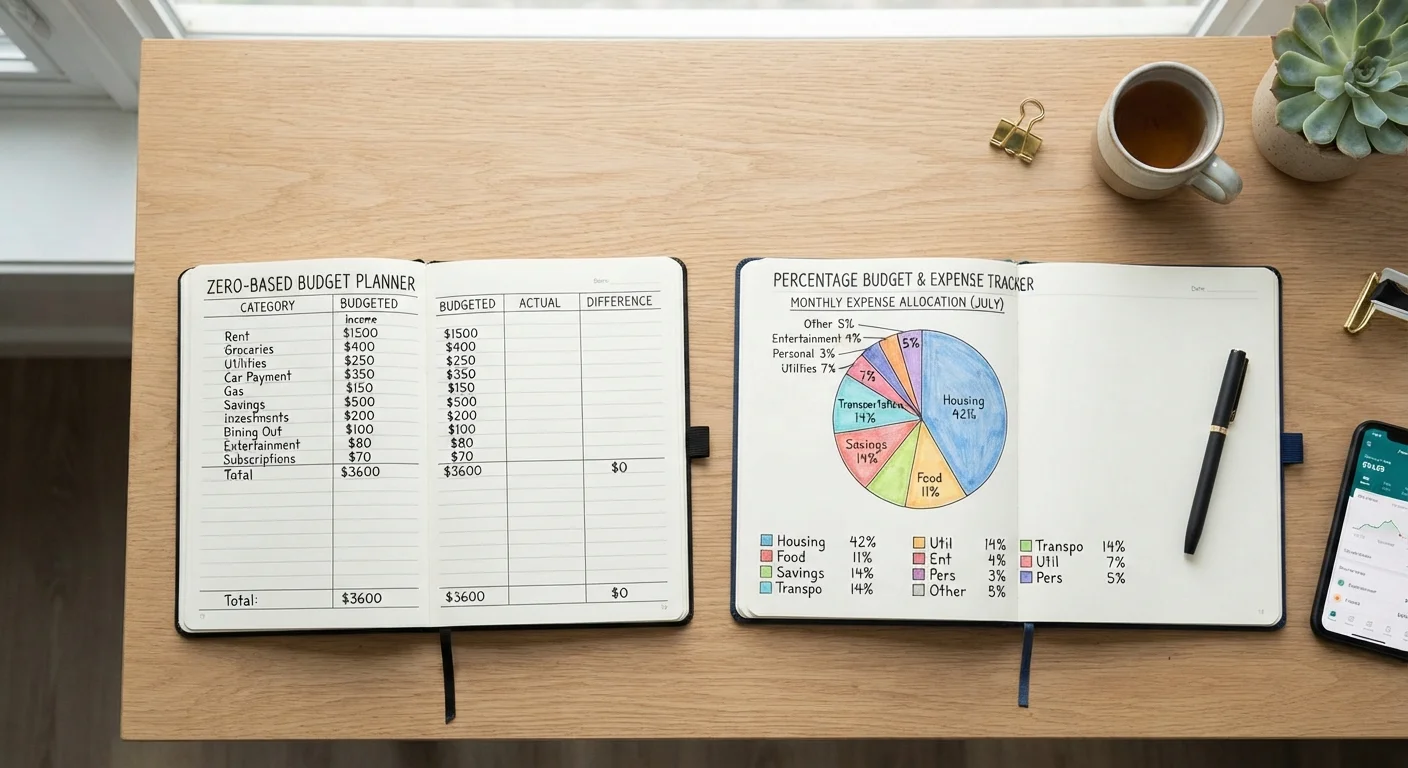
Zero-based budgeting (ZBB) starts with your total monthly income and requires you to allocate every dollar until nothing is left unassigned. If you earn $4,000 a month, you must account for all $4,000 across categories like rent, groceries, transportation, savings, and discretionary spending. The goal is that income minus all allocations equals zero - not because you've spent everything, but because every dollar has been deliberately directed somewhere, including savings and investments.
Percentage-based budgeting takes a different angle. Instead of building a fresh line-item plan, you divide income into predefined proportions. The widely referenced 50/30/20 framework is a common example: 50% of take-home pay toward needs, 30% toward wants, and 20% toward savings or debt repayment. The categories are broad, and the ratios hold regardless of whether you earn $2,500 or $8,000 a month.
Both are tools for intentional spending - they differ in the level of detail and the ongoing effort they demand.
| Criterion | Zero-Based Budgeting | Percentage-Based Budgeting |
|---|---|---|
| Core concept | Every dollar assigned until balance = zero | Income split by fixed category ratios |
| Monthly setup time | High - rebuilt each period | Low - ratios stay constant |
| Spending visibility | Very detailed, line-item level | Broad, category-level |
| Adapts to income changes | Requires full rebuild | Adjusts automatically |
| Best for irregular income | More challenging | More adaptable |
| Ideal for debt payoff | Strong fit | Moderate fit |
| Learning curve | Steeper | Gentler |
Strengths and Trade-Offs
Zero-based budgeting's biggest strength is visibility. When you must assign every dollar, vague categories like "miscellaneous" shrink under scrutiny. This granularity is especially useful when trying to separate needs from wants, a distinction that blurs more than most people expect. The trade-off is time: ZBB requires meaningful effort each pay period to reset and reallocate, which some find unsustainable.
Percentage-based budgeting's main advantage is simplicity and flexibility. Because it uses ratios, it requires no major adjustment when income shifts - you apply the same percentages and move on. The downside is imprecision. Broad category buckets can hide overspending within a category. If "wants" absorbs 30% of income across dozens of sub-categories, you may not notice one area quietly consuming a disproportionate share.
~33%
Americans with a detailed household budget
Gallup polling has consistently found that fewer than one in three Americans maintain a detailed monthly budget, suggesting most rely on informal tracking.
20%
Savings allocation in the 50/30/20 rule
The 50/30/20 framework designates 20% of take-home pay for savings and debt repayment, a proportion financial educators commonly cite as a reasonable starting target.
For those building toward longer-term goals, understanding how budgeting fits into the larger picture - including how surplus funds might be directed toward saving or investing - is worth exploring. See our overview of investing versus saving for context on how those tools differ once a budget creates room for either.
Choosing the Right Fit
The better budgeting method is the one you'll actually maintain. Neither approach guarantees better financial outcomes on its own - implementation and consistency determine results far more than the system chosen.
Consider starting with percentage-based budgeting if you're new to budgeting or have irregular income. It creates structure without demanding precision you may not yet have visibility into. Once you've tracked a few months and identified where money tends to disappear, shifting to a zero-based approach for a defined period - say, while paying down debt or saving for a specific goal like a travel fund - can sharpen your focus considerably.
Some people run a hybrid: broad percentage targets to anchor overall allocations, with zero-based detail applied only to the categories where they historically overspend. There's no rule requiring you to pick one method exclusively.
Hybrid Approaches Are Legitimate
Many budgeters don't use a single method exclusively. Applying percentage targets at a macro level while drilling into zero-based detail for high-risk categories is a practical middle ground. The goal of any budget is sustainable behavior change, not methodological purity. If a hybrid keeps you engaged, it's working.
This article is for general informational and educational purposes only and does not constitute personalized financial advice. Consult a qualified financial professional for guidance tailored to your specific situation.