

Key Takeaways
Option A
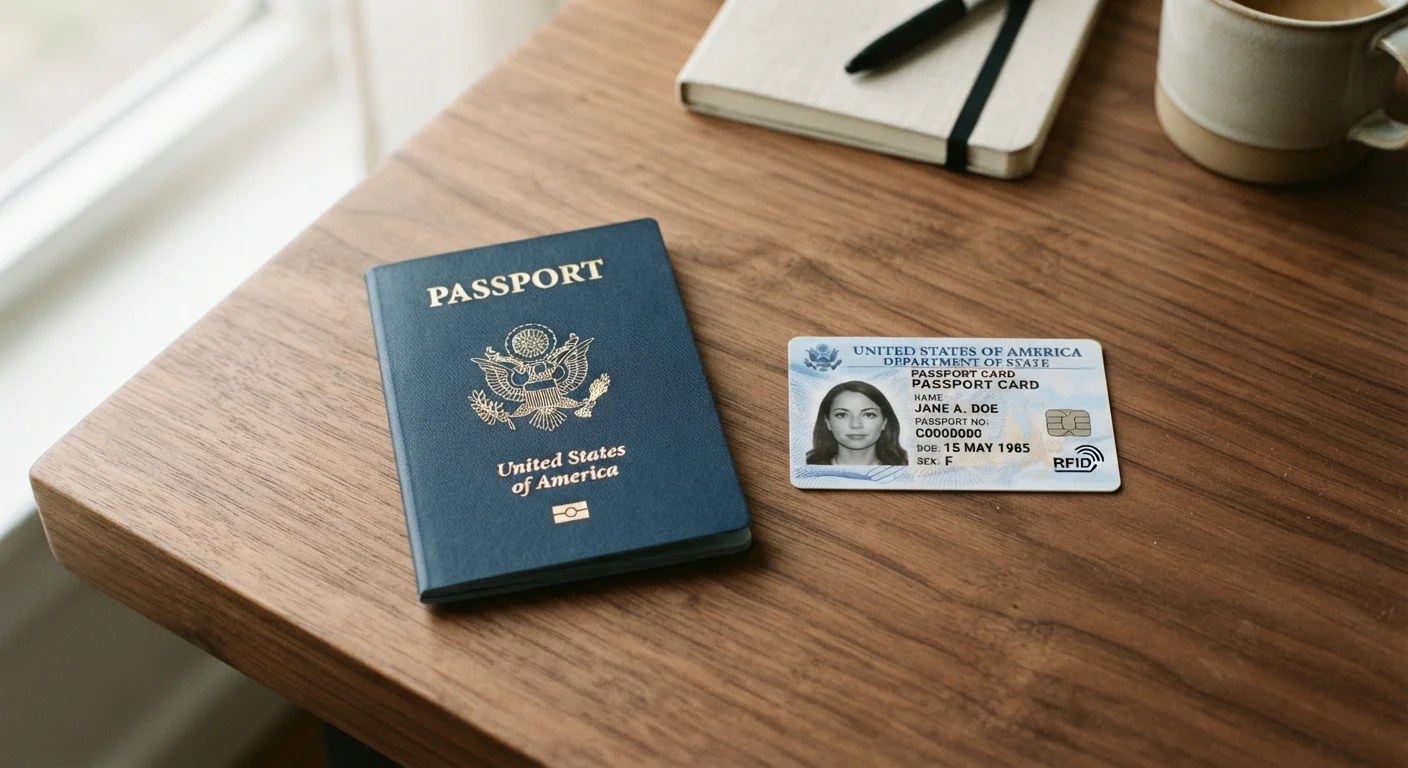
U.S. Passport Book
The comprehensive, universally accepted travel document.
Best for: Anyone traveling internationally by air, or crossing into any country worldwide.
Option B
U.S. Passport Card
The wallet-sized, limited-use alternative for land and sea travel.
Best for: Frequent land-border crossers to Canada, Mexico, and the Caribbean by sea.
If you plan to travel internationally by air at any point
U.S. Passport Book
The passport card is explicitly not valid for international air travel. Only the passport book is accepted at airport immigration worldwide.
If you regularly cross the U.S.-Mexico or U.S.-Canada border by land or sea
U.S. Passport Card
The card is WHTI-compliant for land and sea crossings to Canada, Mexico, Bermuda, and the Caribbean, and it fits conveniently in a wallet.
If you want a single document that covers every travel scenario
U.S. Passport Book
The passport book is the only document that works for air, land, and sea travel to any destination globally — no exceptions.
If you already hold a passport book and want a low-cost backup ID for border commuting
U.S. Passport Card
Adding a passport card as a secondary document is relatively affordable and protects your passport book from daily wear at the border.
What Each Document Actually Is
Both the U.S. passport book and the U.S. passport card are official identity and citizenship documents issued by the U.S. Department of State. They confirm you are a U.S. citizen and allow you to re-enter the United States. That's where the similarities largely end.
The passport book is the traditional 28-page (or 52-page) document most travelers know. It is accepted for entry into virtually every country on earth and is required for all international air travel.
The passport card, introduced in 2008, is the size of a driver's license and uses RFID (radio-frequency identification) technology. It was specifically designed to facilitate faster processing at land and sea ports of entry under the Western Hemisphere Travel Initiative (WHTI). Its use is strictly limited: it is valid only for travel between the United States, Canada, Mexico, Bermuda, and the Caribbean by land or sea. It cannot be used to board an international flight. As common international travel misconceptions illustrate, many travelers assume any valid U.S. document covers any border crossing — that assumption can create real problems.
Side-by-Side Comparison
The table below outlines the key differences across the criteria that matter most to travelers making this decision.
| Criterion | Passport Book | Passport Card |
|---|---|---|
| Valid for international air travel | Yes | No |
| Valid for land border crossings (Canada & Mexico) | Yes | Yes |
| Valid for sea travel to the Caribbean & Bermuda | Yes | Yes |
| Accepted worldwide | Yes | No — limited regions only |
| Adult first-time application fee (approx.) | ~$130 + $35 execution fee | ~$30 + $35 execution fee |
| Physical format | Booklet (28 or 52 pages) | Credit-card size |
| Validity period (adults) | 10 years | 10 years |
| RFID chip | Yes (in cover) | Yes |
Cost figures are subject to change; always check the U.S. Department of State's official fee schedule before applying.
When the Passport Card Falls Short
The card's geographic and modal restrictions are its defining limitation. If your travel plans involve any international flight — even a short hop to a Caribbean island or a connecting flight through a foreign hub — you need a passport book. Airlines will not board you on an international itinerary with only a passport card.
Cruise travelers face a particular nuance here. A closed-loop cruise (one that departs and returns to the same U.S. port) technically allows U.S. citizens to travel with a birth certificate and photo ID, but the passport card is a stronger alternative for sea-only itineraries. However, if the cruise calls at ports that require a passport book, or if an emergency requires you to fly home mid-voyage, only the book will work. Our guide on cruise documentation requirements covers this scenario in detail.
Emergency Travel and Flights Home
One scenario travelers overlook: a medical emergency or trip disruption while on a cruise or at a land-border destination may require flying back to the United States. In that situation, a passport card alone will not get you onto an international flight. Travel planners and the U.S. Department of State generally recommend carrying a passport book as your primary document whenever international travel — even sea-based — is involved.
Should You Get Both?
Many frequent travelers choose to carry both documents. The logic is practical: the passport book stays home or in a hotel safe during day trips across the border, reducing the risk of loss or theft, while the card handles routine land crossings. For border-region residents who commute regularly to Canada or Mexico, the card significantly reduces wear on the passport book.
The added cost of holding both is relatively modest, especially at renewal time when a card can be added to a book application. Neither document, however, substitutes for destination-specific research. Entry requirements — including visas, health documentation, and local regulations — are set by the destination country, not the U.S. government. Always verify current requirements through official government sources well before your departure date.
150M+
Valid U.S. passports in circulation
The U.S. Department of State has reported that more than 150 million valid U.S. passports are in circulation among American citizens.
10 years
Validity period for adults (both documents)
Both the passport book and passport card issued to adults are valid for ten years from the date of issue, after which renewal is required.
~$100
Approximate cost difference (book vs. card)
Based on U.S. Department of State published application fees, the passport book's base fee is roughly $100 more than the passport card for a first-time adult applicant.