

Key Takeaways
Monroney Label (Window Sticker)
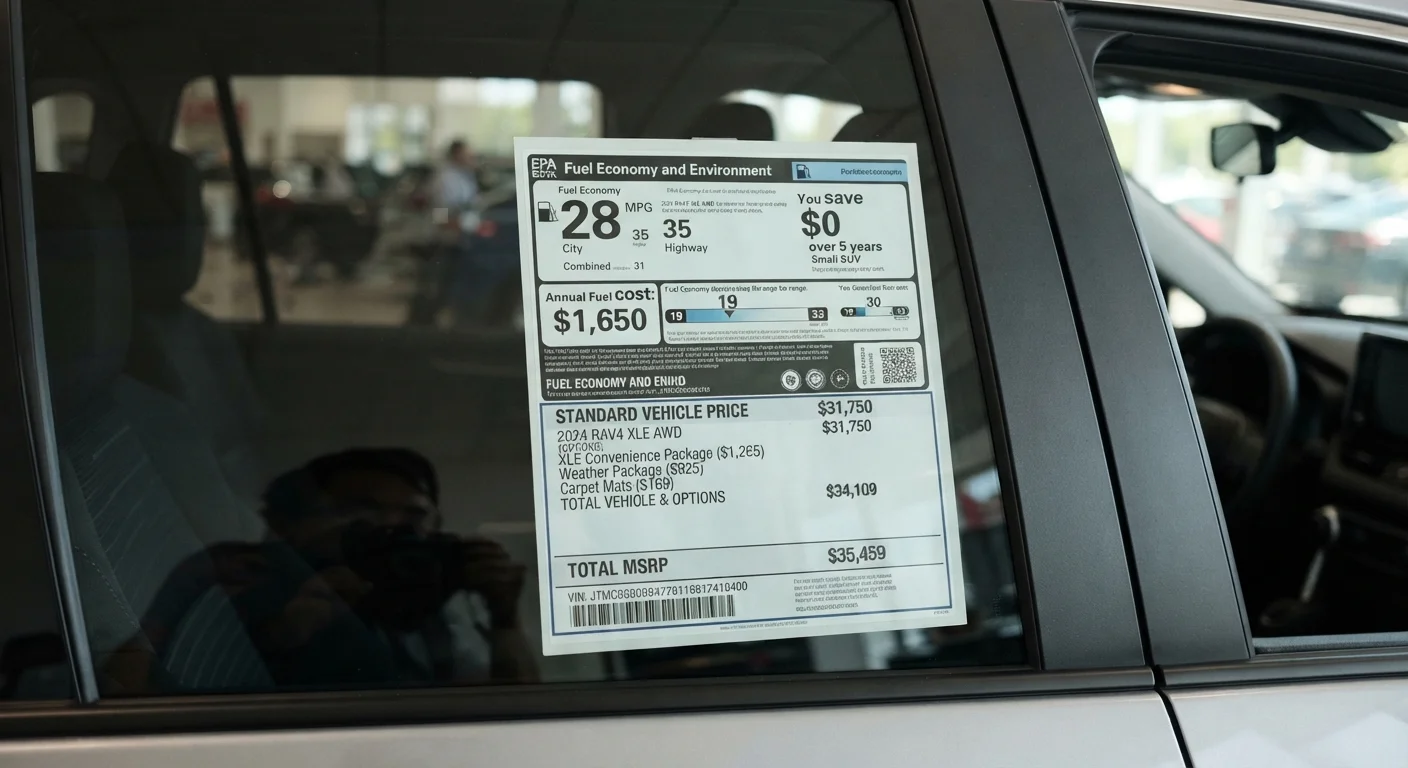
The Monroney label is the federally required sticker affixed to every new car sold in the United States. It discloses the vehicle's manufacturer suggested retail price (MSRP), standard and optional equipment, fuel economy estimates, and safety ratings. By law, only the buyer - not the dealer - can remove it before the sale.
The label is named after Senator Mike Monroney, whose 1958 Automobile Information Disclosure Act mandated it. The EPA and NHTSA each contribute sections of data that appear on the sticker.
Why the Window Sticker Exists
Before 1958, car buyers had little recourse against undisclosed markups or mystery options added at the dealership. The Automobile Information Disclosure Act changed that by requiring every new vehicle to carry a standardized label with consistent, government-overseen information. The result - the Monroney label - is one of the more underappreciated consumer protection tools available to car shoppers.
Understanding what the sticker actually contains helps you make a more informed decision before you sign anything. It also gives you a clearer picture of a vehicle's everyday safety and ownership profile, well beyond what a salesperson's pitch conveys.
Digital Stickers Are Now Common
Many automakers now make Monroney label data available online through a vehicle's VIN. This lets you review full sticker details before visiting a dealership - useful when comparing trim levels or confirming which safety features are standard on a specific model configuration.
Breaking Down the Major Sections
The sticker is divided into several distinct sections, each serving a different purpose:
- Vehicle identification: At the top, you'll find the make, model, trim level, and vehicle identification number (VIN). The VIN is especially useful - you can run it through free government databases to confirm the vehicle's history and check for open recalls.
- Standard and optional equipment: This lists every feature included in the base trim and any packages or individual add-ons selected for this specific vehicle. Cross-reference this carefully against what the dealer verbally describes.
- Fuel economy estimates: The EPA city, highway, and combined MPG figures appear prominently. A cost-to-drive comparison against an average vehicle is usually included. For electric and hybrid vehicles, this section displays MPGe (miles per gallon equivalent) and range estimates.
- MSRP breakdown: The base price, destination and handling charge, and any dealer-installed options are itemized separately, so you can see exactly what's driving the total sticker price.
1958
Year the Monroney Act became law
The Automobile Information Disclosure Act has required standardized window stickers on all new U.S. passenger vehicles for over six decades.
~$800-$1,500
Typical destination charge on the sticker
Destination and handling fees are set by the manufacturer and are non-negotiable; they appear as a fixed line item on the Monroney label.
5 stars
Maximum NHTSA overall safety rating
NHTSA's star rating system, displayed on qualifying vehicles' window stickers, evaluates frontal crash, side crash, and rollover resistance.
Safety Information You Can Extract from the Sticker
For drivers focused on road safety, the sticker is more than a pricing document. Two sections are particularly valuable:
Government crash-test ratings: Where available, NHTSA Overall Safety Ratings - shown as one to five stars - appear on the label. These cover frontal crash, side crash, and rollover resistance. A five-star overall rating indicates strong performance across all categories, though it's worth checking NHTSA's website for the individual sub-scores.
Standard safety technology: Features like automatic emergency braking (AEB), forward collision warning, rearview cameras, and lane departure warning are now required to be listed clearly. Knowing which driver-assistance systems are included as standard - versus only available as paid upgrades - matters for real-world collision avoidance. See our checklist for getting familiar with a new vehicle's controls once you drive it off the lot.
Cross-Reference the VIN for Open Recalls
The VIN printed at the top of the window sticker can be entered into the NHTSA recall database at nhtsa.gov at no cost. This takes about 60 seconds and confirms whether any open safety recalls exist for that specific vehicle before you finalize a purchase.
What the Sticker Doesn't Tell You
The Monroney label is thorough, but it has gaps. IIHS (Insurance Institute for Highway Safety) ratings - which use different tests, including small overlap frontal crashes - are not required on the sticker. A vehicle can carry a five-star NHTSA rating and still have a lower IIHS score in specific categories, or vice versa. Checking both sources gives a more complete safety picture.
The sticker also doesn't reflect long-term reliability, cost of ownership, or how the vehicle will perform with age and miles. For that context, see our piece on what the odometer doesn't tell you about vehicle condition.
Finally, how automakers classify their own vehicles can affect sticker comparisons across brands. A vehicle marketed as a crossover by one manufacturer may share nearly identical specs with another brand's compact SUV. Our explainer on how automakers define their vehicle segments can help put those comparisons in context.
Using the Sticker as a Negotiation and Safety Tool
The window sticker is your baseline for any price conversation. The itemized breakdown reveals which dealer add-ons were applied after factory production - these are often the most negotiable line items. Market-adjustments listed above MSRP are dealer decisions, not manufacturer requirements.
From a safety standpoint, treat the sticker as a pre-purchase audit. Confirm that the specific safety packages you want are listed as included, not just available. If you're relocating and need to understand whether your new state has different inspection or equipment requirements, our guide on what changes when you move to a new state with your car covers those details.
“The window sticker is the one document at the dealership that the law requires to be honest. Treat it as your primary reference point for price, equipment, and safety data - not the sales sheet.”
— Cars & Maintenance Editorial Team, Automotive consumer education writers