

Key Takeaways
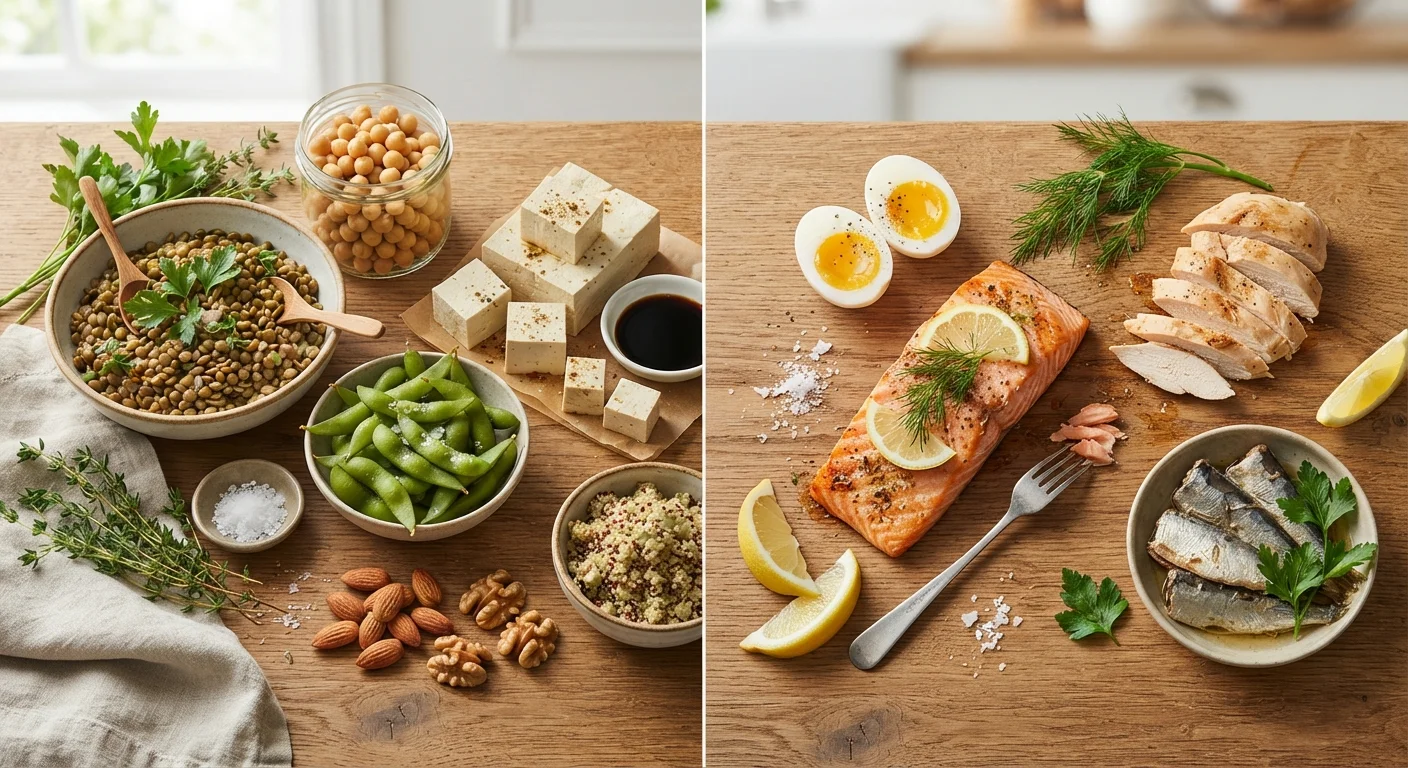
Option A
Plant-Based Protein
The fiber-rich, environmentally lighter protein source.
Best for: People who want to increase protein intake while also gaining dietary fiber, phytonutrients, and reducing saturated fat consumption.
Option B
Animal Protein
The complete, highly bioavailable protein benchmark.
Best for: People seeking the most efficient route to meeting all essential amino acid needs in a single food source, including those with higher protein demands.
If you follow a vegan or vegetarian lifestyle
Plant-Based Protein
A well-planned variety of legumes, soy foods, whole grains, nuts, and seeds can meet protein and amino acid needs without animal products. Attention to vitamin B12 and iron sources is essential.
If you have elevated protein needs, such as older adults or athletes
Animal Protein
Animal proteins offer high bioavailability and complete amino acid profiles, which research links to more efficient muscle protein synthesis — an important factor when protein needs are higher.
If you want to support heart health through diet
Plant-Based Protein
Replacing some animal protein — particularly red and processed meat — with plant sources is associated with favorable cardiovascular outcomes in observational research.
If you want a flexible, balanced approach
Animal Protein
Moderate inclusion of lean animal proteins such as fish, poultry, eggs, and dairy provides reliable nutrient density with relatively low dietary planning effort.
If your priority is gut and metabolic health alongside protein
Plant-Based Protein
Whole-food plant protein sources deliver dietary fiber and phytonutrients that support gut microbiome diversity and metabolic markers, benefits animal proteins do not provide directly.
What Makes a Protein 'Complete' or 'Incomplete'?
Protein is made up of amino acids — the body needs 20 in total, nine of which it cannot manufacture on its own. These nine are called essential amino acids (EAAs). A protein source that contains all nine in adequate proportions is called a complete protein.
Animal proteins — including meat, poultry, fish, eggs, and dairy — are complete proteins. Most plant proteins are not: they contain all nine EAAs but typically in insufficient amounts of one or more, sometimes called the limiting amino acid. Soy (edamame, tofu, tempeh) and quinoa are notable exceptions among plant foods, generally considered nutritionally complete.
This distinction matters for people who rely heavily on a single plant food for protein. However, current evidence supports what dietitians call protein complementation over a day's eating — combining foods such as legumes and whole grains achieves a full EAA profile without requiring careful meal-by-meal pairing. See our guide to building a balanced meal for practical strategies on this.
Protein Complementation: A Day-Long View
Older nutrition guidance suggested pairing complementary proteins at every meal — for example, rice and beans together. Current scientific consensus, reflected in guidance from the Academy of Nutrition and Dietetics, indicates that consuming a varied mix of plant proteins throughout the day is sufficient for the body to pool and use amino acids effectively. Strict per-meal pairing is not considered necessary for healthy adults.
Bioavailability: How Much Protein Your Body Actually Uses
Protein quantity on a food label tells only part of the story. Bioavailability — the proportion of a nutrient that is digested, absorbed, and used by the body — varies considerably between sources.
Nutrition scientists use the DIAAS (Digestible Indispensable Amino Acid Score), the current gold-standard metric endorsed by the Food and Agriculture Organization, to compare protein quality. By this measure, animal proteins such as whey, eggs, and dairy score above 1.0 (excellent), while most plant proteins score below 1.0. Pea protein and whole soy foods tend to score higher among plant options.
Several factors reduce plant protein bioavailability: antinutrients such as phytates and tannins — found in legumes and whole grains — can bind to protein and minerals, partially limiting absorption. Cooking, soaking, and fermenting significantly reduce these compounds, which is one reason why prepared beans or fermented soy foods are nutritionally superior to raw equivalents.
≥1.0
DIAAS score for eggs and dairy
The FAO recognizes DIAAS scores at or above 1.0 as indicating an 'excellent' protein source relative to human requirements.
~0.64
Typical DIAAS for cooked peas
Research published in peer-reviewed nutrition journals places cooked peas among the higher-scoring plant proteins, though still below most animal sources.
~25%
Reduction in digestibility from phytates
Studies indicate antinutrients in raw legumes and grains can reduce protein digestibility by roughly 10–25%; soaking and cooking substantially mitigate this effect.
Beyond Protein: The Nutritional Context of Each Source
Protein rarely travels alone in food. The surrounding nutritional matrix shapes the health implications of each choice.
Animal protein sources commonly deliver vitamin B12, heme iron (the most readily absorbed form), zinc, omega-3 fatty acids (especially from fatty fish), and vitamin D. Many are low in fiber. Red and processed meats also tend to be higher in saturated fat and have been associated with increased colorectal cancer risk in large observational studies, though lean poultry, fish, eggs, and dairy carry a different risk profile.
Plant protein sources bring dietary fiber, a wide array of phytonutrients, folate, and magnesium. They are generally lower in saturated fat. The fiber content specifically supports gut microbiome diversity, which is an active area of research linked to metabolic and immune health. Plant foods do not provide vitamin B12 naturally; anyone relying primarily on plant proteins should discuss B12 status with a healthcare provider. For a fuller picture of nutrient comparisons, our article on whole foods versus processed foods explores how food form affects nutritional value more broadly.
| Criterion | Plant-Based Protein | Animal Protein |
|---|---|---|
| Amino acid completeness | Usually incomplete (soy/quinoa excepted) | Complete in all sources |
| Bioavailability (DIAAS) | Generally lower; varies by food | Generally higher |
| Dietary fiber | Present in whole-food sources | Absent |
| Saturated fat | Typically low | Varies; higher in red/processed meat |
| Vitamin B12 | Not naturally present | Naturally abundant |
| Heme iron | Absent (non-heme iron only) | Present in meat and fish |
| Phytonutrients | Rich, varied | Minimal |
| Omega-3s (EPA/DHA) | Limited (ALA mainly) | Rich in fatty fish |
What Does Current Research Actually Say?
The research landscape is nuanced — and evolving. Large studies such as the EPIC cohort and Harvard's nurse and health professional cohort studies consistently find that dietary patterns matter more than any single protein source. Diets rich in plant proteins are associated with lower rates of type 2 diabetes, heart disease, and certain cancers. However, these outcomes are difficult to separate from the overall dietary context and lifestyle factors of study participants.
For muscle protein synthesis specifically, high-quality protein from animal sources has traditionally been considered more efficient, partly because of DIAAS scores and leucine content. Emerging research suggests that adequate total daily protein from well-planned plant sources can achieve comparable muscle outcomes, though the volume consumed may need to be higher to compensate for lower bioavailability.
If you use protein supplements, it is worth reviewing what supplements can and cannot do alongside whole-food choices. Similarly, understanding what 'high protein' labeling actually means helps decode processed food marketing.
This article is for general informational purposes only and does not constitute medical or dietary advice. Speak with a registered dietitian or qualified healthcare professional before making significant changes to your diet, particularly if you have an existing health condition or are in a special life stage such as pregnancy.