

Key Takeaways
Why the Nutrition Facts Panel Looks the Way It Does
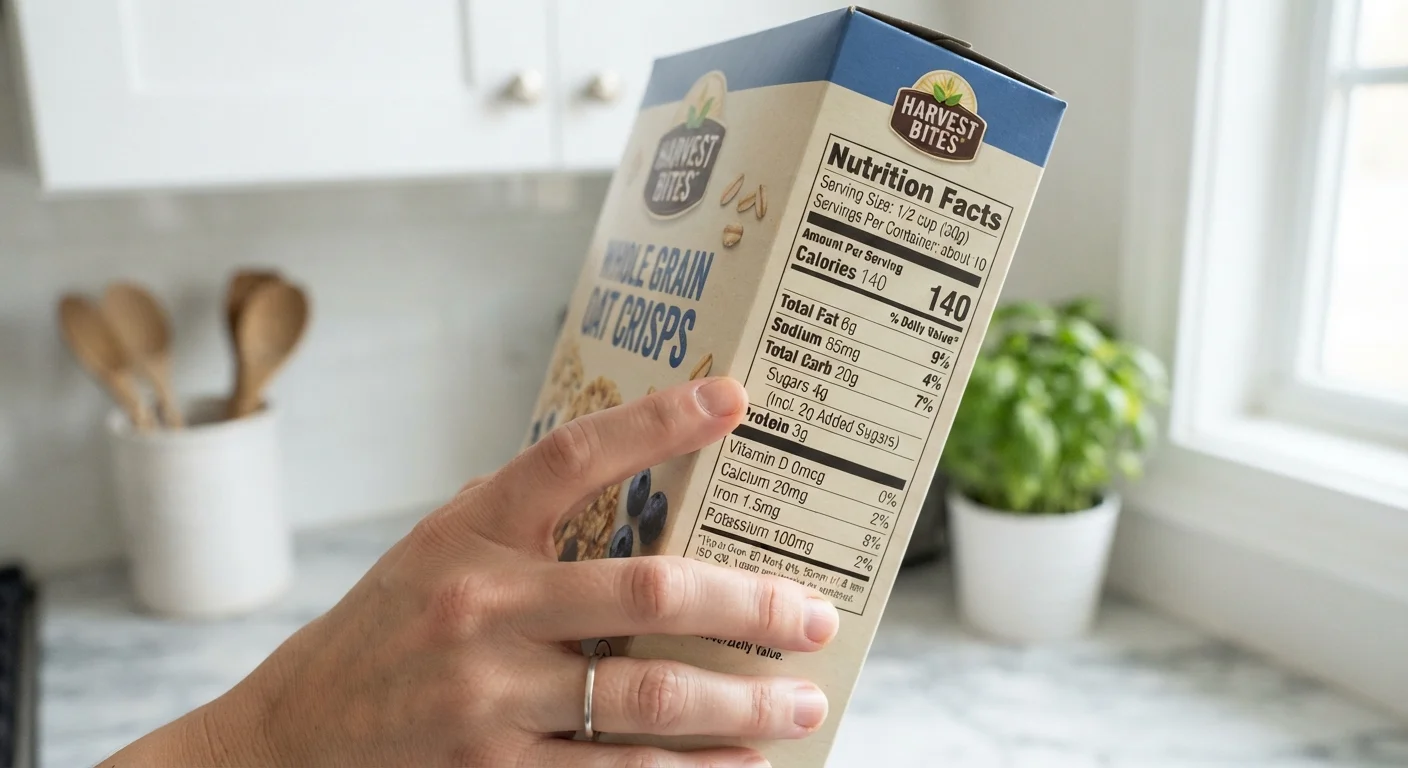
The US Nutrition Facts panel is regulated by the Food and Drug Administration (FDA) and follows a standardized format, which means the layout is identical across virtually every packaged food sold in the country. The current format reflects updates that took full effect in 2021, including a larger calorie display, the addition of added sugars as a separate line, and the updated micronutrient section.
Understanding the logic behind the label — not just the individual numbers — makes it far easier to use. The panel is organized from most calorie-dense information at the top to micronutrients at the bottom. Nutrients generally considered worth limiting (saturated fat, sodium, added sugars) appear toward the upper middle; nutrients many people need more of (fiber, vitamin D, calcium, iron, potassium) anchor the bottom. For a deeper look at how label sections connect to broader meal planning, see our guide on building a nutritionally balanced meal.
US Nutrition Facts Panel
The standardized label mandated by the FDA on most packaged foods — the primary document you will be reading.
FDA's Daily Value Reference Chart
A free online resource from the FDA that lists the Daily Value benchmarks used to calculate % Daily Values on labels.
Step-by-Step: Reading Every Section of the Label
Work through these steps in order the first few times you read a label. With practice, scanning the key figures becomes second nature in under 30 seconds.
What you will need
Start with Serving Size and Servings Per Container
The serving size appears at the very top of the label, directly under the bold 'Nutrition Facts' header. It is listed in a common household measure (such as 2/3 cup) alongside a gram weight. This is the standardized reference amount — every other number on the label applies to this quantity, not the whole package.
Directly below it, 'Servings Per Container' tells you how many of those portions are in the package. If a bag of chips lists a serving size of 1 oz (about 28 g) and contains 3.5 servings, eating the whole bag means multiplying every nutrient figure by 3.5.
Read the Calories
Calories are displayed in the largest, boldest type on the panel — a deliberate design choice by the FDA to make this figure easy to spot. The calorie count reflects one serving as defined above. Calories measure the total energy a food provides from fat, carbohydrates, and protein combined.
Calories alone do not determine whether a food is nutritious, but they are a useful reference point when managing overall energy intake.
Review Total Fat, Saturated Fat, and Trans Fat
Below calories, the label breaks down fat into subcategories. Total fat covers all fat types. Saturated fat is listed separately because high intake is associated with elevated LDL cholesterol in some people. Trans fat — produced industrially through partial hydrogenation — appears on its own line; health authorities generally recommend limiting it as much as possible.
Unsaturated fats (monounsaturated and polyunsaturated) may also be listed, but are not required. These are generally considered more favorable and do not need to be actively limited for most people.
Check Sodium and Cholesterol
Cholesterol and sodium each appear on their own lines. Both include a % Daily Value. The Daily Value for sodium is 2,300 mg per day for most adults — a benchmark established by federal dietary guidelines. Processed and packaged foods are among the leading sources of dietary sodium, so the label figure is worth noting, especially if you consume multiple servings or several packaged foods in a day.
Decode Total Carbohydrate, Dietary Fiber, and Sugars
Total carbohydrate covers all carbs in a serving. Underneath it, dietary fiber and total sugars are indented as subcategories. A further sub-line, added sugars, was introduced in the FDA's updated label format and is particularly useful: it distinguishes sugars naturally present in food (like lactose in milk or fructose in fruit) from sugars added during manufacturing.
The Daily Value for added sugars is 50 g, based on a 2,000-calorie reference diet. Watch for red flags around added sugars, such as multiple sugar-derived ingredients that collectively rank high on the list.
Look at Protein and the Micronutrient Section
Protein is listed next but does not carry a required % Daily Value for most foods. Below a thick dividing line, the label lists four key micronutrients: Vitamin D, Calcium, Iron, and Potassium. These were chosen because they are nutrients many Americans tend to consume in insufficient amounts. Each displays a % Daily Value. The previous label version listed Vitamins A and C; those were removed because deficiency is now rare in the US population.
Understand the % Daily Value Footnote
At the bottom of the panel, a footnote explains that % Daily Values are based on a 2,000-calorie daily diet. Your individual calorie needs may differ depending on your age, size, sex, and activity level. This footnote is a reminder that % DV figures are reference points for comparison — not a personalized prescription. Use them to compare similar products or to gauge how a food fits into a varied diet.
Use the 5% and 20% Rule
A quick mental shortcut from the FDA: 5% Daily Value or less per serving is considered low for a nutrient, while 20% or more is considered high. Use this to quickly gauge whether a food is a significant source of something you want more of — or something you want to limit.
Packages Often Contain Multiple Servings
It is easy to assume a single bottle or bag equals one serving, but many packages contain two or more. If you consume the whole container, multiply every number on the label by the number of servings listed. This single habit prevents the most common calorie and sodium miscalculations readers make.
Labels Are a Reference Tool, Not a Prescription
The Nutrition Facts panel is designed to help you compare foods and make more informed choices — it is not a medical guide to how you personally should eat. Individual nutrient needs vary based on age, health status, activity level, and other factors. Always consult a registered dietitian or qualified healthcare professional for guidance tailored to your specific health situation.
Once you're comfortable reading standard labels, it's worth knowing that the same principles apply to beverages — though serving sizes for drinks have their own quirks. See how to read a nutrition label on a beverage for a drink-specific walkthrough. You may also want to explore what ingredient list ordering reveals about a product, since the label and ingredient list together give the most complete picture of what's in a food.
This article is for general informational purposes only and does not constitute medical or dietary advice. Consult a registered dietitian or qualified healthcare provider for guidance specific to your health needs.