

| Ordering rule | Heaviest ingredient listed first, lightest last (FDA 21 CFR §101.4) |
| Applies to | All packaged foods sold in the US (FDA labeling regulations) |
| Flavor disclosure | Listed as 'natural flavor' or 'artificial flavor' - components not required (FDA 21 CFR §101.22) |
| Compound ingredients | Sub-ingredients disclosed in parentheses after main ingredient (FDA 21 CFR §101.4(b)) |
| Exact percentages | Not required - use Nutrition Facts for gram-level detail (FDA labeling regulations) |
The One Rule That Governs Every Ingredient List
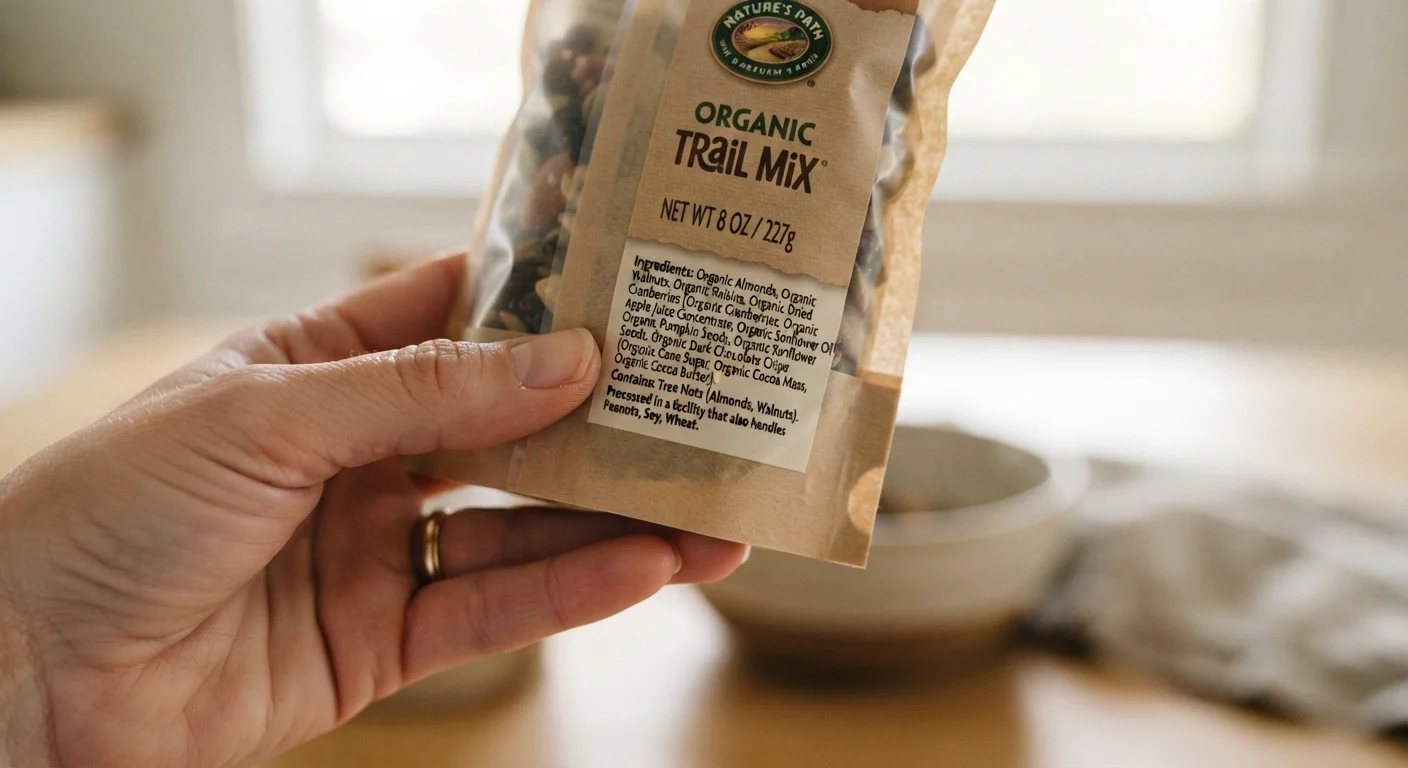
By FDA regulation, every packaged food sold in the United States must list its ingredients in descending order by weight. The ingredient present in the greatest amount comes first; the ingredient present in the least amount comes last. This single rule is the foundation for interpreting any ingredient list you encounter.
That means if a loaf of bread lists enriched wheat flour first and whole wheat flour fifth, most of the bread's weight is refined flour - regardless of what the front-of-package claims suggest. The same logic applies to yogurt, cereal, sauces, and snack foods. Understanding what whole grain means on a bread label helps put this ordering in practical context.
| Ordering rule | Heaviest ingredient listed first, lightest last (FDA 21 CFR §101.4) |
| Applies to | All packaged foods sold in the US (FDA labeling regulations) |
| Flavor disclosure | Listed as 'natural flavor' or 'artificial flavor' - components not required (FDA 21 CFR §101.22) |
| Compound ingredients | Sub-ingredients disclosed in parentheses after main ingredient (FDA 21 CFR §101.4(b)) |
| Exact percentages | Not required - use Nutrition Facts for gram-level detail (FDA labeling regulations) |
How Manufacturers Use Sub-Ingredients and Splitting
Ingredient lists can look cleaner than they are through two common techniques: sub-ingredient disclosure and ingredient splitting.
Sub-ingredients appear in parentheses immediately after the ingredient they belong to. For example: chocolate chips (sugar, cocoa butter, chocolate, vanilla extract). This gives a more complete picture of what a compound ingredient actually contains.
Ingredient splitting occurs when a manufacturer uses several forms of the same ingredient - say, sugar, high-fructose corn syrup, and brown sugar - each in a quantity small enough that none appears at the top of the list individually. Together, those sweeteners may outweigh any other single ingredient, but the ordering rule applies per-ingredient, not per-category. Knowing this, look for multiple names for the same substance clustered across the middle of the list. For a deeper look at how sugar is labeled, see added sugars vs. total sugars on labels.
Descending weight order
The FDA-mandated rule requiring that ingredients be listed from heaviest to lightest by weight per serving or per batch. The first ingredient is always the most abundant.
Sub-ingredient
A component of a compound ingredient, disclosed in parentheses directly after the compound ingredient name. For example, the components of chocolate chips listed within a cookie's ingredient line.
Ingredient splitting
A labeling outcome in which multiple forms of the same substance (e.g., three different sweeteners) are listed separately, each appearing lower in the list than they would if combined into one entry.
Incidental additive
A substance used during food processing that has no functional role in the final product. Under FDA regulations, incidental additives are generally exempt from ingredient list disclosure.
Natural flavor
An FDA-defined term for flavoring derived from plant or animal sources. Manufacturers are not required to disclose the specific compounds within a natural flavor on the ingredient list.
Compound ingredient
A multi-component ingredient used in a food product - such as a sauce or filling - whose own ingredients must be disclosed in parentheses following the ingredient name.
What Position in the List Actually Tells You
Position signals proportion, not quality. An ingredient in slot two could represent 30% of the product's weight or 5% - the list alone doesn't give exact percentages. What it does confirm is relative rank. Use these benchmarks as a practical guide:
- Top three ingredients: These make up the bulk of the product. If water, sugar, or refined flour leads, that's what you're mostly eating.
- Middle of the list: Meaningful contributors but not dominant. Spices, oils, and flavor compounds often land here.
- Last few ingredients: Present in very small amounts - often preservatives, colorings, or micronutrient fortifications. Their impact on overall nutrition is minimal.
This framework pairs well with the Nutrition Facts panel, which confirms quantities like grams of fat, sodium, and sugar that the ingredient list alone cannot provide.
Ingredients That Don't Have to Be Listed
FDA rules include several categories of exemptions that limit how complete any ingredient list can be:
- Incidental additives: Substances that have no technical or functional effect in the finished product - such as processing aids used and then removed - generally do not need to be declared.
- Flavorings: Both natural and artificial flavors can be listed simply as "natural flavor" or "artificial flavor" without disclosing their specific chemical components.
- Colors: Certified color additives must be listed by name (e.g., FD&C Red No. 40), but colors derived from natural sources may be listed more broadly.
This is why the ingredient list, while essential, is most powerful when read alongside the Nutrition Facts panel and any allergen statements. Nutrition label red flags worth paying attention to covers additional ways packaging language can obscure what's actually inside a product.
#1
Position = largest ingredient by weight
FDA regulations require the heaviest ingredient to appear first on every US packaged food label.
3+
Common names for added sugar on labels
Consumers may encounter high-fructose corn syrup, dextrose, maltose, cane juice, and other terms across a single ingredient list, each counted separately in weight order.