

Key Takeaways
Genuine convenience for daily household tasks
Voice-controlled devices let users set timers, play media, control lighting, and check information hands-free — a real time-saver in busy households.
Energy efficiency through smart scheduling
Connected thermostats can learn occupancy patterns and reduce heating and cooling when a home is empty, which can contribute to lower energy use over time.
Remote monitoring adds practical security
Video doorbells and connected locks let residents see who's at the door or verify package delivery from anywhere, which has clear practical value.
Integration improves over time with use
Smart home ecosystems become more useful as devices learn preferences and routines, reducing the manual effort needed to manage home environments.
Always-on microphones create persistent listening risk
Even with wake-word activation, voice-enabled devices are in a continuous listening state, and false activations that capture unintended audio are a documented occurrence across major platforms.
Privacy policies change after purchase
Manufacturers can update data-sharing terms post-sale, and continued device use typically constitutes acceptance. Users have limited leverage once a device is installed.
Third-party data sharing is often broad
Smart device data — including usage patterns, voice interactions, and behavioral signals — may be shared with advertising partners, analytics firms, or cloud infrastructure providers under terms most users never review.
Security vulnerabilities can expose home networks
Poorly maintained or infrequently updated smart devices can serve as entry points for broader network intrusion. A compromised device on the same network as computers or phones creates real risk.
Data deletion is incomplete and inconsistent
Deleting stored voice clips or usage history through an app doesn't guarantee removal from all backup or analytics systems; retention practices vary widely and are not always transparent.
Our Verdict
Smart home devices deliver genuine convenience and efficiency, but they come packaged with real, ongoing privacy trade-offs. The risks are manageable — but only for users who actively engage with privacy settings rather than accepting defaults. Passive ownership carries the greatest exposure.
Best suited to users who are comfortable reviewing privacy dashboards, adjusting data-sharing settings, and keeping device firmware current.
What Smart Home Devices Actually Collect
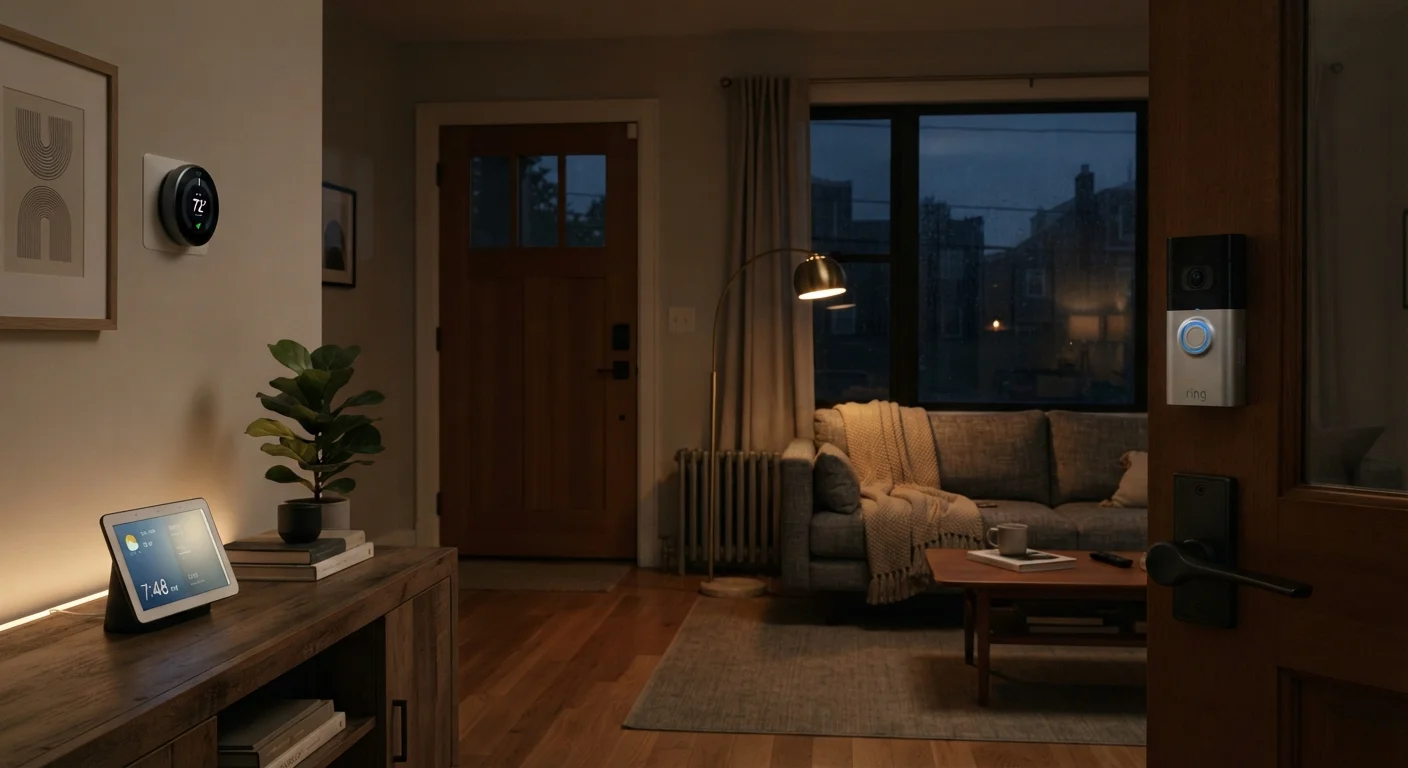
Smart speakers, video doorbells, connected thermostats, and similar devices are designed to be always-on and context-aware. That design requires data — and quite a lot of it.
Voice-activated speakers process audio input locally or in the cloud, depending on the device. Most major platforms use a wake word to trigger recording, but short audio clips before and after the trigger are sometimes captured and stored on manufacturer servers. Thermostats log your temperature preferences, schedule patterns, and occupancy behavior. Doorbells record video continuously or in motion-triggered bursts, often storing footage in manufacturer-operated cloud storage.
Beyond device-specific data, smart home ecosystems frequently link to your account, your phone's location, and third-party integrations. That means a single smart home hub can aggregate data from a dozen connected services. For a broader grounding in how consumer gadgets work under the hood, see our field guide to everyday gadgets.
Local vs. Cloud Processing: A Key Distinction
Some smart devices process commands entirely on-device, meaning audio or sensor data never leaves your home. Others route everything through manufacturer cloud servers for processing and storage. This distinction matters: cloud-dependent devices create a persistent data record even when they're working normally. Check the device specifications or support documentation to understand which model applies to a given product.
The Pros: Why People Welcome These Devices Anyway
Privacy concerns aside, smart home devices solve real problems and earn their place in millions of households for legitimate reasons.
Genuine convenience for daily household tasks
Voice-controlled devices let users set timers, play media, control lighting, and check information hands-free — a real time-saver in busy households.
Energy efficiency through smart scheduling
Connected thermostats can learn occupancy patterns and reduce heating and cooling when a home is empty, which can contribute to lower energy use over time.
Remote monitoring adds practical security
Video doorbells and connected locks let residents see who's at the door or verify package delivery from anywhere, which has clear practical value.
Integration improves over time with use
Smart home ecosystems become more useful as devices learn preferences and routines, reducing the manual effort needed to manage home environments.
The Cons: Privacy Trade-Offs That Rarely Get Discussed
The data practices behind smart devices are disclosed — technically — but buried in lengthy privacy policies that almost no one reads before plugging in a device. That gap between disclosure and awareness is where most of the risk lives.
Always-on microphones create persistent listening risk
Even with wake-word activation, voice-enabled devices are in a continuous listening state, and false activations that capture unintended audio are a documented occurrence across major platforms.
Privacy policies change after purchase
Manufacturers can update data-sharing terms post-sale, and continued device use typically constitutes acceptance. Users have limited leverage once a device is installed.
Third-party data sharing is often broad
Smart device data — including usage patterns, voice interactions, and behavioral signals — may be shared with advertising partners, analytics firms, or cloud infrastructure providers under terms most users never review.
Security vulnerabilities can expose home networks
Poorly maintained or infrequently updated smart devices can serve as entry points for broader network intrusion. A compromised device on the same network as computers or phones creates real risk.
Data deletion is incomplete and inconsistent
Deleting stored voice clips or usage history through an app doesn't guarantee removal from all backup or analytics systems; retention practices vary widely and are not always transparent.
81%
US adults concerned about company data collection
According to Pew Research Center survey data, a large majority of Americans feel they have little control over data collected by companies, including device manufacturers.
~1 in 5
Smart speaker owners who reviewed the privacy policy
Industry research has consistently found that a small minority of smart device purchasers read associated privacy documentation before activating a device.
What You Can Control (and What You Can't)
Manufacturers do provide privacy tools, though they vary significantly in scope and transparency. Most platforms offer a voice history dashboard where you can review and delete stored audio clips. Many devices include a physical microphone mute button — a hardware switch that cuts the mic circuit regardless of software state, which is generally more trustworthy than a software mute.
Data sharing with third-party advertisers can often be limited through account privacy settings, though opting out of all sharing may reduce device functionality. Firmware updates should be applied promptly; they frequently contain security patches that close known vulnerabilities.
One of the highest-impact steps is network-level protection. A properly secured home Wi-Fi network limits the ability of compromised devices to expose broader household data. The practical walkthrough on securing your home network covers the specific steps worth taking, from enabling WPA3 encryption to isolating smart devices on a guest network.
What you largely cannot control: whether manufacturers change their data policies post-purchase, what data is shared with cloud infrastructure partners, or how data is handled in response to lawful government requests. Understanding what app permissions actually mean is also relevant here, since companion apps for smart devices often request broad access to your phone.
Making an Informed Decision Before You Connect
The most useful moment to think about privacy is before a device joins your network, not after. A few questions worth answering upfront: Does the device need cloud connectivity to function, or can it operate locally? Does the companion app request permissions unrelated to its core function? Is the manufacturer transparent about data retention periods and third-party sharing?
Reviewing the device's privacy policy — at minimum the sections on data sharing and retention — takes about ten minutes and surfaces the material trade-offs. If the policy is vague about who receives your data or how long it's stored, that's a meaningful signal.
Smart home privacy isn't an all-or-nothing issue. Selective adoption — choosing categories of devices that match your comfort level and configuring each carefully — is a reasonable middle path. The Internet & Connectivity hub covers additional context on how network-level decisions interact with device security.