

Key Takeaways
Summary
24 items · 30-90 minutes per seasonal check
Why Seasonal Checks Matter More Than a Single Annual Service
A single annual service visit is a solid baseline, but it doesn't account for the shifting demands each season places on your vehicle. Cold winters tax your battery and thicken your engine oil. Hot summers stress your cooling system and accelerate tire wear. Spring and fall are transition points where problems from the previous season often surface.
Running a short, focused checklist four times a year gives you a consistent rhythm - and it keeps small issues from compounding into expensive failures. For a broader view of how maintenance fits into your overall costs, see how to build a realistic annual ownership budget.
Before you start, pull out your owner's manual. It contains the manufacturer-recommended service intervals specific to your vehicle - the single most reliable source for your car's needs. Our guide on reading the maintenance schedule section of your owner's manual explains exactly how to use it.
Tire Pressure Gauge
Used to check and verify tire inflation across all four tires each season.
Coolant/Antifreeze Tester
Measures freeze-protection level in your coolant reservoir before winter sets in.
Flashlight or Work Light
Helps you inspect belts, hoses, undercarriage, and fluid reservoirs in low-light conditions.
Tread Depth Gauge
Accurately measures remaining tire tread depth to determine if replacement is needed.
Battery Load Tester
Tests whether your battery can hold a charge under simulated load - often available at auto parts stores for free.
Owner's Manual
Provides manufacturer-specific service intervals, fluid specifications, and capacity information for your exact vehicle.
The Four-Season Checklist
Work through the groups below at the start of each season. Items marked must are non-negotiable for safe operation. Should items are strongly recommended. Nice-to-have items improve comfort and long-term reliability but can be deferred if time is limited.
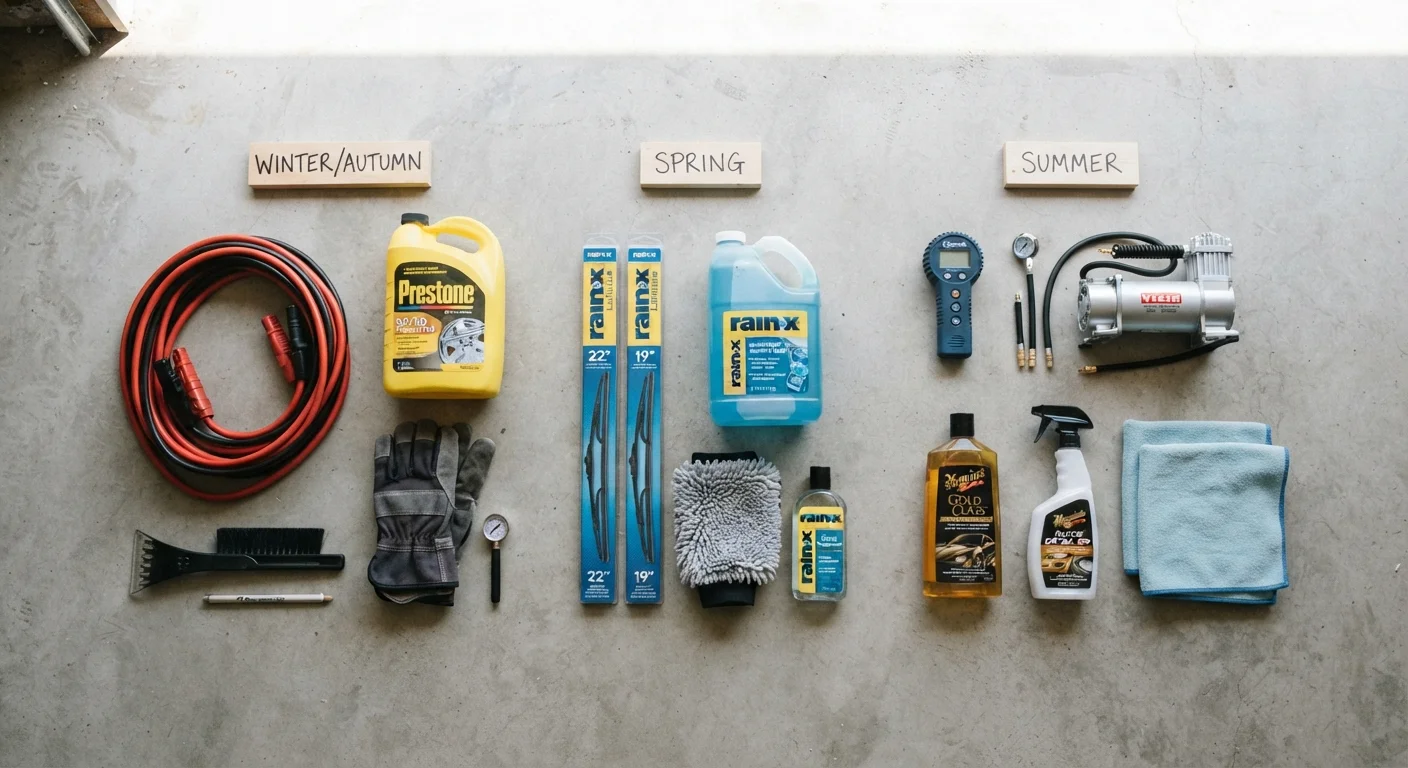
Winter Preparation (Late Fall)
Spring Recovery (Early Spring)
Summer Readiness (Late Spring)
Fall Reset (Early Fall)
Tire Pressure Changes With Temperature
Tire pressure drops roughly 1 PSI for every 10°F decrease in ambient temperature, and rises similarly in heat. A tire that reads correctly in fall may be underinflated by spring or overinflated by midsummer. Check pressure when the tires are cold - ideally before the vehicle has been driven - for the most accurate reading. Refer to your door jamb sticker or owner's manual for the correct PSI, not the maximum number printed on the tire sidewall.
For a deeper dive on one of the most commonly neglected areas, see our complete tire maintenance guide, which covers pressure checks, tread depth reading, and rotation schedules.
What You Can Do Yourself - and When to Call a Pro
Many items on this checklist - checking fluid levels, inspecting wiper blades, testing exterior lights - are safe and straightforward for most drivers. Others, such as load-testing a battery or inspecting brake pad thickness, require tools or expertise that make a shop visit the smarter choice.
Our guide to DIY car maintenance tasks that are safe to handle at home lays out a clear line between what you can tackle confidently and what's best left to a qualified mechanic. When in doubt, err toward the shop - the cost of a professional inspection is almost always less than the cost of a repair caused by an overlooked problem.
Whatever work is done - DIY or professional - record it. A well-kept maintenance log helps you stay on schedule, spot recurring issues, and demonstrate care history if you sell the vehicle.
Brake Concerns Require Immediate Attention
If you notice grinding noises, a pulsating pedal, or significantly increased stopping distances at any point during the year, do not wait for a seasonal check. Have the braking system inspected by a qualified mechanic as soon as possible. Brakes are a primary safety system, and driving on compromised brakes puts both you and others at risk. See what your dashboard warning lights mean for other symptoms that demand prompt attention.
This article provides general vehicle maintenance information for educational purposes. Always consult a qualified mechanic for diagnosis, repair decisions, or when uncertain about a task's safety.