

Key Takeaways
Why Tires Are Your Car's Most Critical Safety Component
Every braking, steering, and acceleration input your car makes passes through four palm-sized contact patches — the points where each tire touches the road. No other system depends so directly on those patches staying in good condition. Yet tire maintenance is among the most neglected aspects of everyday ownership.
Underinflated tires overheat and can fail suddenly at highway speeds. Worn tread can't channel water away fast enough, dramatically increasing hydroplaning risk. Misaligned or unbalanced tires cause premature wear that shortens tire life by tens of thousands of miles. The good news is that the basic checks require no special tools and only a few minutes.
This guide walks through everything a general driver needs to know — from reading a pressure gauge to interpreting wear patterns — so you can stay ahead of problems before they become expensive or dangerous. For a broader view of what to inspect at each change of season, see our seasonal car care checklist.
Checking and Maintaining Tire Pressure
Tire pressure is measured in PSI (pounds per square inch). The correct PSI for your vehicle is printed on a sticker inside the driver's door jamb — not on the tire sidewall, which shows the maximum pressure the tire can hold, not the recommended operating pressure.
How to Check Pressure Correctly
- Check tires when they are cold — meaning the car has been parked for at least three hours or driven fewer than one mile. Driving heats air inside the tire, which artificially raises the reading.
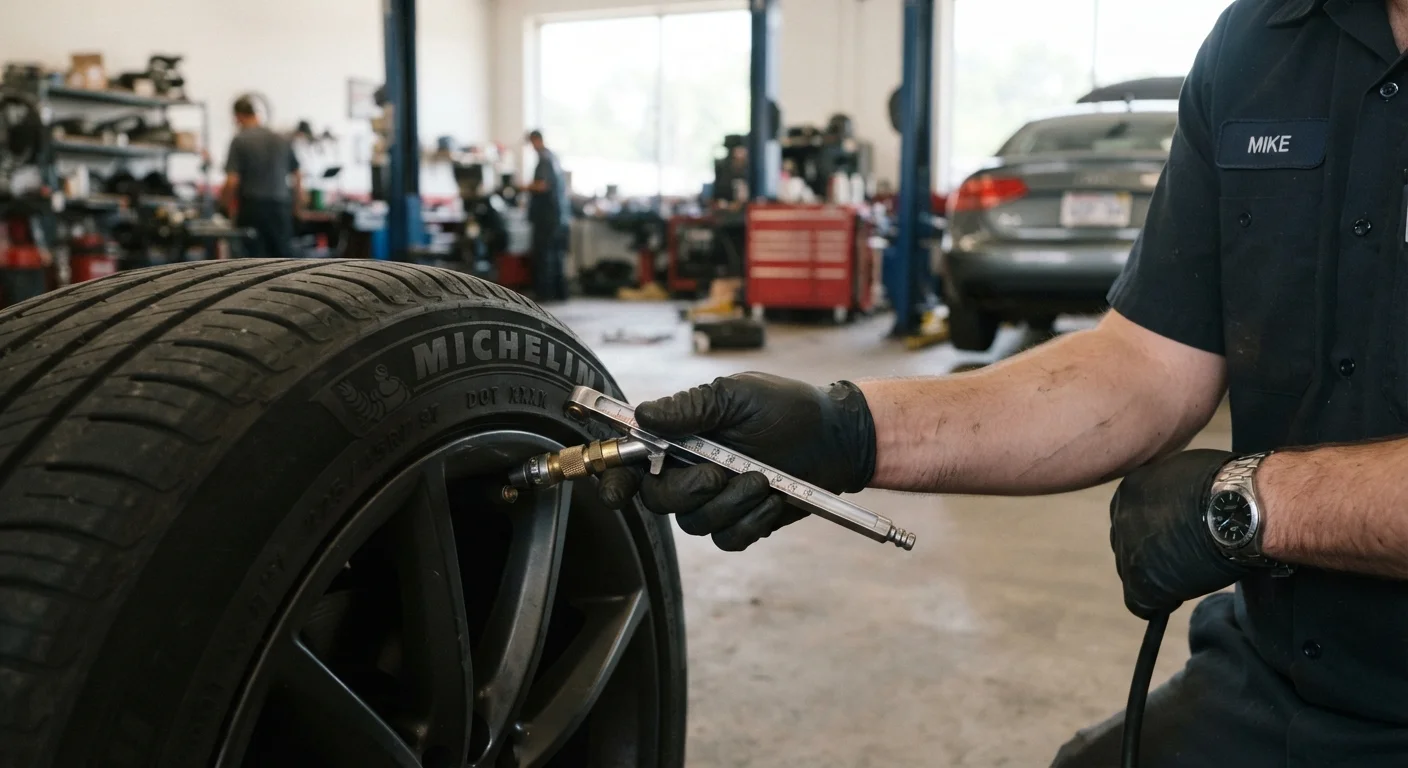
- Remove the valve stem cap and press a quality dial or digital gauge firmly onto the valve.
- Compare the reading to the door jamb specification. Add or release air as needed.
- Replace the valve cap snugly to keep out dirt and moisture.
Check the Spare — It's Easy to Forget
Pull your spare out and check its pressure at least twice a year. Most compact spare tires (also called 'donuts') require 60 PSI — much higher than regular tires. A flat spare discovered roadside is a stressful, avoidable situation.
Check all four tires plus the spare. A neglected spare that's flat when you need it is a common and avoidable problem.
~1 PSI
Pressure drop per 10°F temperature decrease
This is a widely cited rule of thumb from tire industry guidance, meaning seasonal changes can affect inflation without any puncture or leak.
4/32"
Recommended minimum tread depth for wet roads
Many tire safety organizations suggest replacing tires at 4/32" rather than waiting for the 2/32" legal minimum, due to reduced wet-weather braking performance.
5,000–7,500 mi
Typical tire rotation interval
This interval is commonly recommended by tire manufacturers and automotive industry sources; always confirm with your vehicle's owner's manual.
Reading Tread Depth and Knowing When to Replace
Tread depth is measured in 32nds of an inch. New passenger tires typically start at 10/32" to 11/32". U.S. law requires replacement at 2/32", but many safety experts and tire manufacturers recommend replacing tires at 4/32" — especially in wet climates — because wet-braking performance drops significantly before the legal minimum is reached.
The Penny and Quarter Tests
- Quarter test (4/32"): Insert a quarter into a tread groove with Washington's head pointing down. If you can see the top of his head, you're at or below 4/32" — consider replacement.
- Penny test (2/32"): Insert a penny with Lincoln's head pointing down. If you can see the top of Lincoln's head, the tire is at or below the legal minimum and should be replaced immediately.
Most modern tires also have built-in tread wear indicators — small rubber bars molded into the grooves at 2/32". When these bars are flush with the surrounding tread, replacement is urgent.
Always carry a quality dial or digital gauge in your glove box — gas station gauges mounted on hoses are often inaccurate from repeated drops and exposure. A $10–$15 gauge of your own removes that variable entirely.
Accurate pressure readings depend on the gauge itself. A compromised gauge can leave you thinking tires are properly inflated when they aren't.
When you find one tire consistently losing pressure faster than the others, have it inspected even if you can't see an obvious puncture — slow leaks from valve stem deterioration or a bead-seal issue are easy to miss and easy to fix early.
Chronic slow leaks are a common cause of roadside blowouts when drivers assume the tire simply needed a top-off rather than investigation.
Tire Rotation: Schedule and Method
Tires wear at different rates depending on their position. Front tires on front-wheel-drive vehicles, for example, handle both steering and power delivery, so they wear faster than rears. Regular rotation distributes wear evenly, extending the usable life of the full set.
Recommended Intervals
Most manufacturers and tire industry guidance suggests rotating tires every 5,000 to 7,500 miles. A convenient habit is to rotate with every oil change if you're on a 5,000-mile oil change schedule. Your owner's manual contains the manufacturer's specific recommendation — see our guide on reading your owner's manual maintenance schedule for help finding that section.
Common Rotation Patterns
| Drivetrain | Pattern |
|---|---|
| FWD | Forward cross (rears move straight forward; fronts cross to rear) |
| RWD / AWD | Rearward cross (fronts move straight back; rears cross to front) |
| Directional tires | Front-to-rear same side only (tread pattern can't be reversed) |
If you're comfortable with a floor jack and jack stands, rotation is a task many drivers can learn to do safely at home. For guidance on which DIY jobs are appropriate for your skill level, see DIY car maintenance: knowing which tasks are safe.
“Tires are the one component on every vehicle that simultaneously affects safety, fuel economy, comfort, and performance — yet they're inspected the least often by the average driver.”
— Tire Industry Association, U.S. tire industry trade organization representing tire manufacturers, retailers, and installers
Spotting and Diagnosing Uneven Wear Patterns
The way a tire wears tells a story about what's wrong with the vehicle — or how it's being driven. Learning to read these patterns can help you catch alignment and suspension problems early.
Sidewall Bulges Require Immediate Attention
A bulge or bubble on a tire's sidewall means the internal structure has been compromised — typically from a hard impact with a pothole or curb. This type of damage cannot be repaired. Continue driving on a bulged tire and it may fail without warning. Have the vehicle inspected by a qualified tire professional as soon as possible.
Common Wear Patterns and Their Causes
- Center wear
- Tread worn primarily in the middle — classic sign of chronic overinflation. The tire bulges in the center and contacts only that portion of the road.
- Edge wear (both shoulders)
- Wear on both outer edges with a raised center indicates underinflation. The tire flattens out, loading the shoulders instead of the full tread.
- One-sided (inner or outer) wear
- Wear concentrated on one shoulder points to an alignment problem, typically camber misalignment. This requires a professional alignment service.
- Cupping or scalloping
- A wavy, dipped pattern around the tire's circumference usually means worn or loose suspension components — shocks, struts, or wheel bearings — that allow the wheel to bounce rather than roll smoothly.
- Flat spots
- Localized smooth patches are usually caused by hard or prolonged braking, or sitting in one position for extended periods.
For vehicles with high mileage, worn suspension components can accelerate tire wear in ways that aren't obvious from the odometer alone. Our article on high-mileage vehicles and road safety covers what to watch beyond the numbers.
Seasonal Considerations and Long-Term Tire Care
Temperature directly affects tire pressure. For every 10°F drop in ambient temperature, tire pressure typically falls by approximately 1 PSI. This means tires that were correctly inflated in summer may be underinflated by several PSI once winter arrives — without any air loss at all. Check pressure at the start of each season as a minimum.
Winter vs. All-Season vs. Summer Tires
All-season tires are designed for moderate year-round use and are the standard fitment on most passenger vehicles. In regions with sustained snow and ice, dedicated winter tires (sometimes called snow tires) offer significantly better grip at low temperatures because of their tread compounds and patterns. Summer performance tires, by contrast, lose flexibility and traction in cold weather and should not be used in freezing conditions.
Long-Term Care Habits
- Avoid hard acceleration and abrupt braking — both accelerate tread wear.
- Keep tires balanced; vibration through the steering wheel above 50 mph often signals an out-of-balance wheel.
- Inspect tires visually before long trips — look for sidewall bulges, cracks, or embedded objects.
- Store spare tires and off-season sets in a cool, dry place away from direct sunlight and ozone sources (like electric motors).
Incorporating these tire checks into a broader maintenance routine is straightforward. Our seasonal car care checklist provides a full framework for staying on top of every vehicle system throughout the year.
Understanding how your brakes interact with tire condition is equally important — poorly maintained tires lengthen stopping distances regardless of brake quality. See our explainer on how brake pads, rotors, and calipers work for the full picture.