

| AEB Mandated by NHTSA | Required on new passenger vehicles starting model year 2029 (NHTSA final rule, 2024) |
| Voluntary AEB Commitment | 20 major automakers agreed to make AEB standard ahead of regulation (NHTSA / IIHS joint announcement) |
| Features Often Trim-Locked | Blind-spot monitoring, adaptive cruise, lane-centering (General industry pattern across multiple manufacturers) |
| IIHS Top Safety Pick+ Requirement | Vehicles must have acceptable or good AEB ratings to qualify (IIHS evaluation criteria) |
| SAE Automation Levels | Most production vehicles operate at Level 1-2 (driver assistance, not autonomy) (SAE International J3016 standard) |
Why Driver-Assist Coverage Isn't Uniform
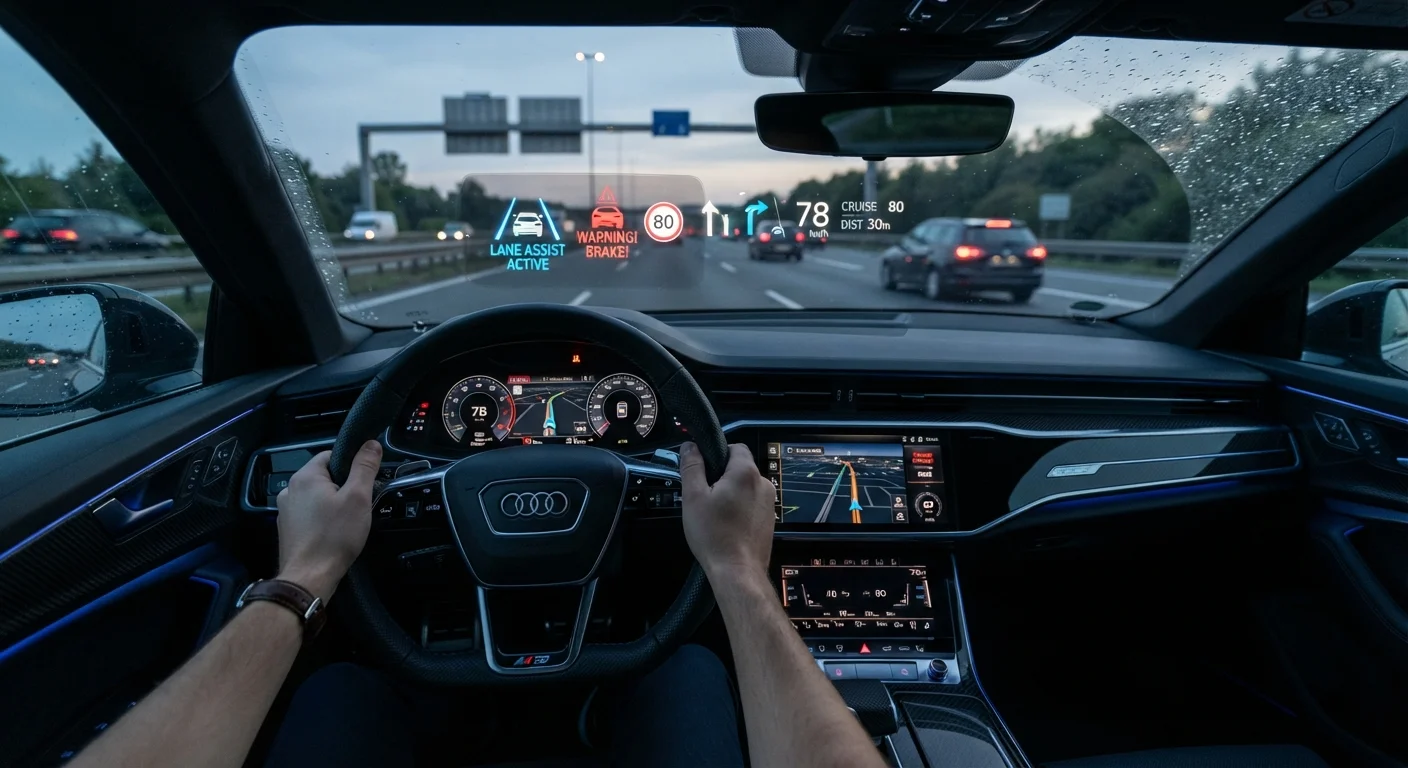
Many drivers assume that a new vehicle - regardless of price or class - comes loaded with the latest active safety technology. In practice, the picture is far more complicated. Features like automatic emergency braking (AEB), lane-keeping assist (LKA), and blind-spot monitoring vary widely depending on the vehicle class, the manufacturer, and - critically - the trim level you choose.
Understanding what's actually included can help you shop more precisely, avoid false assumptions about your current vehicle, and make better-informed decisions on the road. As a complement to reading about physical vehicle dynamics, knowing your car's electronic safety net is equally important. See how trim levels affect safety features for a broader look at what changes between base and higher trims.
| AEB Mandated by NHTSA | Required on new passenger vehicles starting model year 2029 (NHTSA final rule, 2024) |
| Voluntary AEB Commitment | 20 major automakers agreed to make AEB standard ahead of regulation (NHTSA / IIHS joint announcement) |
| Features Often Trim-Locked | Blind-spot monitoring, adaptive cruise, lane-centering (General industry pattern across multiple manufacturers) |
| IIHS Top Safety Pick+ Requirement | Vehicles must have acceptable or good AEB ratings to qualify (IIHS evaluation criteria) |
| SAE Automation Levels | Most production vehicles operate at Level 1-2 (driver assistance, not autonomy) (SAE International J3016 standard) |
What's Broadly Standard Today - And What Isn't
As of model year 2024, automatic emergency braking with pedestrian detection has become standard on nearly all new passenger cars and SUVs sold in the U.S., driven largely by voluntary commitments made by major automakers to the National Highway Traffic Safety Administration (NHTSA). However, "standard" doesn't mean identical - the braking threshold, speed range of activation, and pedestrian detection accuracy differ between systems.
Features that remain inconsistently available across classes include:
- Blind-spot monitoring: Common on mid-to-upper trims of crossovers and SUVs; less consistent on entry-level sedans and compact cars.
- Rear cross-traffic alert: Often paired with blind-spot monitoring but not always included separately.
- Lane-keeping assist vs. lane departure warning: These are different systems - one steers, one only alerts. Many base trims include only the warning.
- Adaptive cruise control: Frequently an upgrade package or limited to higher trims even in vehicle classes where AEB is standard.
- Driver attention monitoring: Emerging in newer models but far from universal.
Pickup trucks present a distinct case. Their larger footprint, higher hood lines, and extended stopping distances create unique safety challenges that electronic assists don't fully compensate for. Learn more in our overview of blind zones and braking in pickup trucks.
Automatic Emergency Braking (AEB)
A system that detects an imminent collision and automatically applies the brakes if the driver does not respond in time. Versions vary in speed range and whether they detect pedestrians and cyclists.
Lane-Keeping Assist (LKA)
An active system that applies gentle steering input to keep the vehicle within lane markings. Distinct from lane departure warning, which only alerts the driver without steering intervention.
Blind-Spot Monitoring (BSM)
A system using radar or cameras to detect vehicles in the driver's blind spots and alert them - typically via a light in the side mirror - when a lane change could be unsafe.
Adaptive Cruise Control (ACC)
An advanced cruise control system that automatically adjusts vehicle speed to maintain a set following distance from the vehicle ahead, using radar or camera sensors.
Rear Cross-Traffic Alert (RCTA)
A sensor-based system that warns the driver of approaching vehicles or objects from the side when reversing out of a parking space, where rearview visibility is limited.
Driver Attention Monitoring
A system that tracks steering patterns, eye movement, or head position to detect driver fatigue or distraction and issues an alert to refocus attention.
How Vehicle Class Shapes Feature Availability
Vehicle class is one of the strongest predictors of which driver-assist features are included at the base trim.
| Vehicle Class | Typically Standard | Often Optional or Absent |
|---|---|---|
| Subcompact / Entry Sedan | AEB, lane departure warning | Blind-spot monitoring, adaptive cruise |
| Compact / Mid-Size Sedan | AEB, lane-keeping assist | Rear cross-traffic alert, driver monitoring |
| Crossover / Mid-Size SUV | AEB, blind-spot monitoring, rear alert | Adaptive cruise, highway assist |
| Full-Size SUV / Pickup Truck | AEB (varies by trim), trailer assist | Pedestrian detection accuracy, lane centering |
| Luxury / Near-Luxury | Most features standard across trims | Advanced highway pilot (varies by brand) |
It's also worth noting that vehicle classification itself isn't always straightforward - what one brand calls a crossover another labels a compact SUV. Our article on how automakers classify their own vehicles covers why those labels matter when comparing features across nameplates.
Driver-Assist Systems Have Real Limitations
No driver-assist system eliminates the need for an alert, engaged driver. AEB systems may not detect all obstacles, especially in poor weather, at high speeds, or in complex road geometries. Lane-keeping assist can be disrupted by faded lane markings or sharp curves. Always read your owner's manual to understand exactly how your vehicle's systems work and when they may not activate.
What to Verify Before You Drive - or Buy
Whether you're shopping for a new vehicle or trying to understand your current one, the steps below help you get accurate information rather than relying on marketing descriptions:
- Check the window sticker or build sheet: The Monroney label lists standard and optional features for that specific trim. Don't rely on brand-level advertising that may reflect a higher trim.
- Read the owner's manual section on driver-assist systems: This details how each system works, its speed range, and its limitations - information that's critical for safe use.
- Look up NHTSA or IIHS safety ratings: Both the National Highway Traffic Safety Administration and the Insurance Institute for Highway Safety (IIHS) test and rate driver-assist performance, not just crash structures.
- Verify feature behavior, not just presence: A vehicle may have AEB but only activate it below 25 mph. Understanding the operating envelope prevents over-reliance.
Driver-assist systems are designed to support attentive driving, not replace it. No current production vehicle is rated for unsupervised autonomous operation on public roads. For a broader look at how safety intersects with vehicle size, see how vehicle size affects safety outcomes.
~94%
Of new US vehicles with standard AEB by 2023
Per IIHS data reflecting automaker voluntary commitments made in 2016 taking broad effect.
Level 1-2
Automation level of most production vehicles
Per SAE J3016, Levels 1 and 2 still require a fully attentive driver at all times.
Varies by 25+ mph
AEB activation speed range difference between systems
IIHS testing found meaningful variation in the speed thresholds at which AEB systems engage across models.