

Key Takeaways
Greater mass offers occupant protection in multi-vehicle crashes
In collisions between a large and a small vehicle, physics favors the heavier occupant. Mass ratio differences mean larger vehicles absorb less crash energy relative to smaller ones.
More interior space supports better safety equipment packaging
Larger cabins allow manufacturers to integrate more airbag coverage, including side-curtain and knee airbags, across more seating positions.
Higher seating position improves forward sightlines in some conditions
Elevated driver seating in SUVs and trucks can extend visibility over traffic ahead on open roads, though this benefit is offset by expanded blind zones in close quarters.
Structural rigidity often increases with vehicle size
Full-frame construction common in larger trucks and body-on-frame SUVs can provide a rigid occupant compartment, though this alone does not determine crash performance.
Longer stopping distances increase collision risk
Greater vehicle weight requires more braking force and distance to stop from any given speed, raising stakes in emergency braking situations - especially in traffic.
Larger blind zones endanger pedestrians and cyclists
Taller hoods and longer front ends create substantial areas the driver cannot see, increasing risk for vulnerable road users near the vehicle.
Higher center of gravity raises rollover risk
Tall vehicles shift their weight less predictably during sharp turns or evasive maneuvers, making rollovers more likely in single-vehicle incidents compared to lower-slung cars.
Hood height worsens pedestrian injury outcomes at impact
Taller front ends strike pedestrians at the torso rather than the legs, causing more severe injuries even at low speeds compared to smaller, lower-nosed vehicles.
Vehicle incompatibility harms occupants of smaller vehicles
When a large vehicle overrides the crumple zones of a smaller car in a crash, the smaller car's engineered safety structures are bypassed, worsening outcomes for those occupants.
Our Verdict
Vehicle size genuinely confers occupant protection advantages in certain crash scenarios, particularly high-speed collisions with smaller vehicles. However, those advantages come packaged with visibility limitations, longer braking distances, and elevated risk for pedestrians and other road users. A smaller, well-rated vehicle equipped with modern active safety technology can outperform a larger vehicle that lacks those features.
Drivers who regularly travel high-speed highways, carry passengers frequently, or operate in rural environments with limited pedestrian traffic may find larger vehicles offer meaningful safety benefits - provided they also understand and actively manage the handling demands those vehicles impose.
How Vehicle Mass and Size Actually Influence Crash Physics
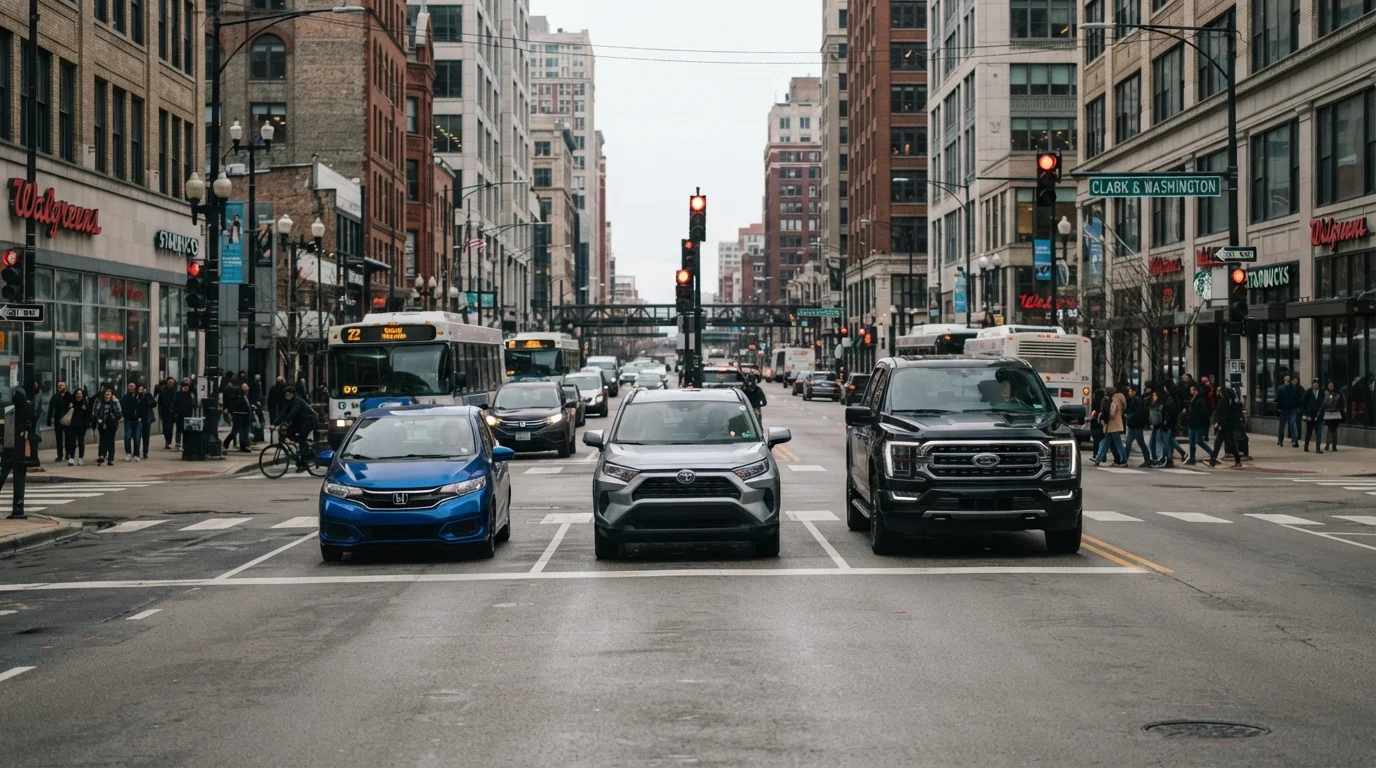
When two vehicles collide, the laws of physics favor the heavier one. A more massive vehicle transfers less of the collision's energy to its own occupants and more to the lighter vehicle - a principle engineers call the mass ratio effect. This is why occupants in a full-size SUV or truck statistically fare better than those in a compact car during a direct collision between the two.
Height adds another layer. Higher ride heights place the front structure of an SUV or truck above the crumple zones designed into smaller passenger cars, sometimes bypassing those engineered safety structures entirely. This mismatch has prompted the Insurance Institute for Highway Safety (IIHS) to study what it calls vehicle incompatibility - the way size and structural differences affect outcomes beyond what single-vehicle crash tests can reveal.
But mass and height don't act uniformly across all crash types. In single-vehicle crashes - rollovers, run-off-road incidents, or collisions with fixed objects - a higher center of gravity works against larger vehicles. Tall SUVs carry a greater rollover risk than lower-slung sedans, and that risk increases when cargo or passengers raise the center of gravity further. Crossovers and traditional SUVs differ meaningfully here, since car-based crossover platforms generally handle more like sedans than truck-based SUVs do.
2-3x
Increased pedestrian fatality risk from SUVs vs. cars
IIHS research has found that pedestrians struck by SUVs face substantially higher fatality risk than those struck by passenger cars, largely due to hood height differences.
~40%
Of US fatal crashes involve a single vehicle
NHTSA data consistently shows that a large share of traffic fatalities occur in single-vehicle incidents, where occupant-protection advantages of size are less relevant than handling and rollover dynamics.
The Risks Larger Vehicles Create for Others
Occupant self-protection is only part of the safety picture. Research consistently shows that pedestrians and cyclists struck by larger, taller vehicles sustain more severe injuries than those struck by smaller cars, even at the same speeds. The hood height of a pickup truck or large SUV contacts a pedestrian's torso rather than their legs - a higher and more vulnerable strike point.
Blind zones represent another serious concern. Taller vehicles with longer hoods create substantial areas directly ahead of and beside the vehicle that the driver simply cannot see. A 2019 Consumer Reports study found that some large trucks and SUVs had front blind zones extending well beyond what drivers typically assume. For pickup truck drivers specifically, understanding these blind zones isn't optional - it's a core safety responsibility.
Stopping distance grows with vehicle weight. Heavier vehicles require more braking force and more distance to stop from any given speed. In emergency situations, those extra feet matter significantly. Drivers of large vehicles should consciously maintain longer following distances than they would in a smaller car.
Crash Ratings Are Size-Class Specific
NHTSA and IIHS assign ratings within vehicle categories, not across them. A top-rated compact car and a top-rated full-size truck are both excellent within their respective classes - but their ratings don't predict what would happen if those two vehicles collided. Understanding this limitation helps you interpret safety scores accurately rather than treating them as universal rankings.
What Crash Ratings Tell You - and What They Don't
NHTSA and IIHS both publish safety ratings, but neither agency rates vehicles against each other across size categories. Ratings are assigned within class - a midsize pickup earns its stars relative to other midsize pickups, not relative to compact sedans. This means a five-star NHTSA rating on a full-size truck and a five-star rating on a subcompact hatchback say nothing about how those two vehicles would interact in a crash.
Reading those ratings accurately requires understanding what each test actually measures. IIHS tests such as the small overlap front test and the side barrier test have exposed meaningful differences even within the same size class. A high rating tells you a vehicle performed well under controlled test conditions - it doesn't guarantee real-world outcomes across every crash scenario.
Active safety features increasingly close the gap between large and small vehicles. Automatic emergency braking (AEB), blind-spot monitoring, and rear cross-traffic alert are now common but not universal. Which features come standard varies significantly by make, model, and trim level - and a compact car equipped with robust AEB may outperform a large SUV without it in many real-world near-miss situations.
Greater mass offers occupant protection in multi-vehicle crashes
In collisions between a large and a small vehicle, physics favors the heavier occupant. Mass ratio differences mean larger vehicles absorb less crash energy relative to smaller ones.
More interior space supports better safety equipment packaging
Larger cabins allow manufacturers to integrate more airbag coverage, including side-curtain and knee airbags, across more seating positions.
Higher seating position improves forward sightlines in some conditions
Elevated driver seating in SUVs and trucks can extend visibility over traffic ahead on open roads, though this benefit is offset by expanded blind zones in close quarters.
Structural rigidity often increases with vehicle size
Full-frame construction common in larger trucks and body-on-frame SUVs can provide a rigid occupant compartment, though this alone does not determine crash performance.
Longer stopping distances increase collision risk
Greater vehicle weight requires more braking force and distance to stop from any given speed, raising stakes in emergency braking situations - especially in traffic.
Larger blind zones endanger pedestrians and cyclists
Taller hoods and longer front ends create substantial areas the driver cannot see, increasing risk for vulnerable road users near the vehicle.
Higher center of gravity raises rollover risk
Tall vehicles shift their weight less predictably during sharp turns or evasive maneuvers, making rollovers more likely in single-vehicle incidents compared to lower-slung cars.
Hood height worsens pedestrian injury outcomes at impact
Taller front ends strike pedestrians at the torso rather than the legs, causing more severe injuries even at low speeds compared to smaller, lower-nosed vehicles.
Vehicle incompatibility harms occupants of smaller vehicles
When a large vehicle overrides the crumple zones of a smaller car in a crash, the smaller car's engineered safety structures are bypassed, worsening outcomes for those occupants.
Making Size Work for Safety, Not Against It
Vehicle size is one input among several when evaluating safety. A larger vehicle driven with awareness of its limitations - adequate following distance, deliberate blind-zone checks, and speed appropriate to its mass - can deliver genuine protection. The same vehicle driven as though it were a nimble sedan creates real danger for everyone nearby.
Consider the full safety picture: your typical driving environment (urban vs. rural, highway vs. surface streets), who else is regularly in the vehicle, and what active safety technology is available at the trim level you're actually purchasing. Common misconceptions about vehicle size and capability often lead drivers toward vehicles that don't match their actual needs or skills.
Wheelbase, which affects both ride stability and crash dynamics, is worth understanding alongside overall size. Wheelbase influences how a vehicle handles energy in a crash and how stable it feels at highway speeds - a detail many buyers overlook when comparing models.
This article provides general information about vehicle safety principles and is not a substitute for guidance from qualified automotive safety professionals or official regulatory sources. Always consult current NHTSA and IIHS data when evaluating specific vehicles.