

Key Takeaways
Our Verdict
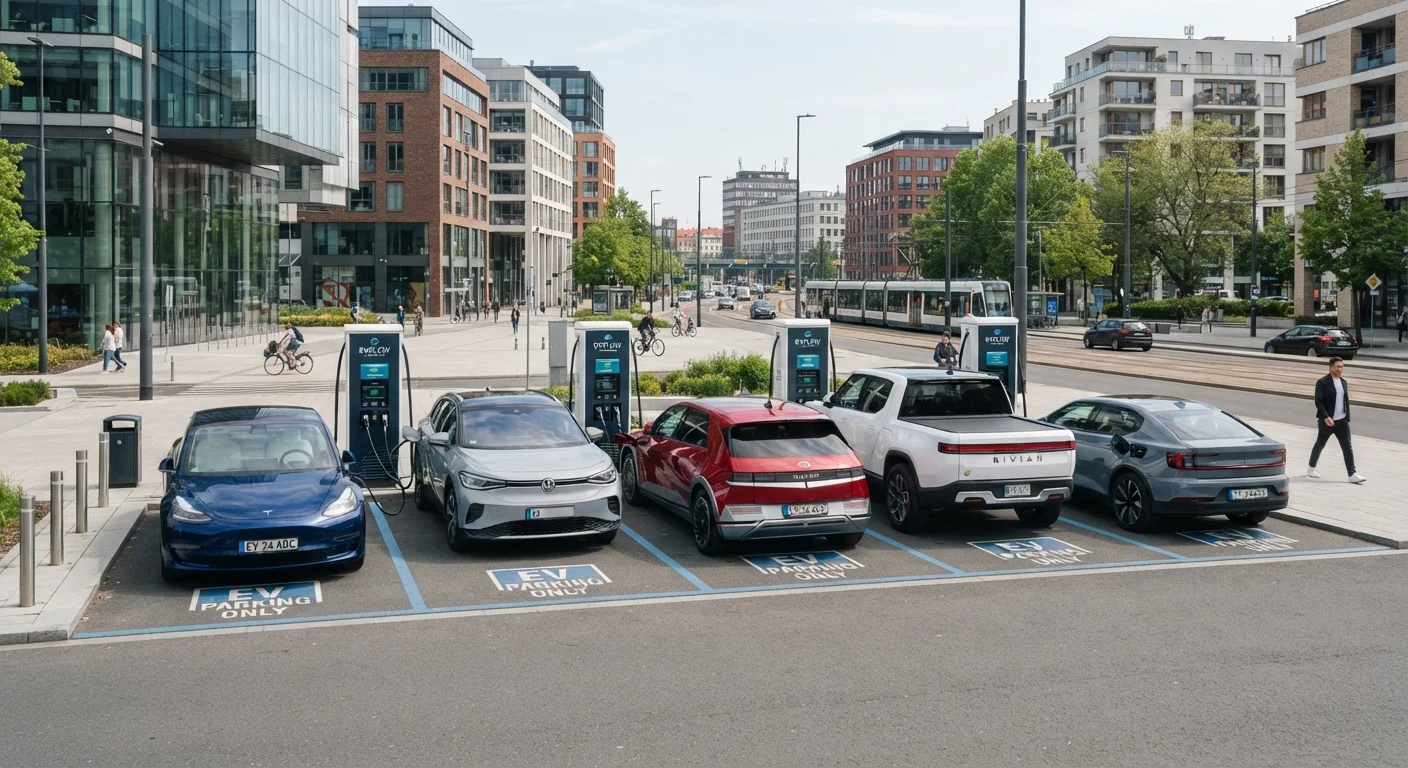
There is no single EV experience. Range, charging speed, and crash protection differ considerably from one make and model to the next - sometimes within the same manufacturer's lineup. Drivers benefit most from evaluating each model on its own specifications rather than assuming all EVs perform similarly.
| Best for | Recommended |
|---|---|
| Long-distance or highway-heavy drivers | Higher-range EV models with wide DC fast-charging network access |
| Urban commuters with home charging access | Smaller, lower-range EVs with efficient Level 2 home charging |
| Drivers prioritizing crash safety verification | Models with current NHTSA or IIHS top-tier safety ratings |
| Households in cold climates | EVs with active thermal battery management and heat pump systems |
Why EVs Are Not One Homogeneous Category
When shoppers talk about buying an electric vehicle, they often treat "EV" as a single product type. In reality, the differences between models can be as substantial as those between a compact sedan and a full-size truck. Battery capacity, charging architecture, structural safety design, and software integration all vary - sometimes dramatically - across manufacturers and even across models within the same brand's lineup.
Understanding these differences is especially important for safety and practical planning. An EV you drove as a rental may behave quite differently from one you own, and specs that matter most - range, charge rate, and crash protection - do not transfer from model to model. See our checklist for driving an unfamiliar make or model before assuming you know how any new EV will feel behind the wheel.
Range: What the Numbers Mean and How They Vary
The EPA publishes estimated range figures for every EV sold in the US, and those numbers span a wide band. Compact EVs designed primarily for urban commuting may be rated below 150 miles, while larger, premium-segment models can exceed 350 miles on a full charge. Within the same body style - say, a mid-size SUV - it's common to see a 100-mile gap between the lowest- and highest-range variants.
Range estimates also behave differently depending on conditions. Cold weather is the most significant real-world factor. When temperatures drop well below freezing, some EVs can lose 20-40% of their rated range, depending on battery chemistry and whether the vehicle uses an active thermal management system or a heat pump. Drivers in northern states or mountain climates should factor this into trip planning more carefully than the EPA sticker alone suggests.
~20-40%
Range loss in extreme cold
Studies by AAA and the US DOE have found that very cold temperatures can reduce EV range by roughly 20-40% depending on vehicle model and thermal management system.
150+ miles
Range gap within same body class
EPA data shows mid-size EV SUVs from different manufacturers can differ by more than 150 miles of rated range within the same model year.
Speed also affects range more noticeably in EVs than in gasoline vehicles. Highway driving at 75-80 mph can reduce range more than city driving for many EV models, which is the inverse of conventional vehicles. Understanding how your specific model's range behaves at speed helps avoid unexpected low-battery situations on longer trips.
Charging Architecture: Connectors, Speeds, and Network Access
Charging is where EV differences become most consequential for day-to-day ownership. There are three main levels of charging that drivers encounter:
- Level 1 (120V): Standard household outlet, adds roughly 3-5 miles of range per hour. Practical only for top-offs overnight for short-commute drivers.
- Level 2 (240V): Dedicated home or public charger, typically adds 15-30 miles per hour depending on the vehicle's onboard charger capacity.
- DC Fast Charging: High-voltage direct current charging that can add significant range in 20-45 minutes. Speeds vary widely - from around 50 kW to over 250 kW - based on both the charger and the vehicle's maximum accepted charge rate.
The maximum DC fast-charge rate a vehicle can accept is set by its onboard electronics, not just the charger. A vehicle rated for 150 kW will not charge faster at a 350 kW charger. This distinction matters when comparing models side by side.
| Compact EV Sedan | Mid-Size EV SUV | Full-Size EV Truck/SUV | |
|---|---|---|---|
| Typical EPA Range | 150-260 miles | 230-330 miles | 280-400+ miles |
| Max DC Fast-Charge Rate | 50-150 kW typical | 100-250 kW typical | 150-350 kW typical |
| Cold Weather Range Impact | Moderate to significant | Moderate | Varies by thermal mgmt |
| Center of Gravity | Low (flat floor pack) | Low-to-moderate | Low for class |
| Pedestrian Acoustic Alert | Required, varies by model | Required, varies by model | Required, varies by model |
| Crash Rating Availability | Per model, NHTSA/IIHS | Per model, NHTSA/IIHS | Per model, NHTSA/IIHS |
Connector compatibility has shifted in the US market in recent years. Many manufacturers have announced transitions toward a common connector standard, but drivers should verify which connectors their specific model supports and what adapter options are available. This is especially relevant for older model years still in circulation. For a broader look at how ownership logistics like charging infrastructure interact with registration and insurance, the owning a vehicle hub offers useful context.
Safety Structure and Crash Ratings Across EV Models
A common assumption is that EVs are uniformly safe because they are newer technology. Crash safety, however, is determined by structural engineering, not by powertrain type. The NHTSA and the IIHS test and rate each model individually, and EV results range from excellent to mediocre depending on the manufacturer's engineering choices.
The battery pack's location - typically mounted flat beneath the passenger floor - does lower the vehicle's center of gravity, which can reduce rollover risk compared to vehicles with higher mass. However, it also introduces new engineering challenges: protecting the high-voltage pack in side or underside impacts requires specific structural reinforcement. Not all designs approach this equally.
Don't Assume Newer Means Safer
EV status does not guarantee a top safety rating. Some EV models have received lower scores in specific crash categories, particularly small-overlap front tests or roof-strength assessments. Always check the current NHTSA or IIHS rating for the specific model year you are evaluating - not the brand's overall reputation or a rating from a prior model year.
Pedestrian safety is another dimension worth noting. EVs operate silently at low speeds, and regulations require manufacturers to add artificial acoustic warnings. The implementation varies by model and can affect how noticeable the vehicle is to pedestrians, cyclists, and children in parking lots. Our article on how vehicle size interacts with safety for drivers and pedestrians covers the broader context here.
For active driver-assist features - automatic emergency braking, lane-keeping assist, and blind-spot monitoring - availability and capability still differ by trim level and manufacturer, just as they do on conventional vehicles. See our analysis of driver-assist technology across vehicle classes to understand what to look for on any specific model.
Making an Informed Comparison
Because EV performance characteristics vary so widely, side-by-side comparison using standardized sources is more useful than relying on brand reputation alone. The EPA's fuel economy website (fueleconomy.gov) publishes official range, efficiency, and charging data for all EV models sold in the US. NHTSA and IIHS publish crash test results by model year. These are the most reliable starting points.
When evaluating body style alongside powertrain, keep in mind that an EV version of a given nameplate may handle differently from its gasoline counterpart due to weight distribution and instant torque delivery. Our guide to choosing between sedan, SUV, and truck body styles can help frame which form factor suits your driving patterns before layering in EV-specific variables.
Ultimately, the EV category rewards drivers who treat each model as its own vehicle rather than assuming uniformity across the segment.