

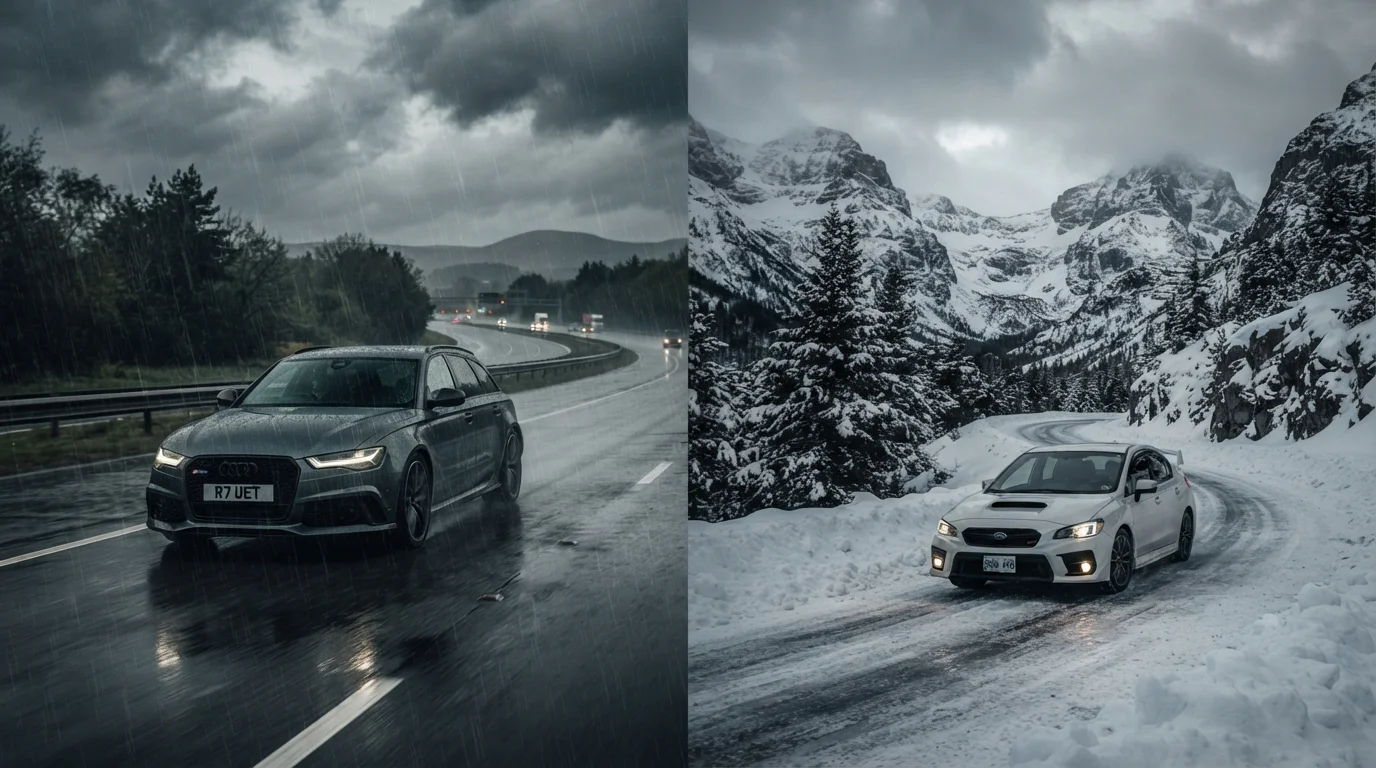
Key Takeaways
Option A
Front-Wheel Drive (FWD)
The efficient, widely available standard for everyday commuters.
Best for: Drivers in mild climates who prioritize fuel efficiency, affordability, and low-maintenance ownership.
Option B
All-Wheel Drive (AWD)
The traction-focused system built for variable and challenging conditions.
Best for: Drivers who regularly face rain, snow, or uneven terrain and want more consistent grip across all four wheels.
If you live in a region with mild weather and mostly paved roads
Front-Wheel Drive (FWD)
FWD handles routine rain well, costs less upfront, and delivers better fuel economy - all without meaningful compromise for most daily driving situations.
If you regularly drive through snow, ice, or steep grades
All-Wheel Drive (AWD)
AWD's ability to distribute torque to wheels with available grip makes a measurable difference in maintaining forward momentum on slippery or uneven surfaces.
If fuel economy and lower ownership costs are your top priorities
Front-Wheel Drive (FWD)
FWD vehicles carry less drivetrain weight and fewer mechanical components, which typically translates to better gas mileage and fewer parts to service over time.
If you frequently haul cargo or passengers across varied terrain
All-Wheel Drive (AWD)
AWD provides more stable, confident power delivery when the vehicle is loaded and roads are imperfect, reducing the risk of wheel spin or loss of control.
How Each System Actually Works
Front-wheel drive (FWD) channels all engine power to the two front wheels, which handle both steering and propulsion simultaneously. This layout places the engine weight directly over the drive wheels, improving traction in light rain and making the system mechanically simpler.
All-wheel drive (AWD) distributes power to all four wheels, either constantly or on demand depending on the system design. Most modern AWD systems use sensors to detect wheel slip and automatically redirect torque where grip is available. This is distinct from four-wheel drive (4WD), which is typically a manually engaged, more robust system found on trucks and off-road vehicles.
Understanding these mechanics matters because it prevents a common misreading: AWD improves how a vehicle accelerates and maintains momentum on slippery surfaces - it does not improve braking. Stopping distance is governed by tires, brakes, and weight, not by how many wheels are receiving engine power. For more on how a vehicle's physical dimensions interact with handling and safety, see why wheelbase shapes so much of how a car behaves.
| Criterion | Front-Wheel Drive (FWD) | All-Wheel Drive (AWD) |
|---|---|---|
| Power distribution | Front two wheels only | All four wheels |
| Traction in snow/ice (acceleration) | Adequate on mild terrain | Notably better grip |
| Braking performance | Same as AWD (tire/brake dependent) | Same as FWD (tire/brake dependent) |
| Fuel economy | Generally better | Typically 1-3 mpg lower |
| Purchase cost | Lower | Higher |
| Mechanical complexity | Simpler, fewer components | More components, more service points |
| Weight | Lighter | Heavier |
| Everyday dry-road handling | Comparable performance | Comparable performance |
Rain, Snow, and Highway Conditions: Real Differences
In steady rain on flat roads, FWD performs competently for most drivers. The front-heavy weight distribution gives the drive wheels reasonable grip, and modern traction control systems help manage wheel spin at low speeds. Most commuters in non-snowy climates will notice little practical disadvantage with FWD.
Snow and ice tell a different story. Here, AWD shows a clear advantage in getting a stopped vehicle moving and maintaining speed on grades or loose surfaces. The ability to shift torque to wheels that aren't spinning reduces the helplessness that FWD drivers sometimes experience on packed snow. However, both AWD and FWD vehicles can slide during braking or cornering on ice - no drivetrain system overcomes physics at that point.
AWD Does Not Prevent Skidding
A common misconception is that AWD makes a vehicle safer in all slippery conditions. AWD helps a vehicle move forward on loose or slick surfaces, but it has no effect on how quickly a vehicle stops or how it responds during a skid. Overconfidence in AWD has contributed to drivers taking risks in icy conditions that their tires and brakes cannot support. Always adjust speed and following distance to match actual road conditions, regardless of drivetrain type.
On dry highways at consistent speeds, drivetrain type has almost no practical effect on handling or safety. The distinction matters most at low speeds in acceleration scenarios - merging onto a wet highway, climbing a snowy ramp, or pulling away from an icy stop sign.
For drivers considering vehicle body style alongside drivetrain, the difference between crossovers and SUVs also affects how AWD is implemented and how the vehicle handles overall.
1-3 mpg
Typical AWD fuel economy penalty vs. FWD
Estimates from the U.S. Department of Energy's fueleconomy.gov indicate AWD vehicles generally consume more fuel due to added drivetrain weight and friction.
~30%
Share of new US vehicles sold with AWD or 4WD
Industry sales data has shown AWD and 4WD adoption climbing steadily over the past decade, particularly in SUV and crossover segments.
Costs, Tires, and What Actually Protects You
AWD adds weight, complexity, and cost. Vehicles equipped with AWD typically show a fuel economy penalty of 1-3 mpg compared to equivalent FWD models. Purchase prices are generally higher, and because all four wheels are driven, tire wear patterns need monitoring across all corners. Drivetrain components - differentials, transfer cases, coupling units - also require periodic service.
The variable that most drivers underestimate is tires. A FWD vehicle fitted with quality all-season or winter tires will outperform an AWD vehicle on worn all-season tires in most snow scenarios. Tires are the only contact point between the vehicle and the road - they determine grip far more than drivetrain configuration in real-world conditions.
Modern driver-assist technology - traction control, electronic stability control (ESC), and antilock brakes (ABS) - is now standard across nearly all new vehicles regardless of drivetrain. These systems work alongside your drivetrain to manage wheel slip and loss of control. How these features vary by make, model, and trim is worth understanding before assuming any drivetrain configuration provides complete protection. The bottom line: choose your drivetrain based on where and how you actually drive - then invest in quality tires appropriate for those conditions.