

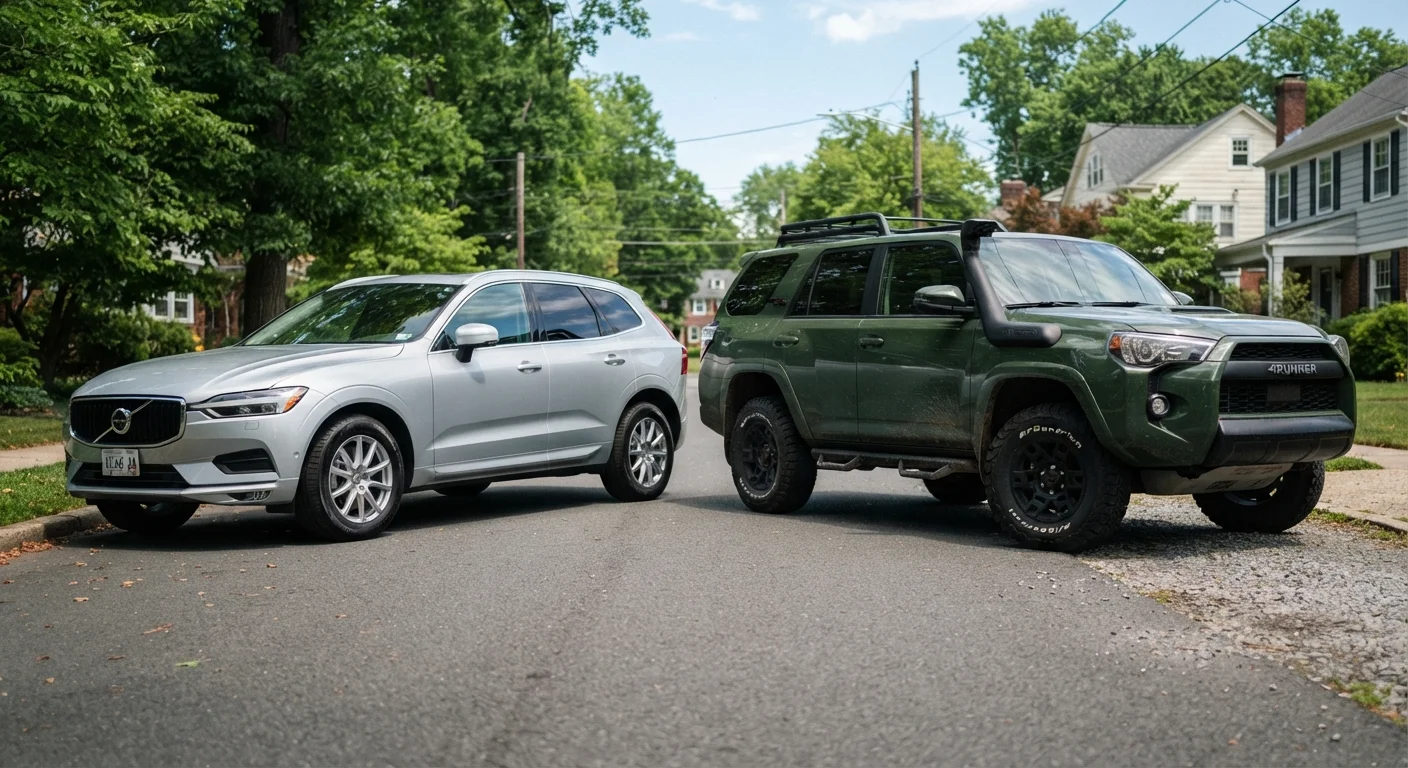
Key Takeaways
Option A
Crossover (CUV)
The car-based, everyday-comfort vehicle.
Best for: Drivers who want SUV-like space and a high seating position with car-like handling and fuel economy.
Option B
Traditional SUV
The truck-derived, heavy-duty hauler.
Best for: Drivers who need serious towing capacity, true off-road capability, or to carry large payloads regularly.
If you drive mostly on pavement and want comfortable daily handling
Crossover (CUV)
Unibody construction gives crossovers sedan-like responsiveness and a smoother ride on highways and city streets.
If you tow a boat, trailer, or camper regularly
Traditional SUV
Body-on-frame SUVs are engineered with the structural rigidity and powertrain tuning to handle heavy tow loads safely.
If off-road driving on rough or unpaved trails is a priority
Traditional SUV
Truck-based frames, higher ground clearance, and available low-range 4WD systems make traditional SUVs far more capable off-road.
If fuel economy and manageable size matter most
Crossover (CUV)
Lighter unibody platforms and car-derived powertrains typically return better fuel economy than heavier truck-based SUVs.
If you're unsure how you'll use the vehicle day-to-day
Crossover (CUV)
For most US drivers whose needs involve commuting, school runs, and occasional cargo, a crossover covers the bases without the trade-offs of a larger truck platform.
The Core Difference: Platform, Not Appearance
Walk into most dealerships today and you'll see vehicles labeled interchangeably as crossovers or SUVs. The marketing overlap is real - but the engineering difference is not cosmetic. It directly influences how a vehicle handles, how safe it is in certain situations, and what it can realistically do.
A crossover (officially a Crossover Utility Vehicle, or CUV) is built on a unibody platform - the same type of integrated frame-and-body construction used in most passenger cars and sedans. The body and chassis are a single welded structure, which keeps weight down and lowers the vehicle's center of gravity.
A traditional SUV uses a body-on-frame platform - a separate rigid frame (the ladder frame) with the passenger body bolted on top. This is the same construction used in full-size pickup trucks. It's heavier and taller, but built for structural demands that passenger vehicles don't face.
For a broader look at how manufacturers apply these labels, see how automakers classify their own vehicles - because the naming conventions vary more than most drivers expect.
| Criterion | Crossover (CUV) | Traditional SUV |
|---|---|---|
| Platform type | Unibody (car-based) | Body-on-frame (truck-based) |
| Typical towing capacity | 1,500-5,000 lbs | 7,000-8,500+ lbs |
| On-road handling | Car-like, responsive | Truck-like, more body roll |
| Fuel economy | Generally higher | Generally lower |
| Off-road capability | Limited (light trails only) | High (low-range 4WD available) |
| Center of gravity | Lower | Higher |
| Vehicle weight | Lighter | Heavier |
| Ride comfort on pavement | Smoother | Firmer, more vibration |
How Platform Choice Affects On-Road Driving
The platform choice ripples through nearly every aspect of the driving experience:
Handling and Ride Quality
Unibody crossovers absorb road vibration through the integrated structure and suspension tuning borrowed from car engineering. The result is a more responsive, smoother ride on paved surfaces. Body-on-frame SUVs, by contrast, can feel more truck-like - with some body roll in corners and a stiffer highway ride, depending on how the suspension is set up.
Rollover Risk
Older truck-based SUVs developed a reputation for rollover risk largely because of their high center of gravity combined with a narrow wheelbase. Modern crossovers' lower center of gravity helps reduce this tendency in emergency maneuvers. That said, modern body-on-frame SUVs have improved substantially with electronic stability control and wider tracks. The NHTSA and IIHS evaluate rollover resistance as part of their standard testing programs - it's worth checking ratings for any specific vehicle you're considering.
Understanding how platform interacts with drivetrain choice also matters. The FWD vs. AWD tradeoffs become more nuanced when you factor in vehicle weight and platform type.
~70%
US new vehicle sales that are crossovers or SUVs
According to automotive industry sales data, crossovers and SUVs collectively account for roughly 70% of new passenger vehicle sales in the US market.
300-600 lbs
Typical weight difference between platforms
Body-on-frame SUVs generally weigh several hundred pounds more than comparable unibody crossovers, affecting both fuel use and handling dynamics.
Fuel Economy
Lighter unibody construction generally means crossovers return better fuel efficiency than comparably sized body-on-frame SUVs. The weight difference can be significant - sometimes several hundred pounds - and that affects how hard the engine works at highway speeds.
Where Traditional SUVs Have the Real Edge
Despite crossovers dominating sales volumes, traditional SUVs retain meaningful advantages in specific use cases:
- Towing capacity: Body-on-frame construction handles the tensile stress of towing far better than a unibody. Full-size SUVs can typically tow between 7,000 and 8,500 lbs, while most crossovers are rated between 1,500 and 5,000 lbs. Exceeding a vehicle's tow rating is dangerous and can cause brake failure or structural damage.
- Off-road capability: Available low-range 4WD systems, higher ground clearance, and the structural rigidity of a ladder frame make truck-based SUVs the appropriate tool for serious off-road use - not marketing-grade "off-road mode" on a crossover.
- Payload and third-row practicality: Larger body-on-frame SUVs offer more usable interior volume and payload capacity for genuinely large families or equipment-heavy work.
If you're weighing these traits against broader vehicle choices, the sedan, SUV, or truck comparison offers a helpful starting point for matching body style to lifestyle.
When the Label Doesn't Tell You Enough
Many vehicles sold as 'SUVs' today are actually unibody crossovers by engineering definition. Manufacturers apply the SUV label loosely because it resonates with buyers. Before assuming a vehicle's capability, check the manufacturer's spec sheet for the platform type, tow rating, and available drivetrain options. These numbers tell you more than the nameplate does.
Making the Choice That Fits Your Actual Driving Life
The honest reality is that the majority of US drivers who purchase traditional body-on-frame SUVs never use their off-road capability or approach their tow limits. That's not a problem - it's just context for evaluating whether the trade-offs (heavier, thirstier, less agile on pavement) are worth it for your situation.
Ask yourself concretely: Do you tow more than 5,000 lbs regularly? Do you drive on unpaved surfaces, not just gravel? Do you need a true third-row that seats adults comfortably for long trips? If yes, a body-on-frame SUV may genuinely serve you better.
If your needs are commuting, occasional cargo, all-weather confidence, and manageable parking, a crossover almost certainly covers your use case - and may handle it more safely on the roads where you actually drive most of the time.
Common vehicle-size misconceptions can also lead drivers to overestimate what a larger platform adds to everyday safety. And if you're thinking about the broader picture of size and crash dynamics, vehicle safety across car size categories is worth reading before you decide that bigger automatically means safer.
This article is for general informational purposes only. Always consult your vehicle's owner's manual and a qualified automotive professional for guidance specific to your vehicle's capabilities and safe operating limits.