

Key Takeaways
Wheelbase
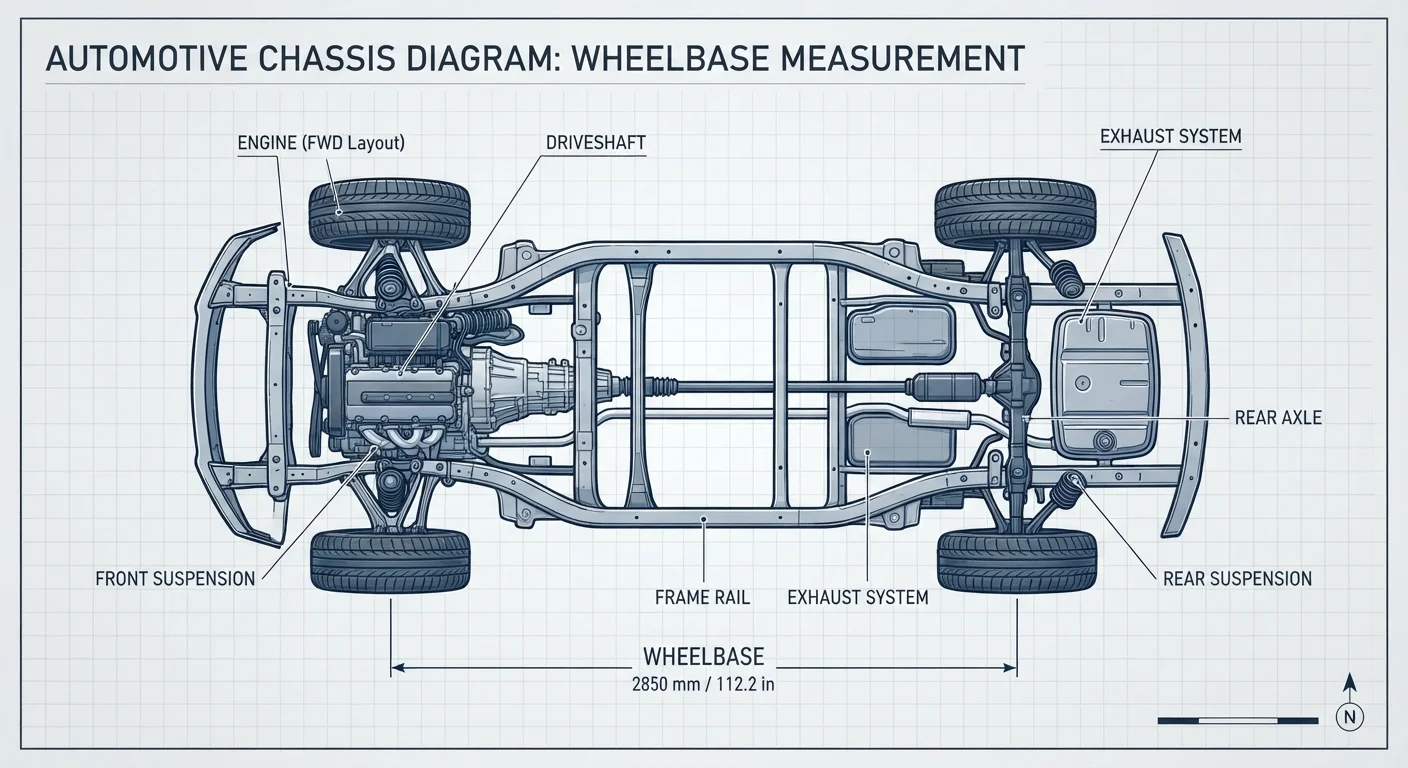
Wheelbase is the distance between the center of a vehicle's front axle and the center of its rear axle. It's one of the most fundamental measurements in vehicle design, directly influencing how a car rides, handles, and absorbs crash forces. Despite its importance, it rarely appears on window stickers or in mainstream buyer conversations.
Wheelbase is expressed in inches or millimeters and is a fixed structural dimension - it cannot be changed after manufacture without significant engineering alteration.
What Wheelbase Actually Measures
When shoppers compare vehicles, they typically focus on horsepower, cargo space, or fuel economy. Wheelbase - the distance from the center of the front axle to the center of the rear axle - rarely makes the list. That's a missed opportunity, because this single measurement shapes more of how a car feels and behaves than most buyers realize.
Wheelbase is not the same as overall vehicle length. A vehicle can have a long hood or a large rear overhang that adds to its total footprint without changing its wheelbase. Two vehicles of similar external length can have meaningfully different wheelbases, resulting in very different driving dynamics and interior proportions.
Wheelbase vs. Track Width
Wheelbase (front-to-rear axle distance) is sometimes confused with track width (left-to-right wheel distance). Both measurements influence handling, but they do so differently - track width affects lateral stability in cornering, while wheelbase primarily governs fore-aft pitch and overall ride behavior. Most spec sheets list both figures separately.
Ride Quality and Stability
The relationship between wheelbase and ride comfort is straightforward in principle: a longer wheelbase means the front and rear wheels encounter road imperfections - a pothole, a bump, a bridge expansion joint - at a greater time interval apart. That spacing gives the vehicle more time to absorb each disturbance before the opposite axle crosses the same spot, producing a smoother, less pitchy sensation for passengers.
Shorter wheelbases do the opposite. The axles are closer together, so the vehicle reacts more quickly - and sometimes more abruptly - to surface changes. This can feel lively and responsive on a curvy road, but unsettled on a rutted highway. City drivers may never notice; frequent long-distance drivers almost certainly will.
Stability at speed is similarly affected. Longer-wheelbase vehicles tend to feel more planted during lane changes and in crosswinds, which is one reason large sedans and full-size trucks are engineered with extended wheelbases. See our guide on vehicle size misconceptions for how these dynamics fit into broader buying decisions.
~6 in.
Typical wheelbase difference between compact and midsize sedans
A difference of roughly six inches in wheelbase is commonly observed between vehicle segments and often corresponds to noticeable differences in rear legroom and ride character.
170-220 in.
Wheelbase range across common U.S. passenger vehicles
Manufacturer specification sheets show U.S. passenger vehicles ranging from approximately 98 inches (subcompacts) to over 150 inches (full-size trucks), illustrating how dramatically wheelbase varies by vehicle class.
Wheelbase and Interior Space
Rear-seat legroom is almost entirely a function of wheelbase. Engineers can only push the rear seat backward - creating more legroom - if there is enough distance between the axles to allow it without compromising the rear passengers' position over or behind the rear axle. This is why "long-wheelbase" variants of luxury sedans are created specifically to add inches of legroom for rear occupants.
Cargo space in sedans and hatches is also influenced by wheelbase, though less directly than passenger room. In trucks and SUVs, a longer wheelbase typically corresponds to a longer bed or a larger third-row area. Understanding this connection helps buyers avoid discovering too late that a vehicle's interior doesn't actually fit their family or cargo needs.
Check the Spec Sheet Before the Test Drive
Before visiting a dealership, look up wheelbase figures for the vehicles you're considering. This lets you compare interior space potential objectively before marketing materials or showroom presentation influence your perception. Manufacturer websites and the NHTSA vehicle database both list this figure in official specifications.
Crash Dynamics and Safety Implications
In a frontal collision, the space between the front bumper and the passenger compartment is critical. Engineers design this zone - often called the crumple zone - to progressively collapse and absorb kinetic energy before it reaches occupants. A longer wheelbase, combined with a longer front overhang, can provide more structural distance to work with.
However, wheelbase alone does not determine crashworthiness. Modern safety engineering, high-strength steel construction, and sensor-triggered restraint systems matter enormously. A shorter-wheelbase vehicle with a well-designed safety cage can outperform a longer vehicle with weaker structural engineering. This is why crash test ratings from organizations like the IIHS and NHTSA remain the most reliable safety reference - not raw measurements. For a broader look at size and safety tradeoffs, see how vehicle size interacts with safety.
Applying This Knowledge When Buying
When comparing vehicles, look up the wheelbase figure in the official specifications rather than relying on external dimensions alone. A compact crossover with a stretched wheelbase may offer rear-seat space that rivals a larger SUV. Conversely, a vehicle that appears large from the outside may have a shorter wheelbase than expected - meaning less interior room and a different ride character.
Consider how you actually use the vehicle. Long daily commutes on open roads favor stability and comfort - qualities a longer wheelbase supports. Dense urban driving, where tight turns and parking matter, may favor a shorter wheelbase. Understanding where drivetrain configuration fits into this picture is also worthwhile; front-wheel drive versus all-wheel drive tradeoffs interact with wheelbase in real-world conditions. Wheelbase won't tell you everything, but it's a reliable, objective signal of how a vehicle was fundamentally designed to perform.
“Wheelbase is the backbone of a vehicle's character. Almost every decision about how a car rides, how much room it offers, and how it manages energy in a crash flows from that one number.”
— Vehicle Dynamics Engineering Perspective, General principle widely cited in automotive engineering literature