

Key Takeaways
Crash Test Ratings
Crash test ratings are safety scores assigned to vehicles after they undergo controlled collision tests performed by independent or government organizations. These tests simulate real-world crash scenarios - such as frontal impacts, side crashes, and rollovers - to evaluate how well a vehicle protects its occupants. The scores help consumers compare vehicle safety before making a purchase decision.
Two primary organizations rate vehicles in the U.S.: the National Highway Traffic Safety Administration (NHTSA), a federal agency, and the Insurance Institute for Highway Safety (IIHS), a nonprofit funded by the insurance industry. Their testing methods, rating scales, and criteria differ meaningfully.
Two Organizations, Two Very Different Systems
Most drivers know that vehicles get crash-tested, but far fewer understand that two separate organizations produce ratings - and that a high score from one does not guarantee a strong score from the other. Conflating their results is one of the most common mistakes vehicle shoppers make.
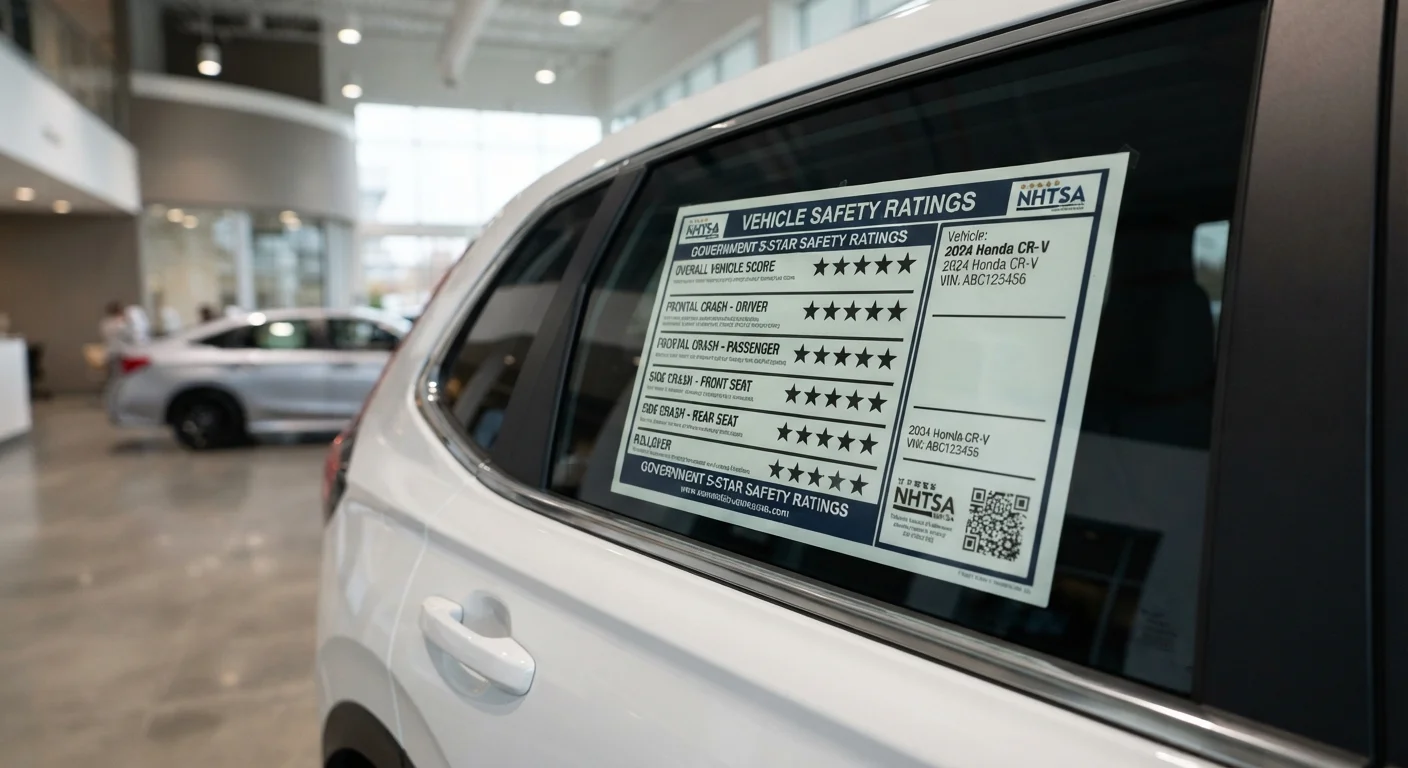
NHTSA (National Highway Traffic Safety Administration) is a U.S. federal agency. It assigns 1-5 stars across categories including frontal crash, side crash, and rollover resistance. An overall star rating is then calculated. NHTSA's tests are designed to inform broad regulatory and consumer guidance.
IIHS (Insurance Institute for Highway Safety) is a nonprofit organization funded by auto insurers. Rather than stars, it uses a four-level scale: Good, Acceptable, Marginal, and Poor. IIHS tests have evolved more rapidly in recent years and now include scenarios like the small overlap rigid barrier test - which targets the front corner of the vehicle and has exposed structural weaknesses that previous tests didn't catch.
Ratings Reflect Controlled Tests, Not All Crashes
Crash test ratings are generated in controlled laboratory conditions using standardized scenarios. Real-world crashes vary enormously in speed, angle, vehicle type, and road conditions. Strong ratings improve the probability of better occupant protection, but they cannot account for every possible collision situation.
Because the two systems test for different crash scenarios and use different rating scales, it's worth checking both before drawing conclusions about a vehicle's safety profile.
What Each Test Actually Simulates
Understanding what's being tested - not just the score - changes how you interpret results.
- NHTSA frontal barrier test: Simulates a head-on crash at a controlled speed into a fixed barrier, covering the full front of the vehicle. It's good for evaluating restraint systems and cabin integrity in direct impacts.
- IIHS moderate overlap frontal test: Overlaps 40% of the vehicle's front with a barrier - closer to the driver's side - revealing how the structure holds up when not hit dead-center.
- IIHS small overlap frontal test: Only 25% of the front corner hits the barrier. This exposed serious structural problems in many vehicles that had previously scored well elsewhere.
- Side impact tests: Both organizations test side crashes, but with different barrier weights, heights, and speeds that reflect different real-world crash partners (cars vs. SUVs vs. pole impacts).
- NHTSA rollover resistance: Uses a dynamic handling test plus a calculated tipping risk formula - particularly relevant for taller vehicles like SUVs and trucks.
For context on how vehicle size interacts with these outcomes, see how size affects crash safety.
25%
Front corner overlap in IIHS small overlap test
The IIHS small overlap frontal test, introduced in 2012, covers only 25% of the vehicle's front corner - a scenario that revealed significant structural weaknesses in many previously well-rated vehicles.
~38,000
U.S. traffic fatalities tracked annually by NHTSA
NHTSA reports approximately this many motor vehicle crash fatalities per year in the U.S., underscoring why vehicle structural safety remains a critical public safety concern.
4
IIHS rating levels for crash tests
IIHS uses four rating tiers - Good, Acceptable, Marginal, and Poor - rather than a numeric scale, allowing for more descriptive differentiation of performance across specific crash scenarios.
The Details That Change Everything
Several details trip up even attentive shoppers when reading ratings.
Model Year Matters
Manufacturers often update vehicle structures mid-generation. A 2021 model may have significantly different ratings than a 2023 version of the same nameplate. Always verify that the rating year matches the vehicle you're evaluating.
Trim Level Can Affect Ratings
Some safety technologies - like automatic emergency braking or improved headlights - are standard on upper trims but optional or unavailable on base models. IIHS in particular evaluates headlight performance as part of its TSP and TSP+ awards, and base trim headlights sometimes score worse than higher trim options.
Ratings Don't Transfer Across Siblings
A rating earned by a sedan does not apply to a related crossover or a rebadged version sold under a different nameplate, even if the vehicles share a platform. Each configuration must be checked independently.
These same assumptions affect how drivers misjudge vehicle size and safety, which is worth reading alongside this guide.
Check Both Agencies Before Deciding
Don't rely on a single agency's overall score. Pull up both the NHTSA and IIHS pages for the exact model year and trim you're considering. Look at individual test scores - especially the small overlap frontal and headlight ratings from IIHS - before concluding a vehicle is comprehensively safe.
How to Use Ratings Practically
Crash test ratings are most useful as a comparative filter - not a single deciding factor. Here's a practical approach:
- Search both NHTSA (nhtsa.gov) and IIHS (iihs.org) for the specific model year and body style you're considering.
- Look at individual category scores, not just the overall rating. A vehicle might score five stars overall but only three in the side crash category.
- Check whether the IIHS rating reflects the trim level you're buying. If the TSP+ award required optional headlights, confirm your trim includes them.
- Note when the ratings were last updated and whether the vehicle has been redesigned since.
Ratings are one layer of information. A vehicle's maintenance history and mechanical condition matter just as much once a car has been on the road for several years.
This article is for general informational purposes only. Crash test ratings and testing methodologies are updated regularly by NHTSA and IIHS - always consult official sources for the most current data before making vehicle decisions.