

Key Takeaways
Why Vehicle Size Decisions Go Wrong
Selecting a vehicle size feels like a practical decision, but it's frequently shaped by assumptions rather than analysis. Drivers mentally anchor to images of what a 'safe family vehicle' or a 'capable truck' looks like, and those images often outweigh a careful look at how the vehicle will actually be used day to day.
The result is a mismatch: an oversized vehicle navigating undersized parking structures, or a compact car dismissed on safety grounds despite strong independent test results. Neither outcome serves the driver - or the other people sharing the road with them.
Understanding which body style fits your actual driving life requires setting aside the assumptions below and replacing them with concrete data and honest self-assessment.
Size Doesn't Guarantee Safety
Many drivers assume a heavier, larger vehicle automatically protects them better in any crash scenario. In reality, a poorly rated large vehicle can perform worse in certain crash types than a well-engineered compact. Always consult crash test results from NHTSA and IIHS alongside size considerations - the two factors work together, not independently.
Common Mistakes That Lead to the Wrong Vehicle Size
Choosing a large truck or SUV assuming it will always protect occupants better in a crash.
Why it happens: The intuition that 'more mass equals more protection' feels logical, and it holds in some vehicle-to-vehicle collisions. However, drivers rarely account for rollover risk, longer braking distances, or how a large vehicle's structure performs in specific crash geometries.
Buying a full-size truck or large SUV based on occasional or hypothetical hauling needs.
Why it happens: People anticipate edge-case uses - one camping trip per year, a future renovation project - and let those scenarios justify a vehicle that doesn't serve everyday driving well.
Assuming a compact car is 'less safe' without consulting any test data.
Why it happens: Size bias is widespread. Compact vehicles are often dismissed as fragile without acknowledging that modern small cars frequently earn top safety ratings due to high-strength steel structures and advanced restraint systems.
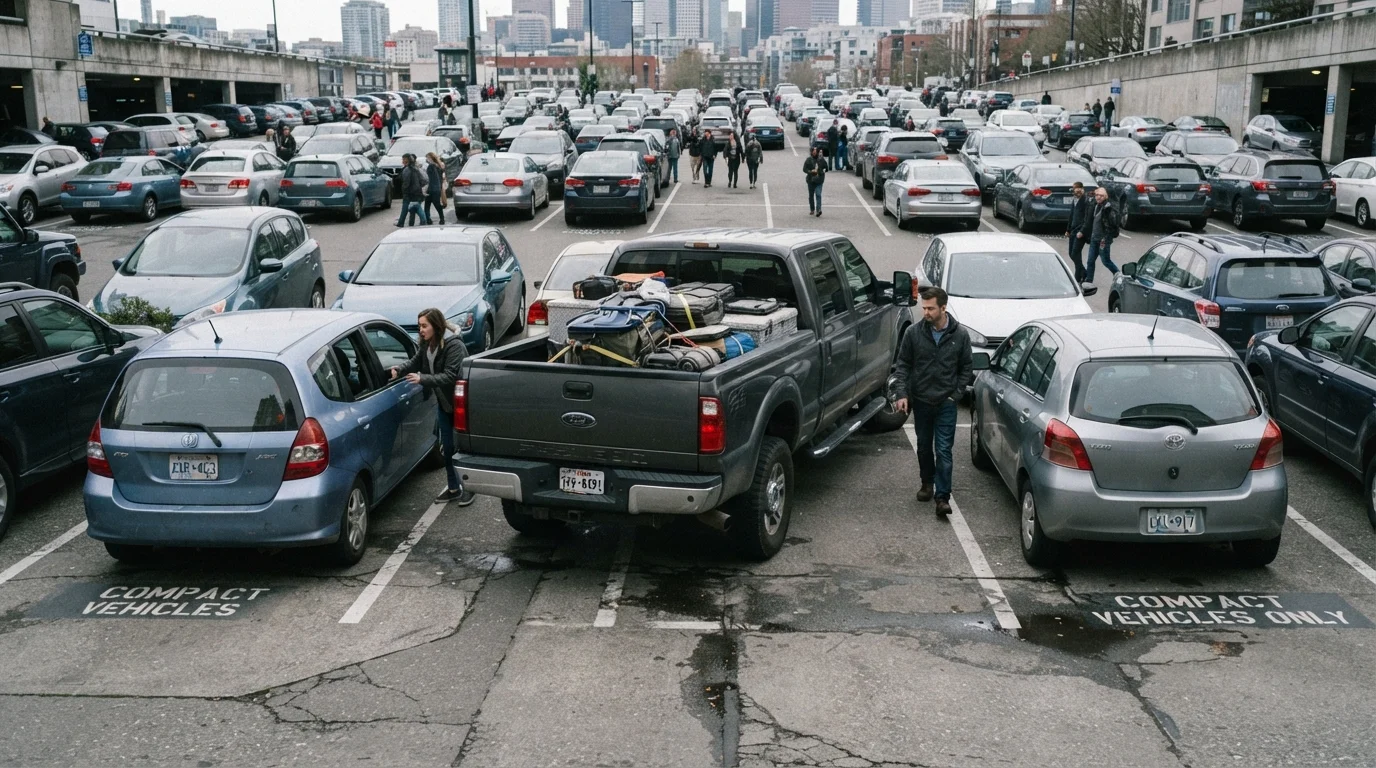
Underestimating how vehicle dimensions affect daily maneuverability in the driver's actual environment.
Why it happens: Shoppers often evaluate vehicles in a spacious dealership lot or on open test-drive routes - environments that don't reflect tight urban parking garages, narrow neighborhood streets, or crowded school drop-off zones.
Treating vehicle classification labels - 'midsize,' 'compact SUV,' 'crossover' - as precise, standardized measurements.
Why it happens: Automakers use these terms inconsistently, and what one brand calls a compact SUV may be physically larger than another brand's midsize SUV. Shoppers rely on the label rather than actual dimensions.
Ignoring how a vehicle's size affects other road users, not just the driver.
Why it happens: Vehicle selection is typically framed as a personal safety decision. Drivers rarely consider that tall hood lines on large pickups and SUVs significantly reduce forward visibility of pedestrians and cyclists at low speeds.
~40%
Of new vehicle sales are pickup trucks or large SUVs
Industry sales data consistently shows trucks and large SUVs make up a substantial share of the US new-vehicle market, reflecting the scale of size-related purchasing decisions.
2-3x
Larger rear blind zones compared to sedans
Research by safety organizations has found that full-size pickups and large SUVs can have rear blind zones two to three times larger than typical passenger sedans.
Beyond individual mistakes, there's a structural problem: automakers don't use consistent size classifications. A vehicle's wheelbase and overall dimensions matter far more than a segment label when you're trying to understand how it will actually fit in your driveway or a parking structure.
Blind Zones Grow With Vehicle Size
Larger trucks and full-size SUVs have significantly larger blind zones around the rear and sides than passenger cars. Drivers who transition from a sedan to a full-size truck without adjusting their habits risk missing pedestrians, cyclists, and low-profile vehicles entirely. Take time to fully relearn mirror positioning and backing procedures whenever you switch to a larger vehicle class.
Before finalizing any vehicle purchase, it's also worth understanding what to verify before driving an unfamiliar make or model - especially when transitioning between significantly different vehicle sizes. Drivers who skip this step often discover handling differences the hard way.
For a broader look at how size interacts with safety across vehicle categories, understanding vehicle safety across car size categories provides a useful framework that goes beyond simple bigger-is-safer thinking.