

Key Takeaways
Pan Temperature Control
Pan temperature control is the practice of deliberately managing how hot your cooking surface is before and during cooking. It determines how food browns, steams, sticks, or chars - often overriding everything else a recipe specifies. Getting this right is less about memorizing heat settings and more about reading what the pan and food are telling you.
Heat transfer in a pan involves conduction from the burner, radiation from the pan surface, and convection from hot oil or fat. Each variable affects how quickly the food's surface temperature rises relative to its interior.
What the Recipe Doesn't Tell You
Most recipes say something like "heat oil in a skillet over medium-high heat." That's it. No guidance on what medium-high actually means on your stove, how long to preheat, or what to look for. This gap is where most home-cooking frustration lives.
A recipe is a framework - it describes ingredients, ratios, and sequence. But it cannot account for your specific burner output, your pan's thickness, or the temperature of your food going in. Those variables are yours to manage, and temperature is the most consequential of them.
Before you even pick up a pan, reading through the full recipe helps you anticipate where heat management will matter most. Once you're at the stove, however, you need to cook by observation, not just instruction.
The Science Behind the Sizzle
Two chemical processes define what heat does to food. The first is the Maillard reaction - a series of reactions between amino acids and sugars that produces the brown crust, roasted aroma, and complex flavor on a seared steak or toasted bread. It requires surface temperatures above roughly 280°F (138°C). Below that threshold, you get gray, steamed protein instead of a crust.
The second is caramelization, the browning of sugars specifically, which begins around 320°F (160°C). Together, these reactions are responsible for most of the flavors we associate with "cooked" food rather than merely heated food.
280°F
Minimum surface temp for Maillard browning
The Maillard reaction - which creates flavor-building brown crust - does not occur below approximately 280°F (138°C) at the food's surface.
~30%
Temperature drop from overcrowding a pan
Adding a large amount of cold food to a hot pan can drop the pan surface temperature by roughly 30% or more, often halting browning entirely.
3-5 min
Typical preheat time for a stainless skillet
A standard stainless steel skillet on a medium-high gas burner generally requires 3-5 minutes of preheating to reach a stable searing temperature.
A cold or underpowered pan suppresses both reactions. Moisture released from food lowers the pan surface temperature further, trapping food in a steaming environment that prevents browning. This is why a hot pan isn't optional - it's the mechanism behind flavor itself. Understanding why cooking temperatures matter at a deeper level reinforces this point across every technique.
Reading Your Pan's Signals
You don't need a thermometer to manage pan temperature effectively. The pan and its contents give you reliable, real-time feedback if you know what to look for.
- Oil shimmer: When oil moves fluidly and begins to shimmer, the pan is approaching cooking temperature. Wisps of smoke mean you're at the high end - add food soon or reduce heat.
- The sizzle: Food added to a properly hot pan should sizzle immediately and consistently. A weak or absent sizzle means the temperature dropped - likely from adding too much cold food at once.
- Steam vs. sear: If you see a cloud of steam lifting from wet or cold food, the pan surface temperature fell below browning range. Give it space and time to recover.
- Color progression: Browning should advance steadily. If the exterior darkens faster than expected, reduce heat. If it stalls, increase it.
Use the Water-Drop Test Before Oil
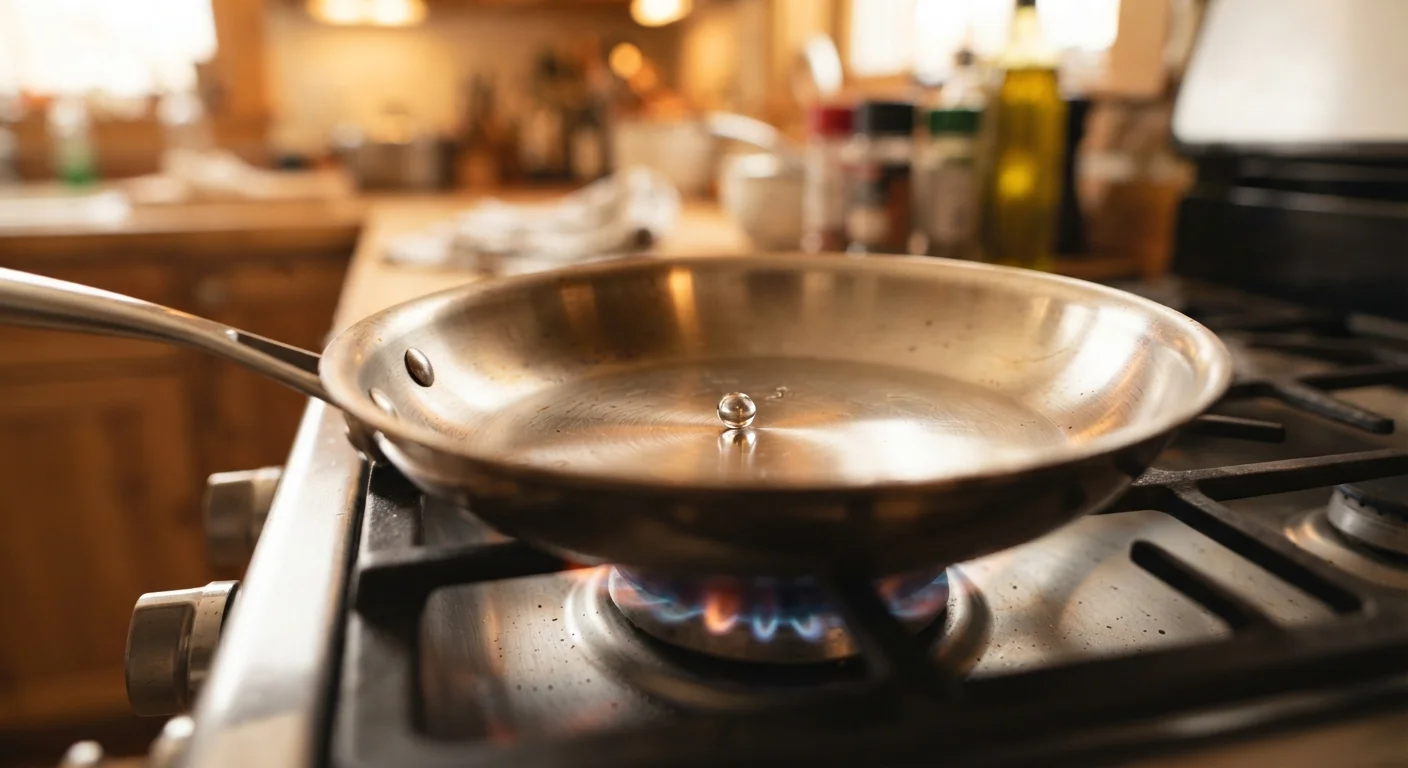
Before adding oil, flick a few drops of water into your dry pan. If they evaporate instantly, the pan is too cold. If they bead up into a single mercury-like ball and glide across the surface - called the Leidenfrost effect - the pan is properly preheated and ready for oil. This works best with stainless steel and cast iron.
Different pan materials complicate this further. Cast iron, stainless, and nonstick surfaces each heat, retain, and distribute energy differently, which affects both preheat time and how aggressively you need to adjust heat mid-cook.
The Overcrowding Problem
The single most common home-cooking mistake that relates to pan temperature isn't starting too cold - it's loading too much food in at once. Every piece of food you add to a pan carries thermal mass that absorbs heat from the cooking surface. Add too much at once and the pan temperature drops significantly, often below browning range.
The result: vegetables that release water and steam in their own liquid instead of caramelizing, proteins that turn gray and rubbery instead of forming a crust. The fix is straightforward - cook in batches, giving each piece adequate contact with a hot surface.
This principle connects directly to understanding dry heat versus moist heat methods. Sautéing and searing are dry-heat techniques that depend entirely on sustained high surface temperature. When overcrowding creates steam, you've accidentally converted a dry-heat method into a moist one - with entirely different (and usually unwanted) results.
Once you internalize heat management, you'll find that tasting and adjusting as you cook becomes far more effective - because the flavors your heat-managed cooking builds give you something genuinely worth refining.