

Key Takeaways
Cruise Itinerary Style
A cruise itinerary style refers to the structural shape of a sailing route — specifically, where the ship departs, where it travels, and where the voyage ends. The three most common styles are loop (returning to the same port), repositioning (one-way travel between regions), and point-to-point (starting and ending at different ports within the same general region). Each style has distinct logistical implications for how you plan flights, hotels, and shore time.
Repositioning sailings are operationally distinct from other itinerary types because they serve the cruise line's fleet-management needs, not just passenger demand — which is why they often appear at lower price points.
Why Itinerary Structure Matters Before You Book
Most travelers focus on destinations when choosing a cruise — the ports, the region, the weather. But the structural shape of the route itself has just as much impact on your experience and your logistics. Whether the ship returns to where it started, or ends on the other side of an ocean, changes everything from how you book your flights to whether you need two hotel nights or none.
The three primary itinerary structures — loop, repositioning, and point-to-point — each have distinct characteristics that suit different traveler profiles and trip goals. Understanding them before you commit avoids surprises that can complicate an otherwise well-planned vacation. For a broader look at how cruises unfold day-to-day, see our guide to the full cruise experience.
Loop Itineraries: The Familiar Round-Trip
A loop itinerary — sometimes called a round-trip or closed-loop sailing — departs from a homeport, visits a series of destinations, and returns to the exact same port where it began. This is the dominant format for cruises marketed to US travelers: a ship leaves Miami on Sunday, calls at several Caribbean islands over seven days, and returns to Miami the following Sunday.
The practical advantages are significant. You book one round-trip flight, you don't need to coordinate transportation between two distant cities, and there's no risk of missing your return sailing because of a delayed inbound flight. For families, first-timers, and anyone who values logistical simplicity, loop sailings are the most forgiving format.
Check the Homeport Before You Book
On loop itineraries, the homeport is both where you board and where you disembark — but cruise lines sometimes offer the same general route from multiple homeports. A Caribbean loop departing from Tampa operates differently from one departing from New York, even if the ports of call are similar. Confirm the exact embarkation city before booking flights.
Loop itineraries dominate the Caribbean, Alaska, and Western Mediterranean markets. If you're exploring options in those regions, you'll likely encounter this structure as the default. The Caribbean vs. Mediterranean comparison breaks down how those regions differ in pace and port depth.
Repositioning Cruises: One-Way Ocean Crossings
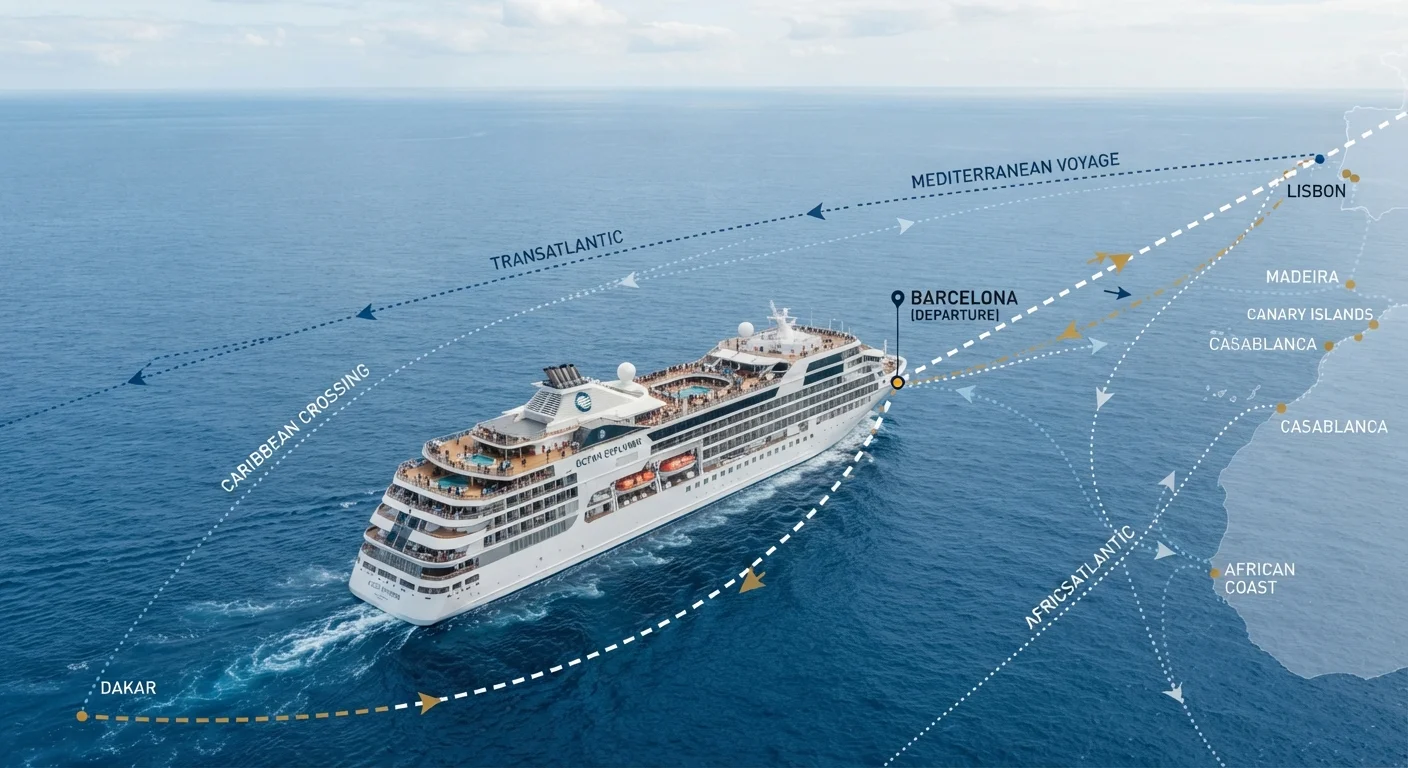
Repositioning sailings exist because cruise ships move seasonally between sailing regions. When a line shifts a vessel from the Caribbean to Europe for summer, or from Alaska to Hawaii for winter, it needs to sail those ships across open ocean — and it sells cabins on those transits to passengers.
The result is a fundamentally different experience. Repositioning cruises typically cross large bodies of water over multiple consecutive days, with far fewer port stops than a comparable loop itinerary. A transatlantic repositioning might include five or six straight sea days before reaching the first European port. For travelers who genuinely enjoy life aboard the ship — lectures, onboard programming, uninterrupted ocean views — this is a feature, not a drawback.
5–7
Typical consecutive sea days on a transatlantic repositioning
Most transatlantic repositioning sailings between North America and Europe include five to seven days at sea before reaching the first port of call.
2x
Flight bookings needed vs. a loop itinerary
Both repositioning and point-to-point itineraries require flights in and out of two separate cities, doubling the flight-planning complexity compared to a round-trip loop sailing.
Spring & Fall
Peak seasons for repositioning sailings
Repositioning cruises are most common in April–May (ships moving to summer regions) and October–November (ships returning to winter sailing areas).
The logistical challenge is real: you board in one city and disembark in another, often on a different continent. That means booking two separate sets of flights and potentially arranging accommodation at both ends. It's also worth noting that repositioning sailings sometimes offer a lower per-night rate compared to loop sailings of similar length, though pricing varies considerably. For travel involving international ports and ocean crossings, reviewing your coverage needs is wise — our cruise travel insurance overview covers the key considerations.
Point-to-Point Itineraries: Directional Sailing Within a Region
Point-to-point sailings — also called one-way itineraries — depart from one port and end at a different port, but unlike repositioning cruises, they stay within the same general region or route corridor. A common example is a cruise that embarks in Seattle and disembarks in Anchorage, or one that starts in Barcelona and ends in Athens after calling at ports along the Mediterranean coast.
This structure suits travelers who want to see a region directionally rather than doubling back. Instead of returning to your starting point, you progress through a geography — which can feel like a more purposeful journey if you're treating the cruise as the centerpiece of a longer trip.
The tradeoff is logistical complexity. You need to arrange separate flights in and out of two different cities, and if either end requires a pre- or post-cruise hotel night, you're coordinating across two locations. Travelers combining a cruise with land travel on either end often find point-to-point itineraries integrate naturally into a broader trip plan. Those interested in more immersive, destination-driven sailing styles may also want to explore expedition-style cruises, which often operate on point-to-point or partial loop routes.
Choosing the Right Structure for Your Trip
The right itinerary style depends on how you want to travel, not just where you want to go. Loop sailings offer the lowest planning friction and work well for travelers who want a clean, contained vacation. Repositioning cruises appeal to those who value the sea-day experience and can handle more complex flight logistics. Point-to-point itineraries reward travelers who are already building a multi-stop trip and want the cruise to serve as one leg of a larger journey.
Before booking any itinerary type, confirm the embarkation and disembarkation ports carefully — these details appear in the sailing details and affect every other part of your trip plan. If you're traveling solo, itinerary structure also intersects with how you'll manage downtime; solo cruise considerations are worth reviewing before you commit. For help thinking through broader travel planning logistics, including how cruises fit into multi-destination trips, our planning hub covers the essentials.