

| Core cabin tiers | Interior, Oceanview, Balcony, Suite |
| Smallest cabin type | Interior (no window, no outdoor access) |
| Most popular upgrade | Interior to Balcony (Commonly cited by cruise industry analysts) |
| Solo-traveler option | Studio/Single cabin (avoids single supplement) |
| Accessibility availability | All four main tiers; limited inventory |
| Suite perks vary by | Cruise line, ship, and suite subcategory |
Why Cabin Categories Matter Before You Book
When you browse cruise fares, the price difference between the least and most expensive cabin on the same sailing can be dramatic — sometimes more than $1,000 per person. That gap isn't arbitrary. It reflects a structured system of cabin categories, each with defined features around location, natural light, outdoor access, and space. Understanding these categories before you book helps you decide what you're actually paying for, rather than being swayed by marketing language alone.
This glossary covers every major cabin type you'll encounter across mainstream cruise lines. For a broader introduction to how the cruise experience works, see our first-cruise walkthrough.
| Core cabin tiers | Interior, Oceanview, Balcony, Suite |
| Smallest cabin type | Interior (no window, no outdoor access) |
| Most popular upgrade | Interior to Balcony (Commonly cited by cruise industry analysts) |
| Solo-traveler option | Studio/Single cabin (avoids single supplement) |
| Accessibility availability | All four main tiers; limited inventory |
| Suite perks vary by | Cruise line, ship, and suite subcategory |
The Four Core Cabin Categories
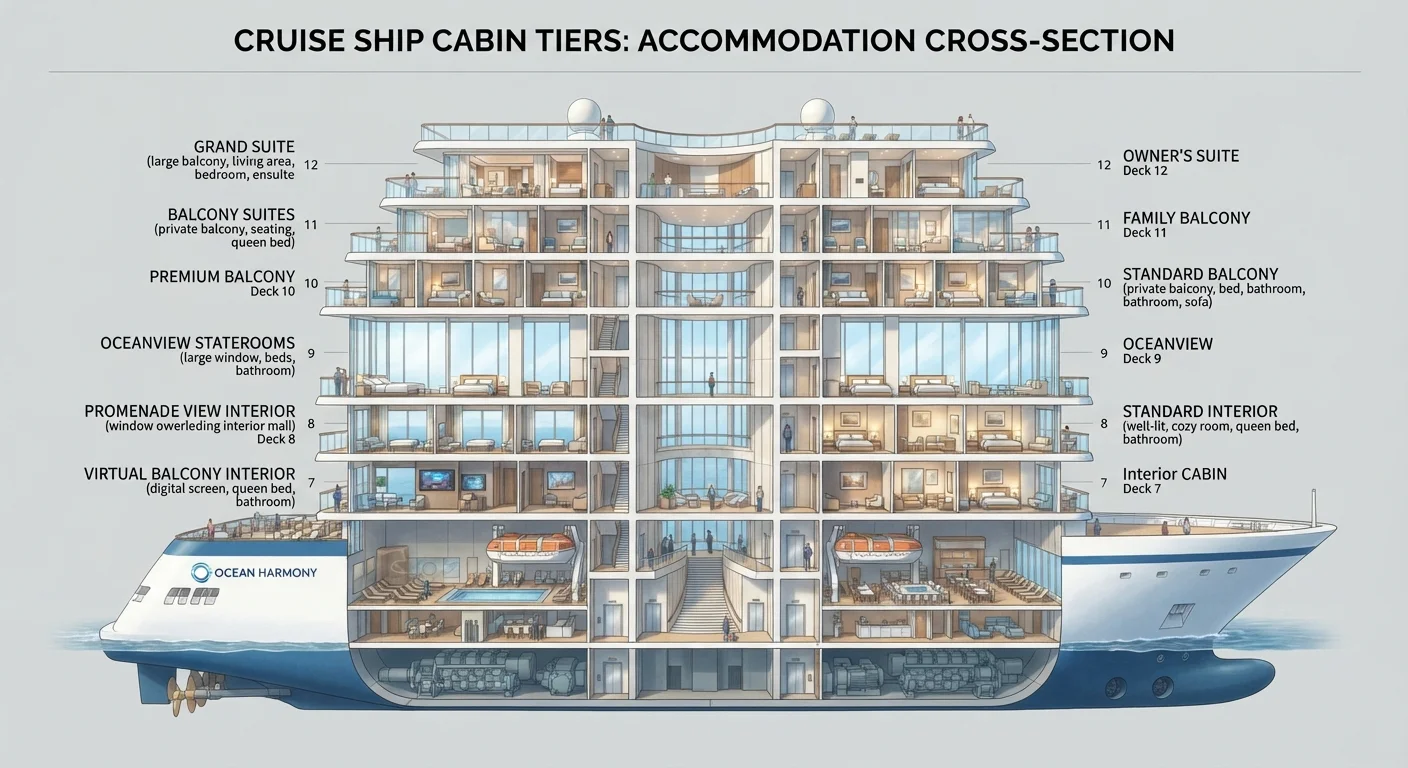
Nearly all cruise ships organize their staterooms into four foundational tiers. Every other subcategory you encounter is a variation of one of these.
Interior Cabins
Interior cabins have no window, porthole, or outside access. They are typically the smallest and least expensive option on any ship. Because they are located in the middle of the ship with cabins or corridors on all sides, they tend to be among the quietest at sea. Some travelers — particularly those who plan to spend most waking hours on deck or ashore — find interiors entirely adequate.
Oceanview (or Ocean-View) Cabins
Oceanview cabins include a fixed window or porthole that lets in natural light and a view of the sea. The window does not open. These cabins sit on an exterior wall of the ship and are generally larger and pricier than interiors. Porthole-style windows on lower decks are smaller and may offer a limited view; larger picture windows on mid-to-upper decks provide a more expansive outlook.
Balcony Cabins
Also called veranda staterooms, balcony cabins include a private outdoor space accessed through a sliding glass door. Balconies typically fit two chairs and a small table. This is the most popular upgrade step for repeat cruisers because it adds genuine outdoor living space without the cost of a suite. Note that some balconies are partially or fully obstructed by lifeboats or structural elements — check deck plans carefully before booking.
Suites
Suites are the largest and most feature-rich cabins on the ship. At minimum, a standard suite typically includes a separate sitting area. Higher suite tiers add dining areas, multiple bedrooms, butler service, priority boarding, and exclusive lounge access. Suite guests on many lines also receive perks such as complimentary specialty dining and enhanced room service menus. See what cruise lines include in the fare for a breakdown of which suite perks are genuinely included versus charged separately.
Interior Cabin
A stateroom with no window, porthole, or outdoor access. Typically the smallest and least expensive category, located in the center of the ship.
Oceanview Cabin
A stateroom with a fixed window or porthole providing natural light and a sea view. The window does not open and there is no outdoor space.
Balcony / Veranda
A private outdoor deck attached to the stateroom, accessed through a sliding glass door. Standard balconies accommodate two chairs and a small table.
Suite
A premium cabin category offering more living space than standard staterooms, typically including a separate sitting area. Higher tiers add butler service, multiple rooms, and exclusive amenities.
Junior Suite
The entry-level suite tier. Larger than a balcony cabin with a sitting area, but usually without a separate bedroom or butler service.
Guarantee (GTY) Booking
A reservation type where the traveler selects a cabin category but allows the cruise line to assign the specific room, sometimes at a discounted rate. The assigned cabin will be within the booked category or higher.
Accessible Cabin
A stateroom designed for guests with mobility needs, featuring wider doorways, roll-in showers, lowered fixtures, and adequate turning space. Available across multiple cabin tiers.
Connecting Cabins
Two adjacent staterooms with a shared interior door that can be opened to create a larger combined living space. Distinct from adjoining cabins, which are side by side but without a connecting door.
Suite Subcategories: From Junior to Owner's
The suite tier is where terminology diverges most sharply between cruise lines. Here are the subcategories you'll encounter most often.
- Junior Suite: Entry-level suite. Larger than a balcony cabin, usually with a sitting area and balcony, but typically no separate bedroom or butler service. On some lines, junior suites are categorized separately from the suite tier entirely.
- Deluxe or Premium Suite: A step above junior, often with a dedicated sitting room and expanded balcony. Amenities vary by line.
- Mini-Suite: A term used primarily by certain cruise lines for a cabin that is larger than a standard balcony but doesn't meet the full suite definition. Typically includes a sofa bed and balcony.
- Family Suite: Configured for groups, with multiple sleeping areas, bunk beds, or connecting doors. Layouts vary significantly.
- Owner's Suite / Penthouse Suite: Among the largest cabins on the ship, usually with floor-to-ceiling windows, an oversized balcony, dining area, and dedicated butler service.
- Grand Suite / Signature Suite: Brand-specific naming for top-tier accommodations. May span two decks (called a duplex or split-level suite) or occupy a corner position for panoramic views.
- Villa or Ship-Within-a-Ship: Some luxury and premium lines designate an exclusive section of the vessel as a private enclave with its own pool, lounge, dining, and concierge team. Access is restricted to guests in that section.
When comparing suites across different cruise lines, look past the name and focus on square footage, included services, and what's on the deck plan. Marketing labels like "penthouse" do not carry a universal standard.
Deck Position Affects More Than Price
Higher decks generally command higher prices and offer better views, but they can also mean more motion in rough seas and longer walks to lower-deck amenities. Cabins at the very front (bow) or rear (stern) of the ship often experience more movement than midship cabins. Reviewing the ship's deck plan — not just the cabin category — is a worthwhile step before finalizing any booking.
Specialty Cabin Types Worth Knowing
Beyond the four core categories, several specialty configurations appear frequently enough to warrant their own definitions.
- Studio / Single Cabin: Designed for solo travelers, these cabins are smaller than a standard interior but avoid the single supplement typically charged when one person books a double-occupancy room. Found on select ships.
- Accessible Cabin: Designed to meet ADA-equivalent standards, including wider doorways, roll-in showers, lowered fixtures, and turning space for mobility equipment. Available at interior, oceanview, balcony, and suite tiers. Request early — inventory is limited.
- Connecting Cabins: Two adjacent cabins with a door between them. Not the same as adjoining cabins, which are merely side by side without a connecting door. A useful distinction for families or groups wanting shared access without a shared room.
- Guarantee Cabin (GTY): A booking category, not a physical cabin type. When you book a guarantee, the cruise line assigns you a specific cabin — at or above the booked category — closer to departure. You trade flexibility for a potentially lower price.
- Spa Cabin: Located near or integrated into the ship's wellness area. May include complimentary thermal suite access, specialty bath products, or quiet-zone proximity. Available at several cabin tiers on select ships.
Once you've matched a cabin category to your priorities, your next planning steps involve itinerary type and what to pack. See itinerary styles explained and what experienced sailors pack ashore for practical next steps.
4
Core cabin categories on most cruise ships
Interior, oceanview, balcony, and suite tiers form the universal framework used across mainstream cruise lines.
7+
Suite subcategories commonly offered
Large contemporary ships may list seven or more distinct suite grades, each with different square footage and included services.